Experts: "Dollar rebound is temporary... Weak dollar trend will continue in the mid to long term"
Attention on potential end of COVID-driven liquidity if strong dollar stance persists
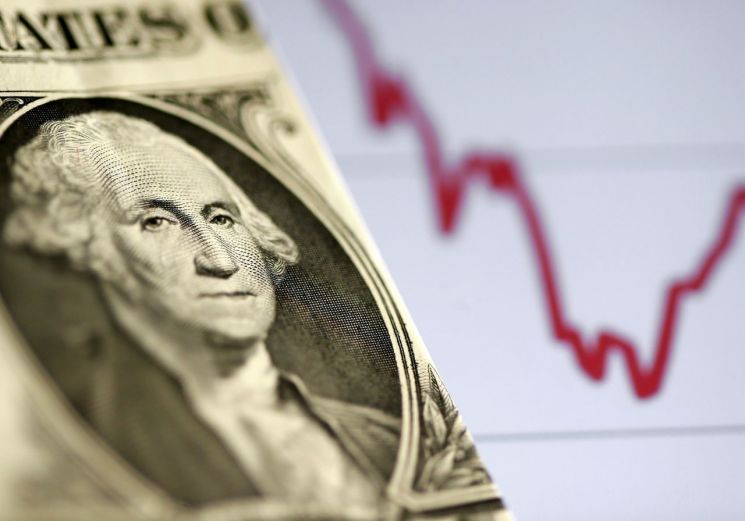
[Asia Economy Reporter Kim Eunbyeol] As the weak dollar trend that continued since last year has paused, debates over the direction of the dollar are unfolding. Just a month ago, forecasts suggested that the won-dollar exchange rate could drop to 1,040 won in the first half of this year, supporting the weak dollar outlook. However, recently, analyses are divided between the view that the dollar value has bottomed out and is on a rebound trend, and the view that the dollar strength is only temporary.
On the 19th at the Seoul foreign exchange market, the won-dollar exchange rate opened at 1,104.0 won, up 0.1 won from the previous day. The won-dollar exchange rate, which had fallen to around 1,070?1,080 won in early last month, has been on a continuous upward trend since the beginning of this year.
Last year, the value of the dollar plummeted as the United States released the largest amount of dollars ever to respond to the COVID-19 pandemic, but recently, the dollar value has been rebounding, which is a factor causing the relative depreciation of the won. The dollar index, which shows the value of the dollar against the currencies of six major countries, has fluctuated around 90.8, rebounding from below 90 at the end of last year.
The recent rebound in the dollar value is influenced by a combination of inflation expectations due to economic recovery and the economic stimulus plans of U.S. President Joe Biden. First, U.S. Treasury yields have been rising recently, reflecting inflation. When Treasury yields show an upward trend, global investors tend to invest in U.S. Treasuries, which inevitably causes the value of the currency (dollar) to rebound. To invest in U.S. Treasuries, investors from various countries must convert their currencies into dollars, increasing the demand for dollars.
If the Biden administration continues its large-scale economic stimulus plans, it will inevitably increase Treasury issuance. As Treasury issuance increases, supply rises, causing Treasury prices to fall (Treasury yields to rebound), which also supports the dollar strength.
In fact, the won-dollar exchange rate at the 1,100 won level is not a significant burden for South Korea. Since South Korea's main industry is export manufacturing, a decline in the exchange rate reduces the profitability of export companies, but an increase in the exchange rate to a certain level does not pose a major burden.
However, if the exchange rate rises, i.e., the dollar strengthens completely, the liquidity injected worldwide due to COVID-19 could tighten, so the foreign exchange authorities are watching this closely.
If the dollar value continues to strengthen, many countries' debt burdens (external debt) increased due to COVID-19 will inevitably grow. When the dollar strengthens, the amount of won needed to repay debts increases, causing a tightening effect. Another point is that if the dollar value begins to strengthen, countries may hesitate to ease monetary policies due to concerns that their own currencies will sharply weaken. If the U.S. economy shows a full recovery and the dollar strengthens, expansive monetary and fiscal policies cannot be freely implemented, raising concerns that the liquidity feast caused by COVID-19 may end.
Meanwhile, Kim Yongbeom, First Vice Minister of Strategy and Finance, chaired a macroeconomic and financial meeting at the Bankers' Hall on the same day and explained, "Recently, U.S. Treasury yields have risen in the global financial market, and this has emerged as an important variable in the global foreign exchange market. The previous weak dollar trend has been adjusted, and major currencies have all weakened against the dollar." Vice Minister Kim added, "Since President Biden's inauguration could affect the global financial market, we will closely monitor related trends."
The market currently views the dollar strength as temporary, with a low possibility of a long-term strong dollar shift. Kim Sungtaek, a senior researcher at the International Finance Center, said, "It is hard to see the weak dollar trend changing because there have been few cases where increasing fiscal spending and raising taxes led to a strong dollar." Gong Dongrak, an economist at Daishin Securities, stated, "From a mid- to long-term perspective, we maintain the existing view that the dollar will weaken this year, and Asian currencies such as the won and yuan will show relatively stronger trends." He expects the recent dollar rebound trend to continue until around the Federal Open Market Committee (FOMC) meeting at the end of this month. He predicted, "After expectations for monetary policy and economic recovery are reconfirmed, the market will stabilize again."
© The Asia Business Daily(www.asiae.co.kr). All rights reserved.
![Clutching a Stolen Dior Bag, Saying "I Hate Being Poor but Real"... The Grotesque Con of a "Human Knockoff" [Slate]](https://cwcontent.asiae.co.kr/asiaresize/183/2026021902243444107_1771435474.jpg)
















