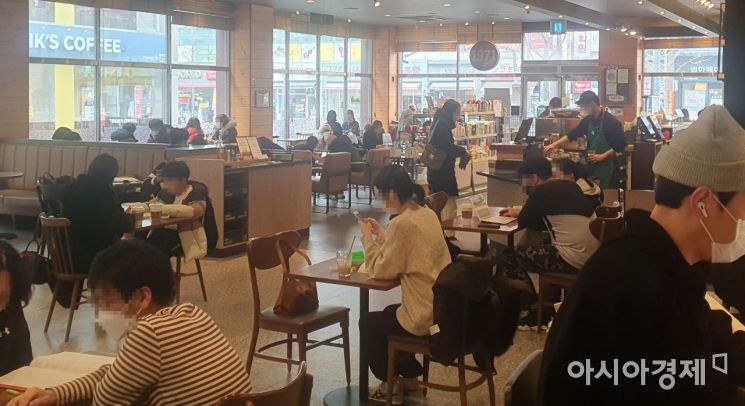
[Asia Economy Honam Reporting Headquarters Reporter Lee Gwan-woo] As operations resumed on the 18th for high-density facilities such as cafes and saunas, which were considered representative industries vulnerable to COVID-19 infection, a bittersweet reality reemerged across Gwangju Metropolitan City, marked by gaps in quarantine due to immature management and a lack of citizens' voluntary participation in prevention measures.
On this day, a large franchise cafe in Nam-gu, Gwangju, was bustling with customers as if eagerly waiting for the gathering ban to be lifted.
Orders began to pile up, and as the cafe reached full capacity, signs of the quarantine net gradually breaking down, such as the ban on private gatherings of five or more people, were observed.
Another issue was that employees were busy with their primary tasks of taking orders and preparing drinks, making it impossible to check each customer's compliance with quarantine rules in the work environment.
The 'ban on private gatherings of five or more people' was relatively well observed, but its enforcement was left to voluntary conscience.
Given this situation, some customers' deviant behavior was also witnessed. A group that had been split into three and two people sitting separately to eat and drink eventually joined at one table to spend time together.
None of Gwangju City's recommendations were followed. The city strongly advised that when two or more people stay in a cafe, they should not remain for more than one hour. However, many customers at the site spent long hours chatting or staying in one place for purposes such as private tutoring or study groups.
The limited operation of saunas and steam rooms also posed infection risks. Each sauna inside bathhouses varied in size, and some facility operators did not even know the maximum allowed occupancy. As a result, users often judged sauna usage by eye estimation, which was common.
Saunas are densely populated and poorly ventilated, making them vulnerable to rapid chain infections, yet they are practically unprotected. Recently, a cluster infection involving about 20 people occurred centered around a sauna in Dongdaemun-gu, Seoul.
A cafe employee said, “Since today is the first day of eased quarantine measures, many customers seem unaware of the basic rules. We announce guidelines over the speakers and ask customers sitting closely together to comply with quarantine rules, but it is insufficient.”
A Gwangju city official stated, “With the easing of restrictions on some facilities such as cafes and saunas that were previously under gathering bans, quarantine blind spots may exist. To fill these gaps, responsible management by facility operators and voluntary participation by citizens must accompany each other.”
He added, “From today, the current level 2 social distancing is maintained, but limited use of some high-density facilities has become possible. Considering the concerns of small business owners, we ask for active participation, such as reporting those who violate quarantine rules within facilities to the relevant local government.”
© The Asia Business Daily(www.asiae.co.kr). All rights reserved.

















