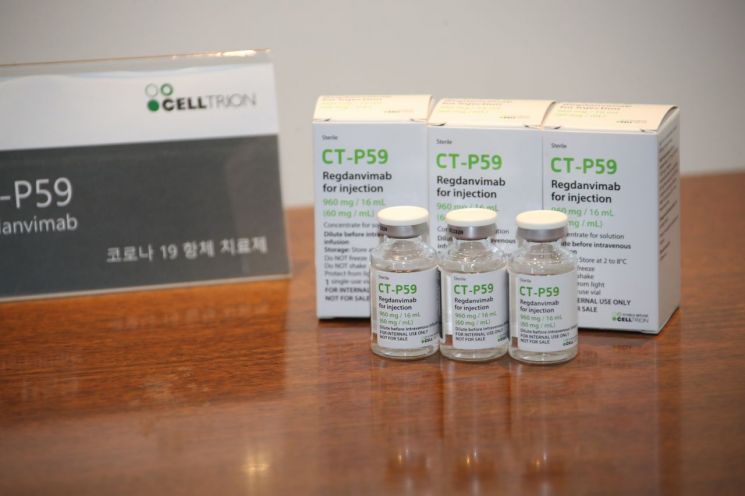
[Asia Economy Reporter Cho Hyun-ui] The Ministry of Food and Drug Safety (MFDS) announced on the 18th that the advisory committee for the verification of COVID-19 treatments recommended granting marketing authorization for Celltrion's antibody treatment 'Rekkironaju' on the premise of conducting a Phase 3 clinical trial.
Kim Sang-bong, Director of the Bio-Pharmaceutical Division at MFDS, said in the afternoon, "Rekkironaju showed statistical significance by reducing the time to improvement of COVID-19 symptoms by 3.43 days."
The advisory committee measured the time taken until all seven COVID-19 symptoms, including fever, disappeared or were judged to have weakened after administering either the drug or a placebo to patients exhibiting at least one of the seven symptoms.
As a result, patients who received Rekkironaju recovered from symptoms after 5.34 days, while those who received the placebo recovered after 8.77 days, confirming that patients treated with the drug recovered approximately 3.43 days faster.
Director Kim stated, "The reduction in time for COVID-19 symptom improvement by administering Rekkironaju was statistically significant and considered clinically meaningful."
The advisory committee also measured the time taken for the virus in nasopharyngeal specimens of treated individuals to convert from 'positive' to 'negative' (time to viral clearance) and compared the reduction in time between patients who received Rekkironaju and those who did not.
Although no significant difference was found between the Rekkironaju and placebo groups, there was an opinion that Rekkironaju tended to reduce the viral load in the body.
Director Kim said, "The advisory committee noted that the viral measurement methods are not standardized and there is considerable variability between test results, so the time to viral clearance does not have significant clinical meaning."
The advisory committee observed a trend toward a reduced proportion of patients requiring hospitalization or oxygen therapy due to COVID-19 after receiving Rekkironaju, but since statistical testing methods for this item were not established during the clinical planning stage, it was judged difficult to draw clear conclusions at this time.
Additionally, there were no deaths among patients who received Rekkironaju or those who did not, so the effect on mortality could not be determined. The advisory committee concluded, "It is necessary to assess specific results and implications through Phase 3 clinical trials."
No serious adverse events occurred after administering Rekkironaju. Generally, mild to moderate adverse events occurred, but the incidence rates were similar when comparing those who received the drug and those who did not.
Adverse events such as hypertriglyceridemia and hypercalcemia that occurred after administration were already identified in Phase 1 clinical trials and were predictable. Reactions caused by intravenous administration, such as itching and pain at the injection site, were rarely observed in both groups.
Director Kim said, "The advisory committee recommended granting marketing authorization on the premise of conducting Phase 3 clinical trials for Rekkironaju, while proposing the product's efficacy and several recommendations."
The advisory committee recommended administering Rekkironaju to adults with mild to moderate COVID-19 infection who meet the following criteria: oxygen saturation exceeding 94% in indoor air, no need for supplemental oxygen, and symptom onset within 7 days prior to administration.
They urged confirmation through Phase 3 clinical trials that the drug significantly reduces progression from mild/moderate to severe disease in a sufficient number of patients.
Regarding clinical use, the advisory committee added that detailed guidelines should be established through separate discussions with relevant agencies, and separate clinical trials combining this drug with existing severe treatments or other immunomodulators should be conducted for patients requiring supplemental oxygen therapy.
Director Kim said, "Based on this advisory committee meeting, we plan to review the remaining quality data and other submitted materials and seek advice from the MFDS's statutory advisory body, the Central Pharmaceutical Review Committee."
Accordingly, the MFDS plans to request Celltrion to submit some major review materials for Rekkironaju that have not yet been submitted within this week.
Meanwhile, the MFDS has additionally requested data necessary for the review of AstraZeneca's COVID-19 vaccine. Director Kim stated, "This week, an on-site inspection of the manufacturing site, SK Bioscience, is planned for manufacturing and quality control evaluation."
© The Asia Business Daily(www.asiae.co.kr). All rights reserved.
![User Who Sold Erroneously Deposited Bitcoins to Repay Debt and Fund Entertainment... What Did the Supreme Court Decide in 2021? [Legal Issue Check]](https://cwcontent.asiae.co.kr/asiaresize/183/2026020910431234020_1770601391.png)















