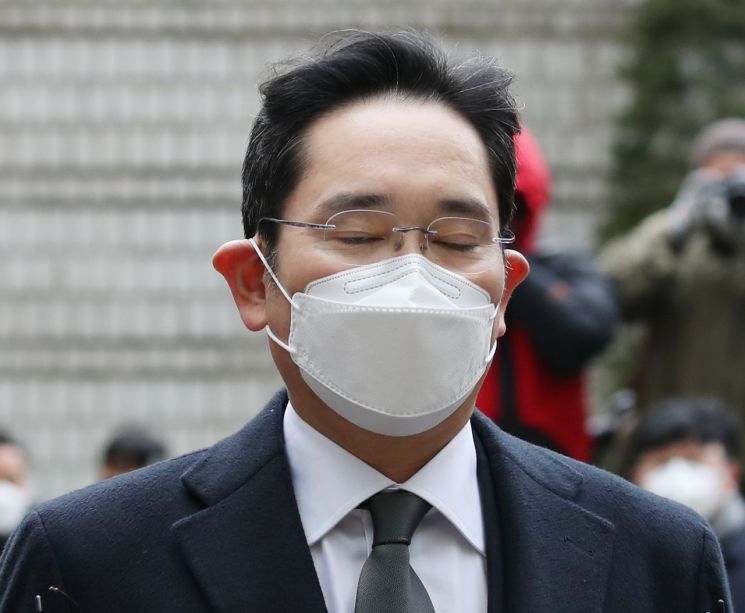
[Asia Economy Reporter Ki-min Lee] Samsung Electronics Vice Chairman Lee Jae-yong was sentenced to 2 years and 6 months in prison on the 18th in the retrial of the National Pension Service scandal and was re-incarcerated, plunging the company into a turbulent sea of 'uncertainty.' As Samsung, which has lost its central figure, faces another period of hardship, red lights have been lit on M&A and large-scale investments.
The Seoul High Court Criminal Division 1 (Presiding Judges Jung Jun-young, Song Young-seung, Kang Sang-wook) held the sentencing hearing for Vice Chairman Lee's bribery and other charges at 2:05 p.m. that day and sentenced him to 2 years and 6 months in prison. Lee was re-incarcerated after 1,079 days since his release on probation in February 2018 during the second trial.
In the business community, there is a prevailing view that Samsung, ranked first in the business hierarchy, will suffer a decline in competitiveness as it faces the biggest adversity of the absence of its head, making it difficult to actively decide on large-scale investments or M&A.
Last year, although the novel coronavirus disease (COVID-19) struck the world, companies rather took steps to preempt future growth engines. The U.S. graphics processing unit (GPU) manufacturer Nvidia acquired semiconductor design company ARM for $40 billion (44 trillion won). In Korea, SK Hynix acquired Intel's NAND business for 10 trillion won to activate the relatively weak NAND sector compared to its main business, DRAM.
Beyond the semiconductor field, last year Hyundai Motor acquired an 80% stake in the U.S. advanced robotics company Boston Dynamics for 1 trillion won, and LG Electronics also formed a joint venture in the electric vehicle powertrain sector by partnering with Canadian automotive parts company Magna International. However, Samsung Electronics has not proceeded with any significant M&A other than the acquisition of U.S. automotive parts company Harman in 2016 due to Vice Chairman Lee's judicial risks.
In particular, after the passing of his father, Samsung Chairman Lee Kun-hee, in October last year, Vice Chairman Lee's re-incarceration at the time when he was about to embark on full-scale management activities has led to analyses that Samsung's large-scale investment plans may face setbacks. Even if professional managers take over, it is difficult to carry out investments while enduring immediate performance declines.
First, there are bleak forecasts that Samsung Electronics' 'Semiconductor Vision 2030,' which aims to become the world's number one in system semiconductors, will also face difficulties. In April 2019, Vice Chairman Lee announced a plan to invest 133 trillion won by 2030 to surpass Taiwan's TSMC, the leader in the system semiconductor market, and achieve the world's number one position. In addition to investments, plans to hire 15,000 professionals and strengthen the domestic system semiconductor ecosystem have been promoted. Vice Chairman Lee has been personally overseeing business progress by visiting workplaces. Samsung has also made various investments to secure competitiveness in global number one positions in smartphones, bio, and home appliances, but is now facing obstacles. Furthermore, considering that the management succession trial has just begun, anxiety within Samsung is intensifying.
© The Asia Business Daily(www.asiae.co.kr). All rights reserved.
![Clutching a Stolen Dior Bag, Saying "I Hate Being Poor but Real"... The Grotesque Con of a "Human Knockoff" [Slate]](https://cwcontent.asiae.co.kr/asiaresize/183/2026021902243444107_1771435474.jpg)
















