Comparison of Basket Prices Between Traditional Markets and Marts
Among 8 Agricultural Ingredients, 6 Are Up to 40% Cheaper at Traditional Markets
Marts Have an Advantage in Supply Diversity
Eggs Sold at 20% Discount
Prices Rise Daily, Closing Time
Sale and Flyer Discount Product Sections Crowded
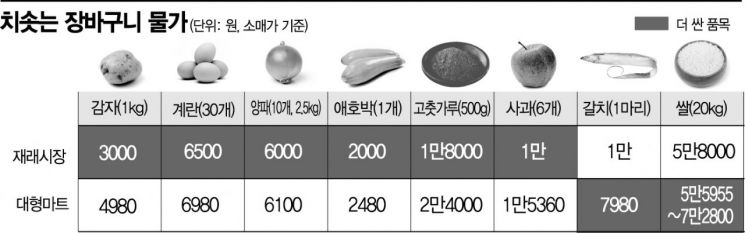
[Asia Economy reporters Minyoung Cha and Seungjin Lee] Amid the continuous surge in prices of agricultural, livestock, and fishery products, Asia Economy visited traditional markets and large supermarkets in Seoul to directly compare prices. The results showed that for most agricultural products, traditional markets were cheaper than large supermarkets. On the other hand, large supermarkets, which offer a wider variety of products such as seafood and rice, were found to be more affordable.
Buy Agricultural Products at Traditional Markets
On the 16th and 17th, a price comparison of major items was conducted at Gyeongdong Market and Emart Yeongdeungpo in Seoul. Among eight key food ingredients, six were sold cheaper at traditional markets than at large supermarkets. For example, potatoes were priced at 3,000 KRW per kilogram at traditional markets, about 40% cheaper than the 4,980 KRW for 900g at large supermarkets. Onions, zucchini, cucumbers, and radishes were also up to 30% cheaper at traditional markets. For red pepper powder (500g), there was a 6,000 KRW price difference between traditional markets and large supermarkets. This is due to the nature of traditional markets where the powder is ground and sold directly at the mill, reducing distribution costs compared to large supermarkets.
For eggs and radishes, which the Ministry of Agriculture, Food and Rural Affairs designated as discounted items due to price surges, there was little difference between traditional markets and large supermarkets. Eggs (30 pieces, large size) were sold for 6,500 KRW at traditional markets and 6,980 KRW at large supermarkets. Shoppers often bought a full tray of 30 or multiple packs of 15 eggs. Some popular 15-egg packs sold out early at large supermarkets. Radishes were priced at 1,000 KRW in the market and 1,264 KRW at supermarkets, showing a difference of about 264 KRW.
Rice and Seafood Are Cheaper at Supermarkets
Rice and some seafood such as hairtail fish were cheaper at large supermarkets than at traditional markets. Rice (20kg) was priced at 58,000 KRW at traditional markets, while large supermarkets started at around 55,900 KRW. Hairtail fish (Jeju, one fish) was 7,980 KRW at large supermarkets, over 2,000 KRW cheaper than the 10,000 KRW at traditional markets.
In terms of supply diversity, traditional markets are weaker than large supermarkets. Large supermarkets sold a total of 50 types of eggs, all at a 20% discount. The sales units were also diversified, including packs of 10, 15, and 30 eggs. In traditional markets, each store sold only one or two types of eggs, and due to the expansion of the avian influenza (AI) outbreak, this was reduced to just one type.
Kim Jihwan (alias), a market vendor, said, "Large supermarkets quickly diversified their sourcing using nationwide logistics networks, but markets could not do so," adding, "They don’t even handle premium eggs." Regarding rice, traditional markets mainly offered cheaper varieties, while large supermarkets stocked a variety of products from different regions nationwide.
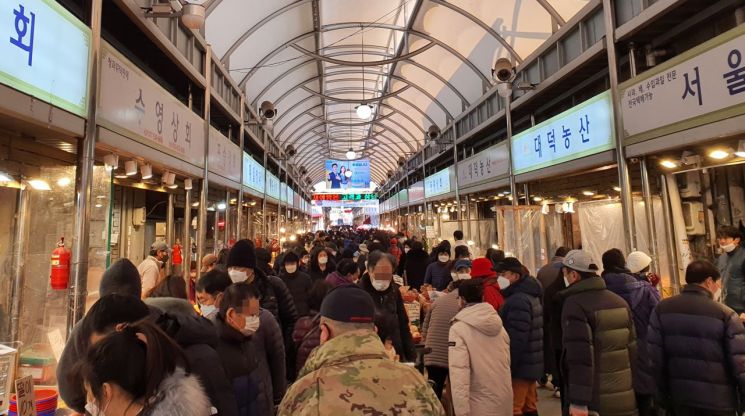 On the afternoon of the 16th, Seoul's Gyeongdong Market was bustling with citizens shopping despite the below-freezing weather.
Markets and Supermarkets Bustling
Despite chilly weekend weather, citizens visited traditional markets and large supermarkets. At Gyeongdong Market, despite the cold, many customers crowded the area. With prices rising daily, many came out thinking to buy cheaper items while they could. For fruits, there were products with significant price differences compared to supermarkets. Especially for tangerines, a 5kg box was priced as low as 6,000 KRW, cheaper than supermarkets, leading many to buy whole boxes.
Choi Gayoung (49, alias), who came to shop at Gyeongdong Market, said, "I shopped at a supermarket last week, and it was too expensive, so I came to the market today. It’s cheaper than the supermarket but still generally very expensive," adding, "Shopping for a family of four, including two college sons, easily exceeds 100,000 KRW."
Large supermarkets were also crowded on the weekend. At Emart Yeongdeungpo, visited around 5 p.m., a parking shortage caused waiting times of over 20 minutes. Inside the store, there were families and individuals shopping. Some were browsing the fresh food section, waiting for the ‘closing sale’ starting at 6 p.m.
Housewife Yoo Heejin (52, alias), met at the supermarket, said, "I only picked items on discount from the supermarket flyer," adding, "Household income keeps decreasing, but food prices keep rising, so I’m waiting for the closing sale after 6 p.m. to buy more basic side dishes."
© The Asia Business Daily(www.asiae.co.kr). All rights reserved.

![Clutching a Stolen Dior Bag, Saying "I Hate Being Poor but Real"... The Grotesque Con of a "Human Knockoff" [Slate]](https://cwcontent.asiae.co.kr/asiaresize/183/2026021902243444107_1771435474.jpg)
















