10 Power Generation Companies Including Korea District Heating Corporation
Stable Adjustment of Fuel Costs
Expected Effect of Electricity Rate Reduction
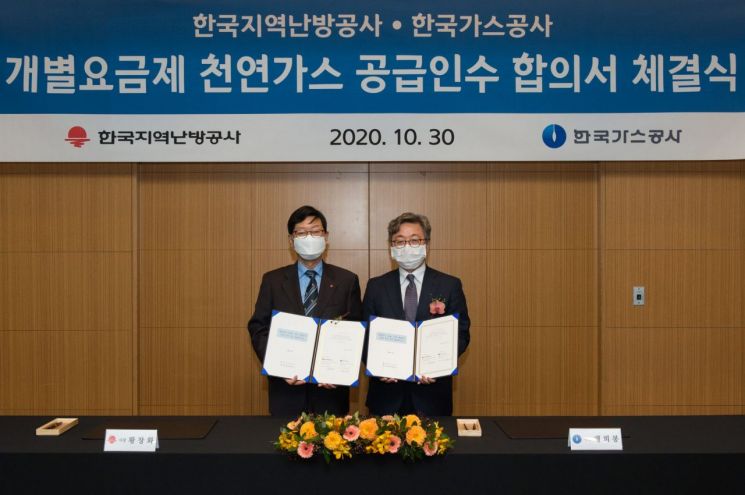 On October 30th last year, Korea Gas Corporation and Korea District Heating Corporation (Hanran) signed a contract to supply approximately 400,000 tons of fixed natural gas volume over 15 years by applying the individual tariff system introduced by Korea Gas Corporation. On the right is Chae Hee-bong, President of Korea Gas Corporation, and on the left is Hwang Chang-hwa, President of Korea District Heating Corporation. (Photo by Korea Gas Corporation)
[Asia Economy Reporter Moon Chaeseok] Korea Gas Corporation announced on the 19th that it will officially implement the 'Individual LNG Pricing System for Power Generation' starting next year, which establishes liquefied natural gas (LNG) supply contracts tailored to the equipment conditions of power plants.
According to Gas Corporation, the introduction of the 'Individual Pricing System' will rationalize the supply system and ultimately help stabilize electricity rates. Previously, small power plants had to purchase raw materials at the average LNG procurement contract price, just like large power plants, but this will no longer be necessary.
To implement the 'Individual Pricing System for Power Generation' next year, Gas Corporation recently expanded the responsible organization and strengthened marketing responses. They are continuously discussing improvements from the existing 'average pricing system' to the individual pricing system by forming consultative bodies with stakeholders such as power companies and associations.
Power producers will have the opportunity to secure higher competitiveness in power generation costs compared to the existing average pricing system by implementing the individual pricing system after contracting with Gas Corporation.
It is expected that electricity rates will decrease as LNG power plants can stably adjust their raw material costs. The lower the LNG price, the cheaper the raw material cost for Korea Electric Power Corporation (KEPCO), which increases the incentive to reduce consumer electricity bills.
The government and KEPCO announced last month that they will newly apply a cost-linked pricing system that links electricity rates to raw material costs.
Gas Corporation plans to promote the introduction of the individual pricing system with about 10 power companies, in addition to Korea District Heating Corporation (KDHC) and Naepo Combined Heat and Power Plant.
They intend to accelerate the promotion of the individual pricing system for power generation through marketing activities that offer various contract options and enable power companies to procure LNG at lower costs.
The introduction of the individual pricing system is expected to strengthen the response capability to national emergencies. Gas Corporation is a 'wholesaler' that purchases gas from abroad and sells it to power producers. If the wholesaler manages LNG volumes in an integrated manner, it will be able to stockpile appropriate amounts.
Direct imports from overseas are characterized by the difficulty for the government to flexibly manage supply and demand. With the implementation of the individual pricing system, Gas Corporation will be able to perform this role more easily.
Improvement in Gas Corporation's LNG supply system is also expected to have a positive impact on the government's eco-friendly energy expansion policy. After the introduction of the individual pricing system, if the profitability of power companies increases, it will help expand LNG distribution accordingly.
Earlier, the government announced through the 9th Basic Plan for Electricity Supply and Demand last year that it plans to retire 30 out of 60 coal-fired power plants by 2034 and replace 24 of them with LNG power plants.
For the government's energy transition policy to succeed, LNG power generation must compensate for the reduced coal-fired and nuclear power generation until solar, wind, and green hydrogen operate stably.
© The Asia Business Daily(www.asiae.co.kr). All rights reserved.

















