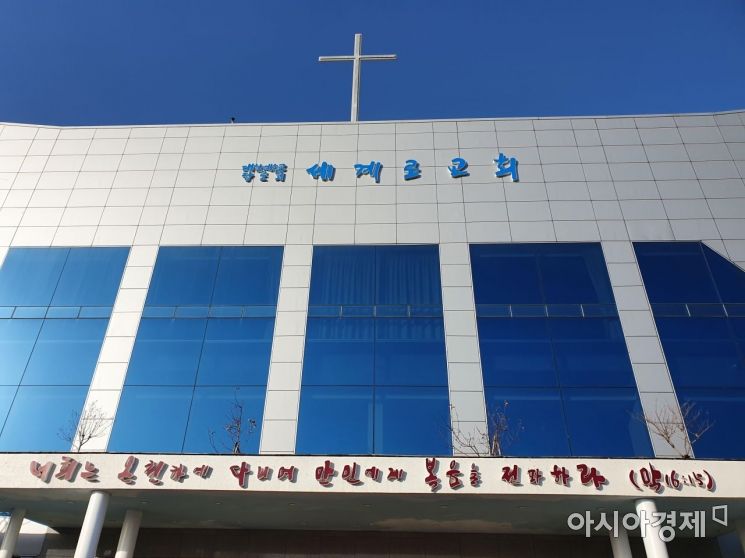
[Asia Economy Yeongnam Reporting Headquarters Reporter Ju Cheol-in] As the government’s social distancing measures to prevent the resurgence of the novel coronavirus infection (COVID-19) continue, controversy has arisen over whether restrictions on in-person worship services for quarantine purposes infringe on religious freedom.
Recently, Busan Segyero Church and Seobu Presbyterian Church, which were ordered to suspend operations and close after violating administrative orders banning in-person worship services, filed a constitutional complaint arguing that the religious freedom guaranteed by the Constitution and the basic rights of citizens must be protected.
Along with this, the two churches applied to the Busan District Court for a provisional injunction to suspend the execution of the administrative order. The Administrative Division 1 of the Busan District Court (Chief Judge Park Min-su) dismissed all applications for provisional injunctions.
The court stated the reason for dismissal, saying, “The ban on in-person worship is unrelated to the freedom of inner faith and does not prohibit worship itself but only restricts the place and method of worship. It is difficult to see this as an infringement on the essential part of religious freedom.”
Choi In-seon, the lawyer representing Segyero Church, said, “We have strictly followed quarantine guidelines such as temperature checks before entry, sitting with distancing, and wearing masks, and above all, no confirmed cases have occurred, yet the church was closed, which is unfair and infringes on the constitutionally guaranteed freedom of faith.”
The controversy over religious freedom infringement due to COVID-19 quarantine measures is not unique to South Korea. The same issue became the subject of judicial review after social debate in the United States as well.
On November 25 last year, the U.S. Supreme Court ruled that the New York governor’s administrative order limiting the number of attendees at religious events to 10 or 25 people to prevent the spread of COVID-19 violated the First Amendment of the U.S. Constitution, which guarantees religious freedom.
The U.S. Supreme Court pointed out that “while religious facilities were limited to 10 attendees, supermarkets and pet supply stores were not regulated,” and ruled that “the Constitution must not be pushed aside or forgotten even during an infectious disease crisis.”
The U.S. ruling means that the Constitution must not be pushed aside or forgotten even during an infectious disease crisis.
The Christian organization Liberty Citizens’ Coalition stated, “Religious freedom, a basic right guaranteed by the Constitution, must not be infringed,” and added, “Preventing in-person worship seriously infringes on religious freedom and basic rights.”
They argued, “Article 49, Paragraph 1, Subparagraph 2 of the Infectious Disease Control and Prevention Act states ‘restriction or prohibition of assemblies, rites, or other gatherings of many people,’ but does not specify the method of rites,” and claimed, “Forcing a worship method has no legal basis and is invalid.” They maintain that worship methods cannot be forced.
Meanwhile, on the 16th, Prime Minister Chung Sye-kyun chaired the Central Disaster and Safety Countermeasure Headquarters (CDSCH) meeting and eased some quarantine measures. From the 18th, regular worship services, Buddhist ceremonies, and masses can be held in person with mask-wearing and social distancing rules observed, allowing up to 10% seating capacity in the metropolitan area and 20% in non-metropolitan areas.
© The Asia Business Daily(www.asiae.co.kr). All rights reserved.

















