Selected 8 Project Sites Including Heukseok 2, Yongdu 1-6, Yangpyeong 13
Radical Incentives Such as Floor Area Ratio Increase and Exclusion from Sale Price Ceiling System
However, Two-Thirds Owner Consent Required for Public Redevelopment
Concerns Over High Rental Housing Ratio and Land Transaction Permission System as Obstacles
Many Owners in Candidate Sites Have Changed Hands to Investors
Experts Warn "Project May Be Suspended If Profitability Is Not Secured"
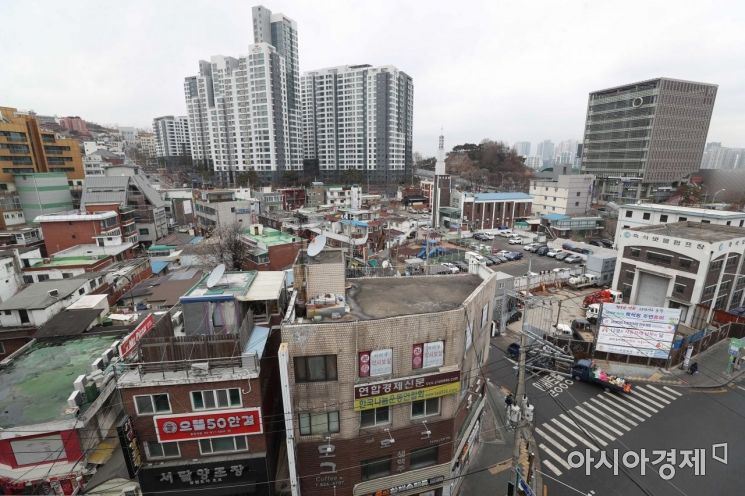 Eight redevelopment areas, including Heukseok 2 District in Dongjak-gu, Seoul, have been selected as pilot sites for the public redevelopment project. The pilot sites are Heukseok 2 in Dongjak-gu, Yangpyeong 13 and 14 in Yeongdeungpo-gu, Yongdu 1-6 and Sinseol 1 in Dongdaemun-gu, Bongcheon 13 in Gwanak-gu, Sinmunno 2-12 in Jongno-gu, and Gangbuk 5 in Gangbuk-gu. A view of Heukseok 2 District in Dongjak-gu on the 15th. Photo by Moon Honam munonam@
[Asia Economy Reporter Onyu Lim] ▲Jongno-gu Sinmunno 2-12 ▲Yeongdeungpo-gu Yangpyeong 13 ▲Yangpyeong 14 ▲Gwanak-gu Bongcheon 13 ▲Dongdaemun-gu Sinseol 1 ▲Yongdu 1-6 ▲Gangbuk 5 ▲Dongjak-gu Heukseok 2….
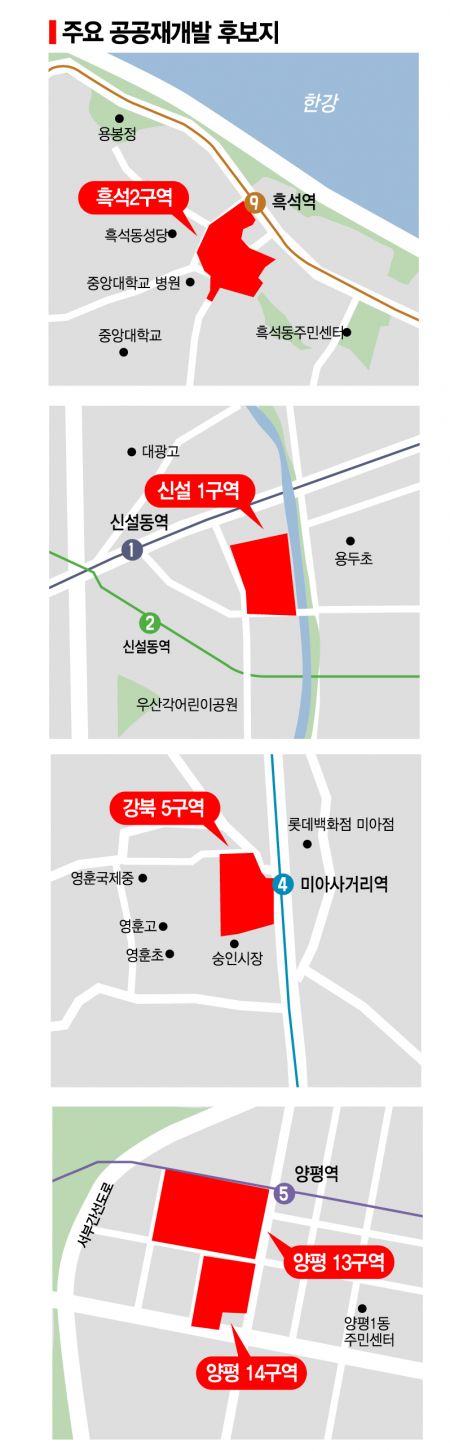
The final candidates for public redevelopment to expand housing supply in urban areas have been selected. The government expects to supply a total of 4,700 households through eight candidate sites. Notably, all six redevelopment zones selected as candidates within Seoul are located in 'station areas.' This is interpreted as a determination to focus supply capacity on station areas where there is significant potential to increase development density, given the practical difficulty of securing large-scale land sites within Seoul.
However, concerns remain that the high proportion of rental housing, which is a prerequisite for the project, could still be an obstacle to gaining residents' consent.
First Announcement of Public Redevelopment Candidate Sites…Exclusion from Price Ceiling System, Increased Floor Area Ratio…Incentives Attracted Many Applications
Seoul City and the Ministry of Land, Infrastructure and Transport announced eight pilot candidate sites for public redevelopment on the 15th. This evaluation was conducted among 12 existing redevelopment zones (one voluntarily withdrawn) that had already established maintenance plans and participated in the public redevelopment contest.
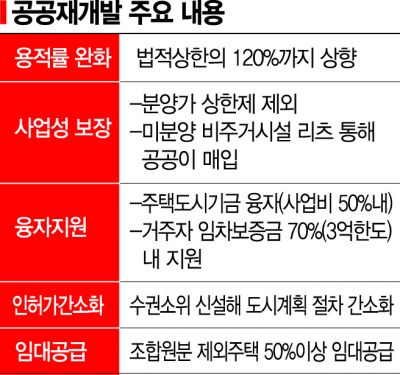
'Public redevelopment' is a maintenance project method where public entities such as Korea Land and Housing Corporation (LH) and Seoul Housing and Communities Corporation (SH) participate as joint implementers alongside resident associations. Residents are given incentives such as increasing the floor area ratio up to 120% of the legal limit and exemption from the price ceiling system. Due to these benefits, over 70 sites in Seoul applied for candidate selection.
All eight zones selected as candidates are station areas adjacent to subway stations but have experienced project stagnation for an average of over 10 years due to lack of profitability and conflicts among residents since their designation as redevelopment zones. The Ministry of Land and Seoul City plan to supply a total of 4,700 housing units in these zones through public redevelopment. A Seoul City official explained, "These are places with a high possibility of supplying quality housing in locations desired by actual demanders if factors hindering project progress are resolved through public redevelopment."
Examining the 8 Zones…Heukseok 2 Zone, Owned by Seo Jang-hoon, to Supply About 1,300 Households
The largest supply scale is in Dongjak-gu Heukseok 2 Zone. It covers a total of 45,229㎡ and currently houses 270 households, which will be transformed into a complex of 1,310 households through public redevelopment. It has attracted attention since the application phase due to its proximity to the Gangnam area. This zone was designated as a redevelopment zone in 2008 and formed a promotion committee the following year, but the project has not progressed due to conflicts with nearby merchants and building owners. It is also known that a seven-story building worth about 12 billion KRW owned by former basketball player Seo Jang-hoon is included in Heukseok 2 Zone.
The supply quantities for the other zones are ▲Yongdu 1-6 Zone 919 households ▲Gangbuk 5 Zone 680 households ▲Yangpyeong 13 Zone 618 households ▲Yangpyeong 14 Zone 358 households ▲Bongcheon 13 Zone 357 households ▲Sinseol 1 Zone 279 households ▲Sinmunno 2-12 Zone 242 households. Among these, Sinmunno 2-12 Zone is a 1,249㎡ urban leftover land located right in front of Gwanghwamun Square. It is a quasi-residential and general commercial area with a floor area ratio of 900% applied.
Kim Seong-bo, head of Seoul City's Housing and Architecture Headquarters, explained, "The first public redevelopment pilot candidate sites were selected focusing on areas where projects can proceed more rapidly through public support." Seoul City initially reviewed 12 zones including these but deferred designation for four due to issues specific to each zone. The city plans to reconsider public redevelopment in the next selection committee.
The eight candidate sites will undergo resident consent processes and then Korea Land and Housing Corporation (LH) and Seoul Housing and Communities Corporation (SH) will be designated as public implementers. Subsequently, Seoul City and local districts will establish maintenance plans applying public redevelopment special provisions to finalize the candidate sites as 'public redevelopment maintenance zones.' Public redevelopment is expected to complete zone designation and begin full-scale projects as early as the end of this year.
Excessive Public Contributions Such as Rental Housing, Land Transaction Permission System Likely to Affect Resident Consent Rates
Experts say the success of public redevelopment depends on resident consent. To designate a housing supply activation district, consent from more than two-thirds of landowners is required. The problem lies in excessive public contributions such as a high proportion of rental housing. Half of the newly constructed housing, excluding units allocated to association members, must be supplied as public rental or profit-sharing lease types. In fact, Dapsimni 17 Zone, which had expressed intention for public redevelopment, withdrew its application due to resident opposition fearing decreased profitability.
Seoul City's land transaction permission system, implemented to prevent speculative trading and curb rapid land price increases, is also expected to significantly influence resident consent. This system requires approval from the local government head when purchasing land exceeding 18㎡ in residential areas and 20㎡ in commercial areas. For housing, a minimum two-year residence obligation applies, effectively prohibiting so-called 'gap investments' involving leasehold rights. Considering many owners in redevelopment zones are investors who have changed hands multiple times, this could provoke considerable opposition.
Ham Young-jin, head of Zigbang Big Data Lab, said, "Public redevelopment can complement the limitations of private redevelopment, but the most important factor is private sector enthusiasm," adding, "Efforts such as easing public contribution ratios are needed to gather consent and create successful role models."
Senior Researcher Doo Sung-gyu of the Korea Construction Industry Research Institute also pointed out, "A fundamental change is needed in the government's stance of not allowing development profits," and warned, "If profitability is not secured, public redevelopment may start initially but could be halted later due to owners' dissatisfaction." He further expressed concerns, "Redevelopment projects inherently take a long time and face many obstacles during progress, and if the government leads, it is uncertain whether it will take full responsibility if the government's nature changes."
© The Asia Business Daily(www.asiae.co.kr). All rights reserved.
![Clutching a Stolen Dior Bag, Saying "I Hate Being Poor but Real"... The Grotesque Con of a "Human Knockoff" [Slate]](https://cwcontent.asiae.co.kr/asiaresize/183/2026021902243444107_1771435474.jpg)


















