Number of Bank Sector ISA Subscribers Continues to Decline
Active Events to Attract Subscribers Since the Beginning of the Year
Domestic Listed Stocks Cannot Be Included Due to Infrastructure Shortages Despite System Improvements
[Asia Economy Reporter Park Sun-mi] The number of individual comprehensive asset management account (ISA) subscribers in the banking sector has been decreasing every month, but the revised ISA system starting this year has sparked a competition to attract subscribers from the beginning of the year. However, despite improvements such as expanded subscription and investment targets, the banking sector's ISA infrastructure has not reflected these changes. As a result, it is difficult to expect a sharp increase in the number of subscribers.
According to the Korea Financial Investment Association on the 15th, the number of ISA subscribers in the banking sector decreased by 8,279 in November last year, bringing the monthly average number of subscribers to 31,489. On the other hand, securities firms saw an increase of 808 subscribers, raising the monthly average to 2,688. The total number of ISA subscribers in the banking sector has been steadily declining, with 1,990,470 at the end of 2018, 1,923,011 at the end of 2019, and 1,794,895 as of November 2020.
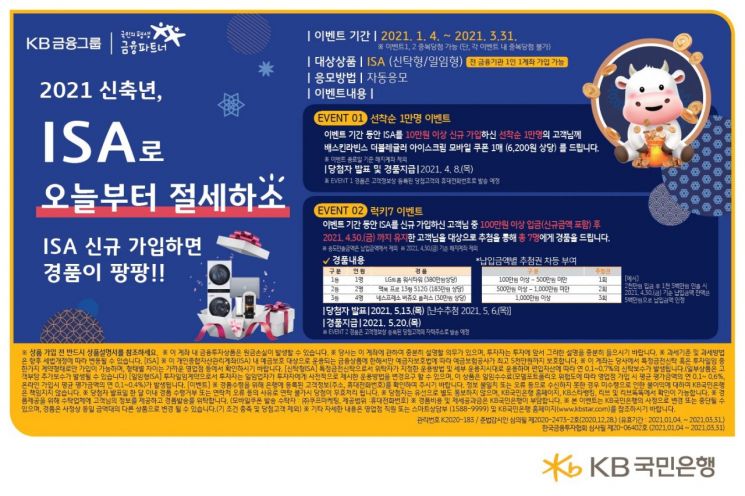
Banks have launched events from the beginning of the year to attract subscribers. Kookmin Bank has been offering mobile ice cream coupons on a first-come, first-served basis to new ISA subscribers from the 4th of this month until the end of March, along with a lottery for home appliances such as LG Tromm Wash Tower. Shinhan Bank is giving coffee coupons to new ISA customers who deposit more than 100,000 won from the 1st of this month until February 28th, and holding a lottery for items such as robot vacuum cleaners. Woori Bank plans to start events for new ISA subscribers from next month.
ISA System Improvements Starting This Year
The conditions for attracting subscribers have improved with the revised ISA system starting this year.
The eligibility criteria, which previously allowed only residents with income to subscribe, have been expanded to include residents aged 19 or older and residents aged 15 to 18 with earned income. The mandatory subscription period has been shortened from five years to three years. ISA accounts, which previously could only hold deposits, funds, and derivative-linked securities, can now also include domestic listed stocks. After offsetting gains and losses between products and periods within the account, up to 2 million won of net income is tax-exempt, and for low-income subscribers, up to 4 million won is tax-exempt. The annual contribution limit is 20 million won, but unpaid amounts from the previous year can be carried forward for up to five years, with a maximum of 100 million won, expanding tax benefits.
However, it is uncertain whether banks can fully utilize the revised ISA system to attract subscribers. Although the KOSPI 3000 era has opened this year and individual stocks can be included in ISA portfolios, banks have not established systems to apply this, unlike securities firms.
If banks without stock trading systems include listed stocks in the scope of ISA asset management, they must build IT systems capable of placing large stock orders through securities firms. Currently, only Kookmin Bank is preparing a process to include individual stocks in discretionary ISA accounts, while most banks are taking a cautious approach, deciding after considering costs and efficiency. Shinhan Bank has already decided not to build IT systems and not to include individual stocks within the ISA asset management scope based on its review.
A bank official explained, "Although the system has changed to allow individual stocks in ISA accounts, it cannot be applied to same-day stock trading, so there are limitations in management, and building the system costs quite a lot. The banking industry is generally reluctant to include domestic individual stocks in ISA."
© The Asia Business Daily(www.asiae.co.kr). All rights reserved.

















