Unlike Other Vaccines, Single Dose... Easy Storage and Transport
Contract to Deliver 12 Million Doses to US by February... Concerns Over Production Delays
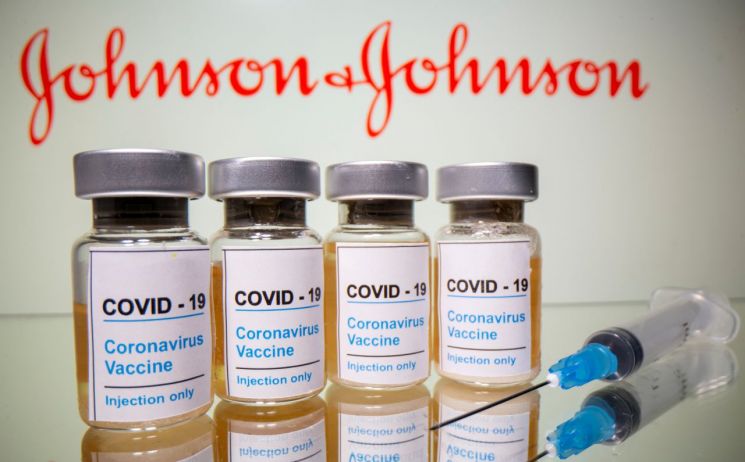
[Asia Economy Reporter Hyunwoo Lee] The new coronavirus disease (COVID-19) vaccine developed by Janssen, a subsidiary of Johnson & Johnson, is expected to receive approval for use from health authorities in the United States and the European Union (EU) next month. Unlike other existing vaccines, this vaccine requires only a single dose, is inexpensive, and is easy to store and transport, raising expectations for rapid distribution. However, concerns have emerged that the initial supply will be smaller than planned due to a production schedule delay of about two months.
According to foreign media including the Associated Press on the 13th (local time), Peter Liese, a member of the European Parliament, posted on Twitter that "Stella Kyriakides, the EU Commissioner for Health, said that Johnson & Johnson is likely to apply for vaccine approval in the EU next month." Earlier, the European Medicines Agency (EMA) had announced that Johnson & Johnson was expected to apply for marketing approval within the first quarter of this year.
Not only in the EU but also the U.S. Food and Drug Administration (FDA) is expected to approve Johnson & Johnson's vaccine next month. According to CNN, Moncef Slaoui, the Chief of Operation Warp Speed, said at a press briefing the day before, "If Johnson & Johnson applies for approval by the end of this month, we expect FDA approval around mid-next month," adding, "This vaccine is effective with a single dose, and millions of doses will be available by the end of February."
Johnson & Johnson plans to announce the results of its Phase 3 clinical trials by the end of this month. Since September last year, Johnson & Johnson has been conducting Phase 3 clinical trials on 60,000 people worldwide. Unlike other vaccines, its advantage of requiring only a single dose has attracted high interest from health authorities worldwide. It only requires standard refrigeration at 2 to 8 degrees Celsius for storage and transport, and its efficacy is maintained for six hours even in high-temperature areas above 30 degrees Celsius, making transportation and storage simpler compared to the Pfizer vaccine, which requires an ultra-cold cold chain. The price per dose is about $10, which is much cheaper compared to Pfizer and Moderna vaccines, which cost around $40 for two doses combined.
However, concerns have arisen that the initial supply will be smaller than expected due to production delays. The New York Times (NYT) reported on the same day, citing government officials, that Johnson & Johnson's production schedule has been delayed by about two months. According to the NYT, Johnson & Johnson had contracted with the U.S. government in August last year to supply 12 million doses by next month and prepare 100 million doses by the first half of this year, but due to production delays, it is expected to be difficult to supply all 12 million initial doses even by April.
© The Asia Business Daily(www.asiae.co.kr). All rights reserved.
![Clutching a Stolen Dior Bag, Saying "I Hate Being Poor but Real"... The Grotesque Con of a "Human Knockoff" [Slate]](https://cwcontent.asiae.co.kr/asiaresize/183/2026021902243444107_1771435474.jpg)
















