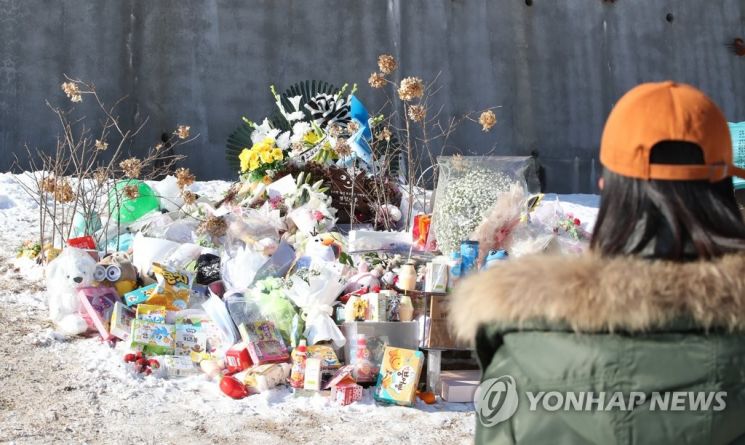
 On the 8th, citizens are paying tribute to Jeong-in, who died at 16 months old due to abuse by her adoptive parents, at Hi Family Andersen Park Cemetery in Yangpyeong-gun, Gyeonggi-do.
[Asia Economy Reporter Choi Seok-jin] The partial amendment bill to the Special Act on the Punishment of Child Abuse Crimes (so-called Jeong-in Act), prepared to prevent child abuse crimes and strengthen the protection of abused children in the wake of the ‘Jeong-in death case,’ passed the National Assembly on the 8th.
The National Assembly integrated and adjusted the contents of six partial amendment bills to the Child Abuse Punishment Act, which were proposed from June to November last year, and six partial amendment bills, including three proposed on the 5th of this month, to prepare and approve a committee alternative.
According to the National Assembly’s bill information system on the 10th, after the ‘Jeong-in death case’ was re-highlighted by a broadcast report on the 2nd, lawmakers from both ruling and opposition parties proposed 15 amendment bills within just 3 to 4 days, but only three bills proposed on the 5th were reflected in the committee alternative.
The alternative proposed under the name of the Chairperson of the Legislation and Judiciary Committee states the reason for the proposal as “to prevent child abuse crimes and strengthen the protection of abused children by improving and supplementing some deficiencies in the current law’s procedures for responding to child abuse cases, such as on-site dispatch, on-site investigation, and emergency measures.”
What Does the Amended Child Abuse Punishment Act Contain?
The most notable change in this amendment is the imposition of an obligation on local governments or investigative agencies to immediately start investigation or inquiry when a child abuse crime is reported.
The amendment newly adds paragraph 4 to Article 10 (Obligation and Procedure for Reporting Child Abuse Crimes), stating, “When a report of a child abuse crime is made pursuant to paragraph 2, the city/province, city/county/district, or investigative agency shall immediately commence investigation or inquiry unless there is a justifiable reason.”
The authority of police officers or public officials investigating child abuse crimes has been strengthened.
First, paragraph 2 of Article 11 (On-site Dispatch) expanded the places where judicial police officers or child abuse dedicated public officials who receive reports of child abuse crimes can enter and investigate from the existing ‘reported site’ to ‘reported site or places necessary to protect the abused child.’
Also, paragraph 7 of Article 12 (Emergency Measures for Abused Children, etc.) was newly established to provide legal grounds for judicial police officers to enter another person’s land, building, boat, or vehicle to restrain child abuse acts or to separate the abuser from the abused child.
The investigation procedures for abused children and regulations on investigating child abuse crime scenes were also supplemented.
Paragraph 5 of Article 11 (On-site Dispatch) newly states, “When judicial police officers or child abuse dedicated public officials who have received a report of child abuse crimes investigate or question the child or related persons such as the abuser at the reported site, necessary measures such as conducting the investigation in a place separated from the abuser so that the abused child, reporter, or witnesses can freely testify shall be taken.”
Paragraph 7 of Article 11 also establishes an obligation that when judicial police officers and child abuse dedicated public officials do not accompany on-site dispatch, the heads of investigative agencies and local government heads such as governors, mayors, county heads, or district heads must notify each other of the investigation results following the on-site dispatch.
Paragraph 1 of Article 11-2 (Investigation) newly adds an obligation clause stating, “The abuser and related persons shall comply with requests for attendance, testimony, and submission of materials by the child abuse dedicated public official for investigation necessary for the protection and case management of the abused child unless there is a justifiable reason.”
Furthermore, those who violate this obligation by refusing attendance, testimony, or submission of materials, or who give false testimony or submit false materials, will be fined up to 10 million won according to the newly established Article 63 (Fines), paragraph 1, subparagraph 3-2.
When a witness to a child abuse crime is recognized to be at risk of harm to life or body from the defendant or others, a mandatory provision was newly established in Article 17-2 (Measures for Witness Protection) requiring the prosecutor to request the chief of the competent police station to take necessary measures for the witness’s personal safety.
The witness can request the prosecutor to take necessary safety measures, and the presiding judge can request the prosecutor to do so. The police chief who receives the request must immediately take necessary measures for the witness’s safety and notify the prosecutor of the fact.
The upper limits of fines and penalties have also been raised.
First, the maximum fine for obstructing the duties of judicial police officers, child abuse dedicated public officials, or employees of child protection agencies by assault, intimidation, fraud, or coercion under Article 61 (Obstruction of Duty) was increased more than threefold from 15 million won to 50 million won. Going forward, obstruction of duty will be punishable by imprisonment for up to five years or a fine of up to 50 million won.
Also, the upper limit of fines under Article 63, imposed for refusing a judge’s summons without justifiable reason, failure to report by a mandatory reporter of child abuse crimes, refusal of on-site investigation, or refusal of on-site investigation conducted by judicial police officers, child abuse dedicated public officials, or child protection agency employees, was raised from 5 million won to 10 million won.
In addition, the period for emergency measures (Article 12, paragraph 3), such as separating the abuser from the abused child, handing over the abused child to a child abuse-related protection facility, or transferring an abused child requiring urgent treatment to a medical institution, which could not exceed 72 hours, will now exclude holidays and Saturdays from the calculation, allowing the period to be extended within 48 hours if deemed necessary for the protection of the abused child.
The upper limit of the period during which a prosecutor can request temporary measures after receiving an application from a judicial police officer under Article 15, paragraph 2, was also changed from “within 72 hours from the time emergency measures were taken” to exclude holidays and Saturdays, allowing a maximum extension of 48 hours.
The Minister of Justice or heads of related administrative agencies are now required to provide mandatory education on specialized knowledge necessary for investigating and managing child abuse cases, procedures stipulated in the Child Abuse Punishment Act, related laws and systems, children’s rights as specified in international human rights treaties, and investigation methods for protecting abused children to judicial police officers, in addition to child abuse dedicated public officials and child protection agency workers (Article 55).
A mandatory provision was newly established in paragraph 5 of Article 51 requiring family courts to notify the city/province governor or mayor/county head/district head when the protection order period for an abused child expires.
Strengthening Punishment for Child Abuse Offenders Excluded... First Trial of Jeong-in’s Adoptive Parents on the 13th
The current amendment does not include provisions to increase the statutory penalties for child abuse crimes to strengthen punishment for offenders.
During the bill review process in the Legislation and Judiciary Committee’s subcommittee, many opinions were reported that raising statutory penalties might discourage victims and others from reporting, potentially concealing child abuse crimes, and increase the burden of proof for prosecutors during indictment, thus requiring a more cautious approach.
Under the current Child Abuse Punishment Act, the crime of child abuse homicide, which causes the death of a child through abuse, is punishable by life imprisonment or imprisonment for five years or more, and child abuse serious injury, which causes risk to the child’s life or results in disability or incurable disease, is punishable by imprisonment for three years or more. Additionally, habitual child abuse offenders may be punished with up to half of the statutory penalty increased.
Meanwhile, the first trial of the adoptive mother Jang and adoptive father Ahn, who caused the death of Jeong-in after months of abuse following her adoption in January last year, will be held on the 13th at the Seoul Southern District Court, Criminal Division 13 (Presiding Judge Shin Hyuk-jae).
Previously, the Women and Children Crime Investigation Division of the Seoul Southern District Prosecutors’ Office (Chief Prosecutor Lee Jung-woo) indicted adoptive mother Jang on charges of child abuse homicide under the Child Abuse Punishment Act and adoptive father Ahn on charges of violating the Child Welfare Act (child abandonment/neglect, child abuse) without detention.
The prosecution is currently requesting multiple forensic pathologists to re-examine Jeong-in’s medical records and evidence photos to determine the cause of death and extent of injuries to consider the possibility of applying murder charges against Jang and others.
© The Asia Business Daily(www.asiae.co.kr). All rights reserved.