'Faceless Angels' Donation Parade Continues
Areumdaun Foundation "Efforts Needed to Establish Proper Donation Culture"
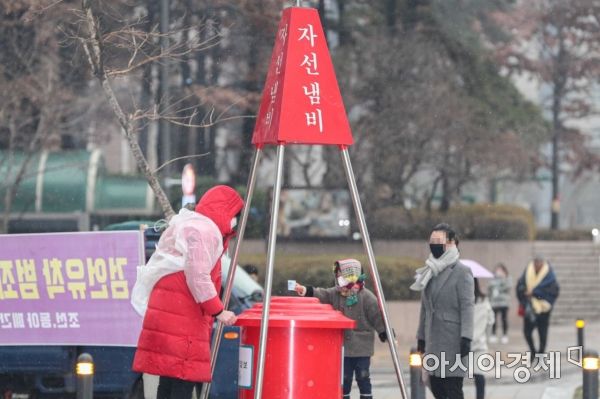 On the 29th of last month, a child is donating money to a charity kettle in Sejong-ro, Jongno-gu, Seoul.
 Photo by Jinhyung Kang aymsdream@
[Asia Economy Reporter Kim Suwan] "Please use this to help those in need," "Everyone is struggling due to COVID-19, but I want to contribute even a little to help our neighbors in difficulty."
Despite the increased economic hardships caused by the COVID-19 pandemic, more citizens have been participating in or expressing willingness to participate in donation activities. Especially, those who are actively donating have touched hearts by extending a warm hand to neighbors despite their own tightened budgets. On the other hand, some have pointed out low trust in donation organizations, emphasizing the urgent need for countermeasures.
Kim (29), an office worker who recently donated through a welfare organization, said, "Actually, my income has decreased due to COVID-19, so I am cutting unnecessary expenses," but added, "(The reason for donating) was that I hoped it could help neighbors in difficulty even a little." He continued, "No matter how hard I am, can it be harder than neighbors shivering in the cold without briquettes during the severe winter?" and "I just thought it was natural for those in better circumstances to help little by little. My friends around me also participate in donations through various means such as volunteer work."
According to a recent survey, despite the economic difficulties intensified by COVID-19, many people are still participating in donation activities.
Market research firm Embrain Trend Monitor conducted a survey on donation activities and donation culture perceptions among 1,000 male and female office workers aged 19 to 59 on the 30th of last month. The results showed that despite the hardships caused by COVID-19, 54.9% of respondents participated in donations.
The reasons for participating in donation activities included △feeling the need to do socially meaningful work (40.2%, multiple responses allowed) △believing that sharing is more necessary in difficult times (39.9%) △thinking that it brings great psychological satisfaction (38.9%) △believing that others’ happiness leads to one’s own happiness (22%) △liking the donation organization (21.6%) and △feeling that the economic difficulties of socially vulnerable groups are worsening due to COVID-19 (11.3%).
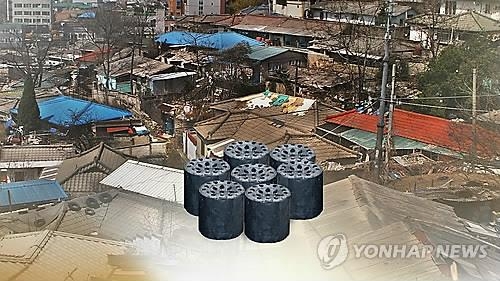 Donation campaigns continue for neighbors marginalized in each local community. Photo by Yonhap News
However, the amount of donations has decreased compared to before. This is due to worsening economic conditions such as increased household debt caused by COVID-19. According to the Bank of Korea, as of the third quarter of last year, household debt reached 1,940 trillion won, surpassing the nominal GDP of 1,918 trillion won.
In fact, according to the Community Chest of Korea, a representative social contribution organization, the amount raised in this winter’s 'Love Temperature Tower' campaign was 121.9 billion won as of the 17th of last month, which is 3 billion won less than the same period last year. Citizens’ donation activities that used to warm the winter cold every year are also shrinking.
Also, the Seoul Briquette Bank saw its briquette donations and volunteers reduced by half. From January to November 2019, briquette donations amounted to 2.08 million pieces, but last year, it dropped to 1.24 million pieces, a decrease of about 40%. The number of people participating in briquette-sharing volunteer work also halved from about 12,000 in 2019 to about 6,000 in 2020.
Despite the unfavorable situation, anonymous donation waves have continued in various regions to welcome the New Year. According to the Jeonbuk Community Chest of Korea on the 7th, an anonymous donor using the pseudonym 'Kim Dalbong' donated 120 million won in cash to support multicultural families in difficulty in Jeonbuk. He had also donated 200,000 protective masks last month to help socially marginalized groups struggling with COVID-19 in the region.
There were also those who shared money saved little by little for their neighbors. A resident who visited a community center in Gunsan said, "The amount is small, but it is filled with sincerity," donating a red piggy bank containing 178,690 won in coins. A mother who visited a welfare center in Ulsan with her two elementary school sons said, "My two children wanted to help friends in difficulty, so we collected money together for a long time," handing over a piggy bank and an envelope containing pocket money.
On the other hand, those who have no intention of participating in donation activities in the future raised concerns about the misuse and embezzlement of donation funds, making it difficult to trust donation organizations. There is a call for transparent management by donation fund operators to establish a proper domestic donation culture.
Meanwhile, the Beautiful Foundation’s Donation Culture Research Institute pointed out at the 18th Donation Culture Symposium 'Giving Korea 2018' that "According to an in-depth survey on public trust in nonprofit fundraising organizations, the trust level of general citizens in Korean society and fundraising organizations was generally low," and "Nonprofit fundraising organizations should specifically consider the effectiveness and efficiency of strategies in providing concrete information related to the use of donations as well as their activities."
The institute further suggested, "Nonprofit fundraising organizations need to provide more concrete information to more people, thereby creating a foundation for citizens to understand their activities."
© The Asia Business Daily(www.asiae.co.kr). All rights reserved.
![Clutching a Stolen Dior Bag, Saying "I Hate Being Poor but Real"... The Grotesque Con of a "Human Knockoff" [Slate]](https://cwcontent.asiae.co.kr/asiaresize/183/2026021902243444107_1771435474.jpg)













