Seoul National University Research Team Develops High-Performance Soft Sensor
Enabling Even More Delicate Remote Operation
[Asia Economy Reporter Junho Hwang] A sensor has been developed that, when attached to joints such as the wrist, enables the transmission of various commands to robots or computers solely through body movements. This technology allows for more intuitive device control and is expected to be applicable in various fields such as wearables and robotics. The research team led by Professor Yongrae Park of the Department of Mechanical Engineering at Seoul National University announced on the 9th that they developed this sensor technology with such capabilities, and the related research results were published in the international academic journal Science Robotics.
Detecting Complex Movements with a Single Sensor
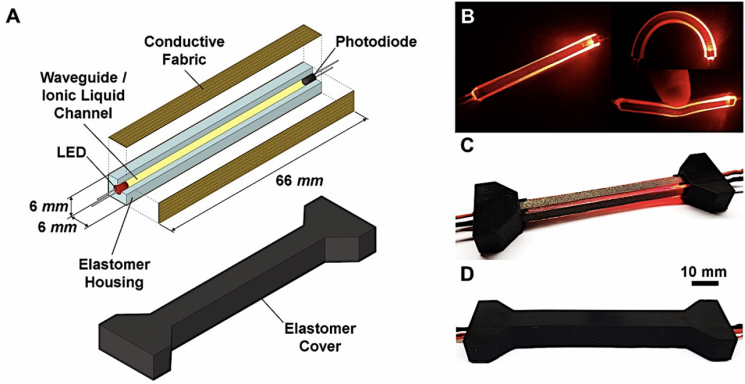
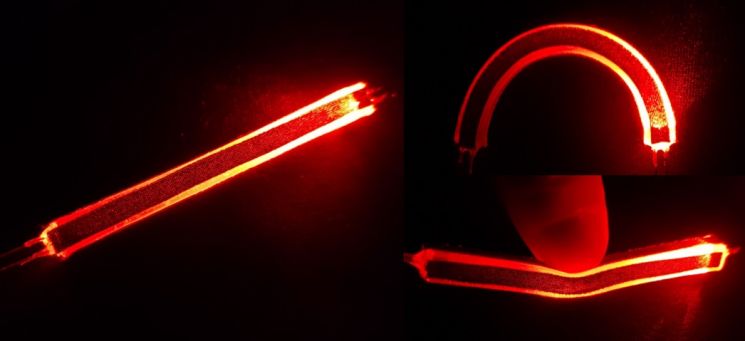
The sensor developed by the research team is a multifunctional soft sensor that can detect individual deformations such as tension, bending, and compression with a single sensor, as well as combinations of two or more deformations. The sensor is made of silicone rubber and contains a fine tube inside its rod-shaped structure. Inside this tube is a transparent ionic solution with electrical conductivity, and a thin conductive fabric is attached to the outer wall of the sensor structure. When the sensor is deformed by stretching or bending, it operates by simultaneously detecting various types of deformation through measuring changes in the ionic solution’s light transmittance, electrical conductivity, and the electrical resistance of the conductive fabric. Using this principle, when a sensor approximately 6mm thick and 7cm long is attached to a joint, it can remotely transmit various commands to robots or computers solely through body movements.
Applicable to Soft Wearable Devices and Robots
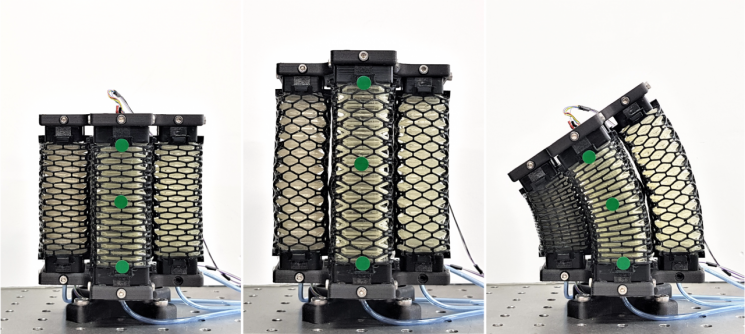
The research team also created a wearable interface using this sensor. They confirmed that it allows easy remote control of devices such as robotic arms and drones. In particular, when combined with soft robots, it was found that the robot’s movements can be accurately monitored. Professor Yongrae Park stated, "Through this technology, it will be possible to develop wearable technology that enables much more intuitive and easy remote control of robots."
© The Asia Business Daily(www.asiae.co.kr). All rights reserved.



















