Representative Chun Junho of the Democratic Party Proposed on This Day
Expecting Revitalization of Public Small-Scale Reconstruction
Floor Area Ratio Over 120%... Up to 50% Public Rental Housing
Supporting Original Residents' Resettlement Through Equity-Type Housing
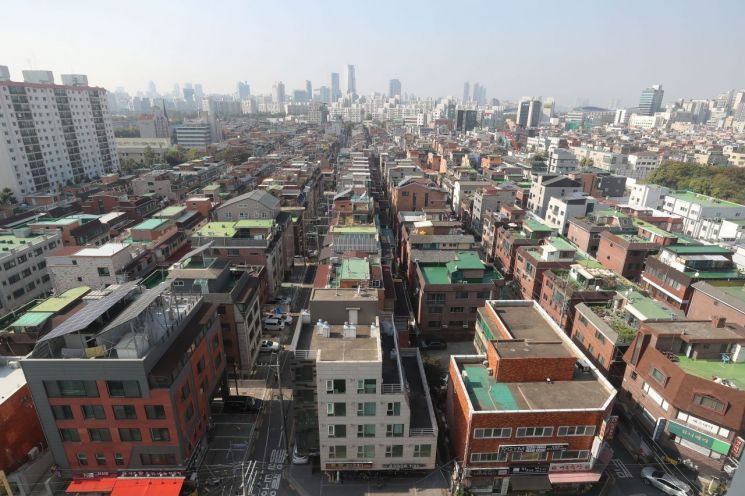
[Asia Economy Reporter Moon Jiwon] A plan for 'public small-scale reconstruction' to increase housing supply by developing low-rise residential areas has been proposed. In this method, if the public sector participates in small-scale reconstruction projects and raises the floor area ratio (FAR) up to 120% of the legal limit, 20-50% of the increased FAR must be built as public rental housing and donated.
On the 7th, according to the National Assembly and the Ministry of Land, Infrastructure and Transport, Assemblyman Cheon Junho of the Democratic Party of Korea is scheduled to officially propose a revision bill to the "Special Act on Vacant Houses and Small-scale Housing Maintenance" containing these details. The revision bill also reflects opinions from the Ministry of Land, Infrastructure and Transport and the Seoul Metropolitan Government.
Small-scale reconstruction projects are aimed at improving the residential environment of aging housing complexes such as apartments and row houses, and can be promoted in areas with a project zone of less than 10,000㎡ and fewer than 200 households in existing housing. It is included in the 'small-scale housing maintenance projects' along with autonomous housing maintenance projects and street housing maintenance projects.
Currently, in small-scale housing maintenance projects, if more than 20% of the total housing is built as rental housing, the FAR can be raised up to the legal limit. The proposed revision adds that if a public development method is introduced in small-scale reconstruction projects, the FAR can be further increased.
The revision bill stipulates that if public institutions such as the Korea Land and Housing Corporation (LH) participate as public implementers in small-scale reconstruction projects and raise the FAR up to 120% of the legal limit, 20-50% of the increased FAR must be built as public rental housing and donated.
In public small-scale reconstruction projects, the FAR limit can be increased from 250% to 300% in second-class general residential areas, and from 300% to 360% in third-class general residential areas. Relaxation of building regulations such as floor limits will be applied at a level similar to public participation-type street housing maintenance projects. Accordingly, in Seoul's second-class general residential areas, the floor limit will be relaxed from 7 floors or less to 15 floors or less.
Public small-scale reconstruction, like street housing maintenance projects and autonomous housing maintenance projects, will not be subject to the price ceiling system for sale prices, and it is expected to proceed quickly as integrated review will be applied during the local government's project management process.
Additionally, the revision bill establishes a legal basis to supply equity-type housing in small-scale reconstruction and other small-scale housing maintenance projects. Equity-type housing is a sales method where the house price is paid in installments over 20-30 years. This is a measure to prevent original residents with insufficient financial resources from being displaced during urban housing development.
Assemblyman Cheon explained through the revision bill, "Some of the increased housing due to the increased FAR will be donated as public rental housing, and by supplying equity-type housing for the resettlement of original residents, we aim to contribute to the housing stability of low-income people."
The ruling party and government expect that with such deregulation, public small-scale reconstruction projects will be revitalized. In Seoul, there are 2,070 aging multi-family housing complexes over 30 years old eligible for small-scale reconstruction, totaling about 60,000 households, so increased participation could also increase housing supply in the city center.
Public small-scale reconstruction is also expected to play an important role in the Seoul city center housing supply expansion plan, which is known to be announced before the Lunar New Year holiday. On the 5th, Minister of Land, Infrastructure and Transport Byun Changheum held a policy meeting with major public and private institutions related to housing supply and said, "If subway station areas, semi-industrial areas, and low-rise residential areas with low-density development in Seoul are effectively utilized, a sufficient amount of housing can be supplied even in the city center of Seoul."
© The Asia Business Daily(www.asiae.co.kr). All rights reserved.

















