Remaining Domestic and International Merger Review Processes by the Fair Trade Commission and Others
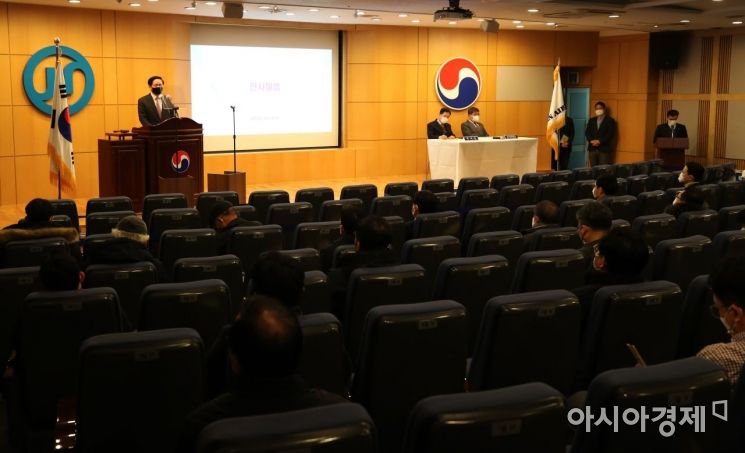 On the morning of the 6th, Woo Ki-hong, President of Korean Air, who chaired the extraordinary general meeting of shareholders held at the Korean Air headquarters in Gangseo-gu, Seoul, is delivering a greeting. 2021.01.06
[Asia Economy Reporter Yoo Je-hoon] Korean Air has passed the amendment to its articles of incorporation for a paid-in capital increase at an extraordinary general meeting of shareholders, marking a significant milestone in the airline merger. Once domestic and international merger reviews and the paid-in capital increase to raise funds for the acquisition of Asiana Airlines are completed, the 'mega carrier' is expected to officially emerge by the end of June.
◆Airline Big Deal Passes Major Milestone... Mega Carrier Within Sight= The amendment to increase the total number of issued shares was a necessary condition for Korean Air's acquisition of Asiana Airlines. Korean Air decided to carry out a paid-in capital increase worth 2.5 trillion KRW to finance the acquisition of Asiana Airlines, which required issuing an additional 173.6 million shares. In this case, the total of existing circulating shares (about 174.2 million shares) and the new shares would exceed the current limit on the total number of issued shares (250 million shares), necessitating a revision of this regulation.
With the passage of this amendment, Korean Air's acquisition of Asiana Airlines can proceed more swiftly. Since last month, Korean Air has formed an acquisition committee composed of working groups in planning, finance, passenger, and cargo sectors, and is currently conducting due diligence on Asiana Airlines as a whole. Korean Air plans to complete the post-merger integration (PMI) plan to maximize synergy by mid-March.
In March, Korean Air will secure 2.5 trillion KRW through a paid-in capital increase by rights offering followed by a general public subscription for forfeited shares. Of this, 1.5 trillion KRW will be invested in June in a third-party allotment paid-in capital increase of Asiana Airlines, securing a 63.9% stake to complete the acquisition process. Additionally, the integration of three low-cost carriers (LCCs)?Jin Air, Air Busan, and Air Seoul?as well as related affiliates such as ground handling companies, will proceed sequentially.
After an integration process expected to take at least one to two years, a super-large airline will be born, ranking 10th globally in international passenger service and 3rd in cargo. Although additional capital injections will be inevitable in the short term due to the impact of COVID-19, synergy effects are expected in cargo sectors such as vaccine transportation.
◆Final Variable: Domestic and International Merger Reviews= The last hurdle is the domestic and international merger reviews. To acquire Asiana Airlines, Korean Air must obtain approval not only from the Korea Fair Trade Commission but also from competition authorities in at least four countries: the United States, the European Union (EU), China, and Japan. Korean Air plans to file merger applications with these countries within this month.
Concerns about monopolization are not insignificant among political circles and civil society. The Korea Development Bank and the meeting explained that the integrated airline's slot share at Incheon International Airport is only 38.5%, so concerns are exaggerated, but monopoly is inevitable on major long-haul routes in the US and Europe.
For this reason, the National Assembly Research Service recently stated in a report, "The Fair Trade Commission needs to conduct a thorough review regarding concerns that the integrated airline may monopolize certain routes," adding, "For example, on routes where both companies hold high slot shares, transferring or adjusting traffic rights or slots to non-affiliated LCCs to activate competition and promote consumer benefits could be considered." In fact, in the US, competition authorities ordered the transfer of some slots to other airlines during the merger of American Airlines and US Airways.
Industry insiders believe there will be no significant issues in obtaining approval, as there have been few veto cases in overseas airline mergers and acquisitions (M&A). An industry official said, "Realistically, Asiana Airlines' recovery is difficult without large-scale public funds. This decision is a win-win for both the Korea Development Bank and the company, and competition authorities are expected to take this into account."
© The Asia Business Daily(www.asiae.co.kr). All rights reserved.

















