Airlines Breathe Easier Until Second Half of Year... Business Volume Recovery Is Key
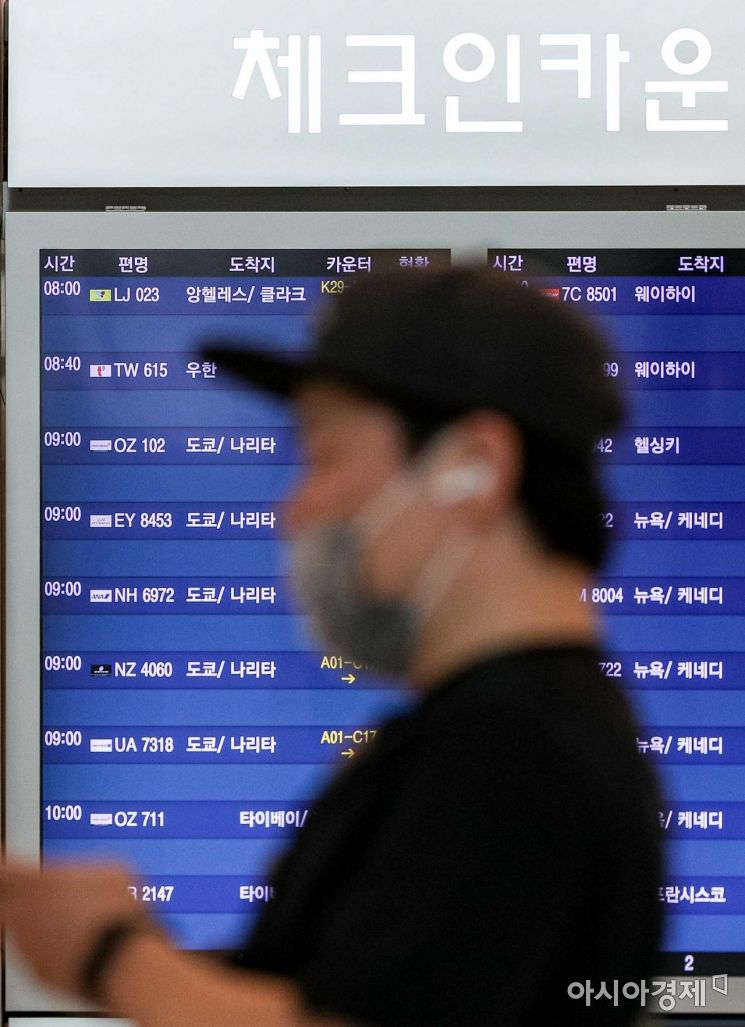 On the 16th, when the air route between Incheon and Wuhan, which had been blocked due to the spread of the novel coronavirus infection, reopened after 8 months, the departure board at Incheon International Airport Terminal 1 showed the departure of a passenger flight bound for Wuhan, China. / Yeongjongdo = Photo by Kang Jin-hyung aymsdream@
[Asia Economy Reporter Yu Je-hoon] As the new year begins, national airlines have reverted to a paid leave and furlough system due to the COVID-19 pandemic.
According to the aviation industry on the 5th, Korean Air, Jeju Air, Jin Air, T'way Air, Air Seoul, and other national airlines have become eligible for paid leave and furlough employment retention subsidies again for 180 days starting from the 1st of this month. Air Busan is also reportedly preparing to switch back to paid furlough around mid-month.
The aviation industry applied for employment retention subsidies for paid furloughs last March when international flights were largely suspended due to the spread of COVID-19. In an uncertain business environment, the subsidies, which cover 75% of leave allowances, help reduce labor costs while maintaining overall employment.
The employment retention subsidies significantly helped reduce deficits for national airlines. For example, Korean Air posted a surprising profit of 110.2 billion KRW in the second quarter of last year, partly due to a boom in air cargo business, with labor cost reductions (about 500 billion KRW) from using leave and furloughs being a key factor. Last year, airlines applied for these subsidies around mid-March, extended the payment period for 60 days (2 months), and when the payment period ended, they responded with unpaid furloughs and leave usage in November and December. Considering the system operates on a yearly basis, airlines applied again for paid furlough employment retention subsidies at the end of last year.
However, since the subsidy payment period is 180 days, unpaid furloughs are inevitable in the second half of the year. An industry official said, "Even if the paid furlough employment retention subsidy period is temporarily extended like last year, unpaid furloughs in the second half seem unavoidable," adding, "With COVID-19 vaccines developed and the industry gradually recovering, the challenge is to delay the implementation of unpaid furloughs as much as possible."
© The Asia Business Daily(www.asiae.co.kr). All rights reserved.
![From Hostess to Organ Seller to High Society... The Grotesque Scam of a "Human Counterfeit" Shaking the Korean Psyche [Slate]](https://cwcontent.asiae.co.kr/asiaresize/183/2026021902243444107_1771435474.jpg)
















