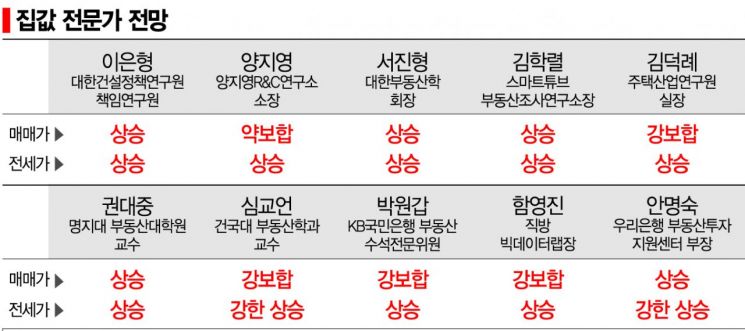
[Asia Economy Reporters Yuri Kim, Donghyun Choi, Onyu Lim] Nine out of ten experts forecast that house prices will rise this year. Opinions diverged on the trends for the first and second halves of the year. This is because they viewed the impacts of key issues such as multi-homeowner listings and the Seoul mayoral election in the first half, and discussions on liquidity withdrawal in the second half differently. However, experts unanimously agreed that the timing and intensity of overcoming the novel coronavirus infection (COVID-19) will have a significant influence on the real estate market movements. In particular, they concurred that the intensified jeonse (long-term lease) shortage highlighted last year will increase upward pressure not only on the jeonse market but also on the sales market.
◆9 out of 10 Expect "Rise or Strong Stability"... 1 Also Predicts "Partial Weak Stability"
The dominant view among experts is that the real estate market will continue to follow an upward curve this year. Considering increased purchase demand due to the jeonse shortage, abundant liquidity, and reduced housing supply, the weight is on price increases rather than declines. Especially, as house prices have risen significantly, acquisition costs such as acquisition tax have increased substantially compared to before, leading to continued withholding of existing housing listings. However, the rate of increase is expected to fall short of last year's. According to KB Real Estate Live On, last year, nationwide housing sales prices rose by 8.35%, marking the highest increase in 14 years since 2006 (11.60%).
The strength of low- to mid-priced listings in Seoul and the metropolitan area is expected to continue. This is because regulations on taxes and loans are less strict, and the 30s age group, emerging as major players in the sales market, find it easier to access these properties amid the jeonse shortage. Meanwhile, ultra-high-priced listings in Seoul, which rose relatively less last year, are also likely to move. Regarding regional markets, areas such as Chuncheon in Gangwon, Asan in Chungnam, Mokpo in Jeonnam, Andong in Gyeongbuk, and Jeju?places that either rose less or are non-regulated areas?as well as Sejong, Ulsan, Daejeon, and Gwangju, where housing supply will decrease this year, are expected to face upward pressure. Seojinhyung, President of the Korea Real Estate Society (Professor at Gyeongin Women's University), said, "Sejong has potential for price increases due to the relocation of the National Assembly, expansion of the administrative capital, and its status as a growth city. The Gangnam 3 districts and Dongjak-gu may see price rises due to the trend of concentrating on a single smart home and the expansion of regulated areas causing a U-turn phenomenon. Areas benefiting from the Metropolitan Area Express Train (GTX) will also show upward trends."
◆Opinions Divided on First Half Down, Second Half Up vs. First Half Up, Second Half Down... Corporate and Multi-homeowner Listings "Influential vs. Minimal"
Opinions on house price movements in the first and second halves of this year were divided. Shim Kyo-eon, Professor of Real Estate at Konkuk University, said, "In the first half, until May, multi-homeowners may dispose of properties further due to tax regulations, and the Seoul mayoral election is also a variable, so both sellers and buyers may pause." Yang Ji-young, Director of Yang Ji-young R&C Research Institute, stated, "Ahead of the strengthening of comprehensive real estate tax, more corporate and multi-homeowner listings will come out than this year. On the other hand, buyers are expected to reduce their purchasing power due to loan restrictions, so the price increase will be less than this year." Conversely, some believed that the impact of multi-homeowner listings on the market in the first half would be limited. Park Won-gap, Senior Real Estate Specialist at KB Kookmin Bank, said, "Some tax-saving listings will appear in the first half, but many multi-homeowners have already gifted or transferred properties, so it won't be to the extent of flooding the market."
◆Jeonse Shortage Intensifies... Concerns Over Increased Upward Pressure on House Prices
All agreed that jeonse prices will rise strongly. There was significant concern that the rise in jeonse prices will push up house prices to the extent that "this year's house prices should be asked to the jeonse prices." Yang Ji-young said, "Jeonse prices in Seoul and the metropolitan area are highly likely to rise more than this year. The rise will be higher especially in areas entering pre-subscription for the 3rd New Towns such as Hanam and Namyangju, as prospective applicants flock to meet residency requirements." Professor Shim Kyo-eon said, "Due to the new lease law, jeonse prices will continue to show a strong upward trend. Seoul and the metropolitan area will show a much stronger rise than regional areas. The waiting demand for the 3rd New Towns will support the strength of jeonse prices." Professor Kwon Dae-jung of Myongji University Graduate School of Real Estate pointed out, "If the gap between jeonse prices and sales prices narrows due to rising jeonse prices, gap investment?buying a house with jeonse?may increase. Ultimately, the rise in jeonse prices can cause a vicious cycle that pushes up house prices."
Variable is 'COVID-19' in Unison... Liquidity Strengthening vs. Gradual Withdrawal at a Crossroads
Experts unanimously agreed that the timing and intensity of overcoming COVID-19 will greatly influence real estate market movements. Attention should also be paid to the direction of excess liquidity driving the real estate market. The impact of overcoming COVID-19 and vaccine distribution will determine whether discussions on liquidity withdrawal begin. However, Eunhyung Lee, Senior Researcher at the Korea Institute of Construction Policy, said, "Even if a COVID-19 vaccine is developed, the global increase in liquidity is certain due to economic stimulus measures by each country. This will lead to a decline in currency value and cause real estate price increases."
Government regulations were also seen as a major variable. While the current regulatory stance is expected to be maintained, attention should be paid to whether stronger regulatory measures will be added. Kim Deok-rye, Head of Housing Policy Research at the Korea Research Institute for Human Settlements, said, "Unexpected policy variables remain a part to watch this year as well. Additionally, according to the institute's analysis, the supply-demand index has influenced apartment price fluctuations over the past 10 years. The balance between supply and demand will determine the direction of house prices."
◆"Government's Core is Stabilizing the Lease Market... Must Focus on 'Expanding Urban Supply'"
This year, experts diagnose that the government should focus on securing effective lease supply and expanding urban supply. Ham Young-jin, Head of the Zigbang Big Data Lab, emphasized, "The intensity of instability in the lease market will be a major variable for next year's market. To mitigate the surge in owner-occupier relocation demand and the ongoing regional balloon effect, efforts should focus on stabilizing the lease market." Kim Hak-ryeol, Director of SmartTube Real Estate Research Institute (Passion), said, "Unless regulations that suppress market transactions are completely reversed, there is no way to stop house price increases. It is important not only to increase physical supply but also to bring out listings that can be traded in the market."
Ahn Myung-sook, Head of the Real Estate Investment Support Center at Woori Bank, said, "Attention should be paid to 'expanding urban supply' through deregulation of redevelopment, reconstruction, and semi-industrial areas. The problem with new towns is not the lack of supply but the time it takes, so policies should move quickly to enable private sector participation and create momentum for urban supply through deregulation and strengthened support." Park Won-gap, Senior Real Estate Specialist, also stressed, "We need to continuously send signals of supply expansion to the market and ensure those signals are credible. Accelerating development of station-area semi-industrial zones is necessary."
© The Asia Business Daily(www.asiae.co.kr). All rights reserved.


















