[Asia Economy Reporter Seulgina Jo] "There is a need to disclose the basis for fee calculation so that the public can verify whether frequencies are being provided at fair and reasonable prices and whether the government is implementing policies that distort the value of public resources."
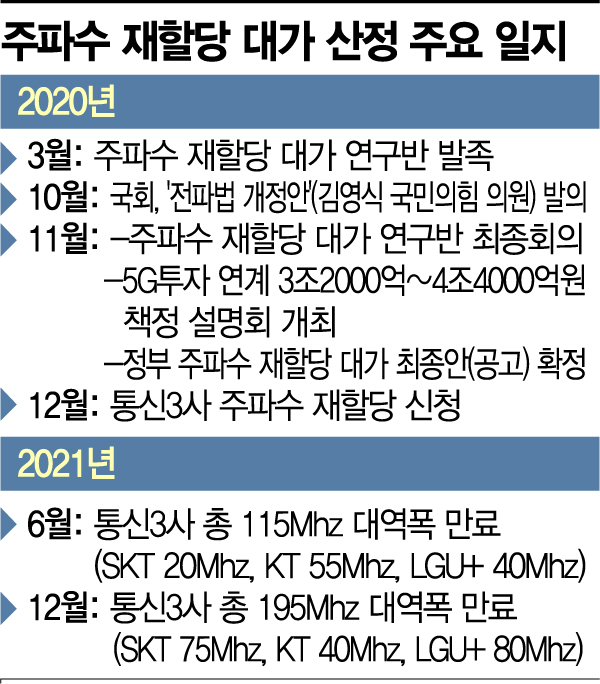
The National Assembly Legislative Research Office proposed that the basis for fee calculation regarding the 'frequency reassignment,' which last year escalated to administrative litigation due to conflicts between the government and the telecommunications industry, be disclosed and that the standards be specified by law. Regarding frequency reassignment, which has faced repeated criticism for lacking clear standards, calls for legislation to enhance predictability are expected to increase.
On the 4th, the Legislative Research Office pointed out issues with the government's frequency allocation in its recently released report titled "Current Issues and Tasks of Mobile Communication Frequency Allocation," highlighting ▲ low predictability of reassignment fees ▲ lack of transparency in the basis for fee calculation ▲ insufficient subdivision of allocation conditions.
Under the current Radio Waves Act, frequency allocation fees are to be calculated considering economic value. Unlike government-calculated allocation fees based on expected and actual sales, reassignment includes an additional judgment factor in the enforcement ordinance allowing the Minister of Science and ICT to consider matters deemed necessary.
Regarding this, the Legislative Research Office stated, "Given that reassignment aims to provide continuous service to users, the government's discretion should be reduced compared to government-calculated allocation fees," adding, "Currently, the government's discretion over reassignment fees is broader. The judgment factors are diverse, and no specific standards are presented, which can undermine the predictability for operators."
There is also criticism that the recent government decision to set 150,000 5G base stations per telecom company as an option condition for LTE frequency reassignment needs to be examined to determine whether it falls within the discretionary scope and whether it overlaps with existing 5G frequency allocation conditions.
The Legislative Research Office also pointed out the problem that the government does not disclose specific detailed standards and judgment bases during the reassignment calculation process. It mentioned, "The detailed frequency policy plan (draft) announced on November 17 only states a policy direction to refer to existing auction prices and consider the 5G environment, but does not present specific grounds for calculating allocation prices," emphasizing the need for transparent disclosure.
Furthermore, unlike countries such as Germany and Japan, the Legislative Research Office added that the Korean government does not specify concrete conditions such as regional coverage rates and speeds in its investment options, resulting in base stations being concentrated only in Seoul and the metropolitan area.
The Legislative Research Office suggested that when amending the Radio Waves Act in the future, more specific calculation standards beyond expected sales and economic value should be stipulated.
Since frequency allocation fees can vary by trillions of won depending on the ministry's judgment, it is necessary to consider establishing specific and clear calculation standards in the law and delegating implementation details to the enforcement ordinance. It also added that reassignment should be reorganized to operate in line with its purpose of continuous business for existing operators and users.
Additionally, the Legislative Research Office criticized the 2019 November draft of the full revision of the Radio Waves Act for delegating most of the frequency allocation fee standards to the enforcement ordinance, stating, "This broadens the scope of administrative discretion compared to the current law," and "It is necessary to review whether it excessively delegates areas requiring legislative oversight."
Along with this, there was an argument that since the way and content of providing the public resource of frequency are closely related to the lives of all citizens, the basis for fee calculation should be disclosed to the public. For example, frequency allocation fees can indirectly affect telecommunication charges.
The Legislative Research Office stated, "To allow the public to verify whether frequencies are provided at fair and reasonable prices and whether the government is pursuing policies that distort the value of public resources, the basis for fee calculation must be disclosed," proposing that frequencies be regarded as state-owned resources and that, like state-owned properties managed under the State Property Act, clear standards for fee calculation be presented in advance or the judgment basis be disclosed afterward.
Moreover, it pointed out that to establish a stable communication infrastructure nationwide, it is necessary to move away from the existing allocation condition based on the number of base stations across the country and consider changing to detailed and specific conditions such as regional coverage and speed, as is done overseas.
© The Asia Business Daily(www.asiae.co.kr). All rights reserved.
![Clutching a Stolen Dior Bag, Saying "I Hate Being Poor but Real"... The Grotesque Con of a "Human Knockoff" [Slate]](https://cwcontent.asiae.co.kr/asiaresize/183/2026021902243444107_1771435474.jpg)
















