[Asia Economy Reporter Yoo In-ho] Controversy continues in the real estate industry over commercial rent. As President Moon Jae-in mentioned the so-called 'fair rent theory,' both positive and negative opinions have emerged.
The government and ruling party are accused of trying to stir up another class conflict by blaming store owners as the source of 'unfairness,' using the prolonged COVID-19 pandemic as an excuse.
On the other hand, there are also calls for a social discussion on rent issues to support tenants who are struggling.
This controversy arose after President Moon Jae-in and Lee Nak-yeon, leader of the Democratic Party of Korea, raised the 'fair rent theory.' President Moon stated, "The question of whether it is truly fair for tenants to bear the burden of rent despite a sharp drop in sales when business is restricted or prohibited according to government quarantine guidelines is a very painful one."
Lee said, "Small business owners and self-employed people are hanging on the edge of a cliff. Income has plummeted since COVID-19, but rent remains the same." Such remarks were interpreted as a signal that the government intends to intervene directly to control commercial store rents.
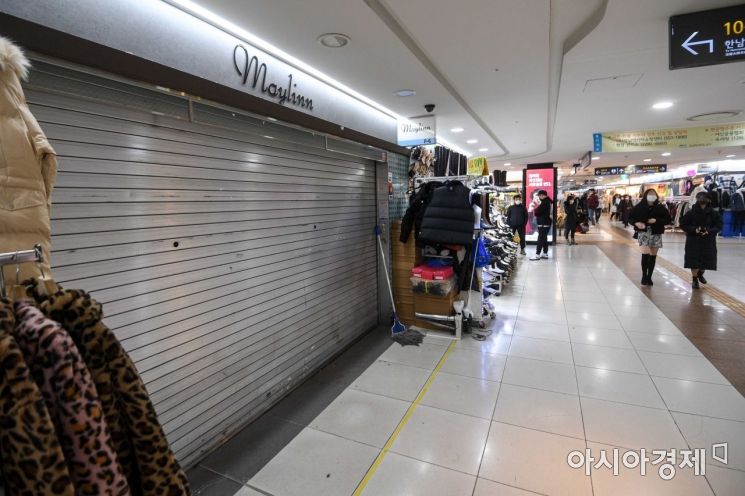 Amid the implementation of strict social distancing measures due to the increase in confirmed cases of the novel coronavirus infection (COVID-19), the underground shopping center at Gangnam Station in Seoul appeared quiet on the 24th, a day before Christmas. Photo by Kang Jin-hyung aymsdream@
Concerns are spreading in the market. Following the forced passage of the revised Housing Lease Protection Act pushed by the ruling party, government, and Blue House in July last year, there is speculation that the Commercial Lease Protection Act may also be pushed through in a similar manner.
On the same day President Moon and Lee mentioned the fair rent theory, Democratic Party lawmaker Lee Dong-joo introduced a bill to amend the Commercial Building Lease Protection Act, known as the 'rent freeze law.'
Article 11 of this law (the right to request an increase or decrease in rent) proposes establishing a 'special case for rent due to infectious disease damage.' If a business is subject to a gathering ban due to an increase in social distancing levels, tenants would not have to pay rent during that period, and if subject to gathering restrictions, rent should be reduced to half or less.
In this case, landlords receiving rent may suffer losses, so the bill also includes provisions allowing financial institutions to defer repayment of interest on secured loans. Earlier, in September, the National Assembly passed an amendment to the Commercial Lease Protection Act allowing small business owners and self-employed people affected by COVID-19 to request rent reductions from landlords.
Experts warn that if the government forcibly intervenes in commercial rent, it will cause fairness issues and disrupt market order. While public institutions or landlords with financial leeway can voluntarily reduce or waive rent, forcing landlords who have invested for livelihood through loans to reduce or waive rent under the banner of fairness is an excessive market intervention that crosses the line.
However, there are also opinions that rent reconsideration is necessary due to the severe market situation. With the prolonged COVID-19 crisis and amendments to the Commercial Lease Protection Act, major commercial districts in Seoul are already on the brink of collapse.
The investment yield on commercial properties, calculated by holding costs and rental income, is also declining. According to the third quarter (July-September) survey of commercial real estate sectors compiled by the Korea Real Estate Board last year, the investment yields for collective commercial buildings, medium-to-large commercial buildings, and small-scale commercial buildings were only 1.15%, 1.14%, and 1.08%, respectively.
These yields are barely enough to cover bank interest payments. Since the fourth quarter of 2019, when yields were recorded at 1.7% to 1.4%, there has been a steady decline. Given this situation, vacancy rates in major Seoul commercial districts are also serious.
In the third quarter of last year, the vacancy rate for medium-to-large commercial buildings in Seoul was 8.5%, up from 7.9% in the second quarter. In Itaewon, the vacancy rate reached a staggering 24.9%, meaning one out of every four stores has closed. Even the Gangnam-daero district, which is said to have no recession, has a vacancy rate of 16.4%.
© The Asia Business Daily(www.asiae.co.kr). All rights reserved.
![From Bar Hostess to Organ Seller to High Society... The Grotesque Con of a "Human Counterfeit" [Slate]](https://cwcontent.asiae.co.kr/asiaresize/183/2026021902243444107_1771435474.jpg)
















