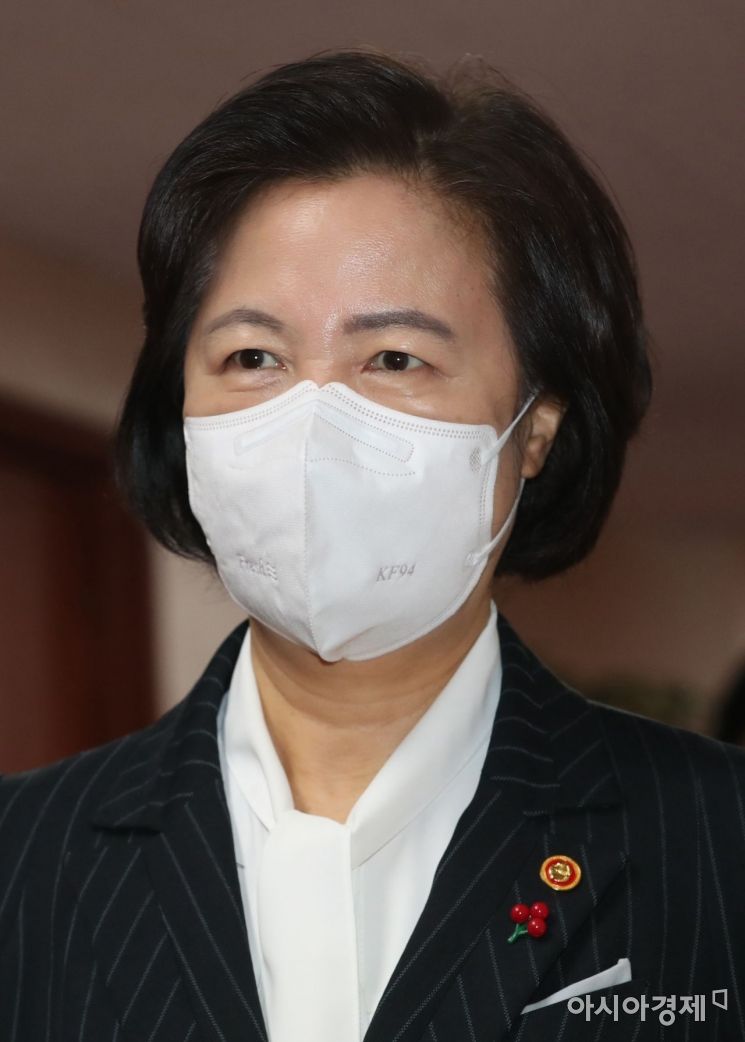
 Minister of Justice Choo Mi-ae is attending the Cabinet meeting held at the Government Seoul Office in Jongno-gu, Seoul on December 29 last year. Photo by Jinhyung Kang aymsdream@
[Asia Economy Reporter Choi Seok-jin] Regarding the allegations of ‘military leave non-return’ involving the son of Minister of Justice Choo Mi-ae, the Seoul Eastern District Prosecutors' Office (Chief Prosecutor Kim Gwan-jung) dismissed all charges against Minister Choo, her son Seo, and her former aide. The Seoul High Prosecutors' Office (Chief Prosecutor Jo Sang-chul), which is handling the appeal case against this non-prosecution decision, stated on the 1st that “we are only investigating the appeal case.”
This was in response to some media reports on the same day claiming that ‘the Seoul High Prosecutors' Office decided to directly reinvestigate the allegations related to Minister Choo’s son from scratch,’ clarifying that no conclusion has been reached yet.
On the same day, the Seoul High Prosecutors' Office stated, “Regarding the article titled ‘Seoul High Prosecutors' Office to reinvestigate Minister Choo Mi-ae’s son’s military leave allegations from scratch’ reported by Chosun Ilbo, the appeal case records were received from the Seoul Eastern District Prosecutors' Office, and we are currently investigating the appeal case. We have neither directly amended the original case dismissed by the Seoul Eastern District Prosecutors' Office nor ordered a reinvestigation.”
They added, “Currently, the case is still under review as a normal appeal case.”
The Seoul High Prosecutors' Office also denied reports that it had submitted a response letter to the office of Kim Do-eup, a member of the People Power Party, stating, “We have not delivered any response letter to Kim Do-eup’s office.”
However, it is known that the Ministry of Justice recently submitted a response letter to Kim’s office, which included that the Seoul High Prosecutors' Office is currently investigating the appeal case, but did not imply that the Seoul High Prosecutors' Office had directly amended the case or ordered a reinvestigation.
Chosun Ilbo reported on the 1st that “it has been confirmed that the Seoul High Prosecutors' Office is directly reinvestigating the ‘military leave non-return allegations’ involving Minister of Justice Choo Mi-ae’s son.”
It also reported that “this means the superior institution, Seoul High Prosecutors' Office, distrusts the no-charge conclusion made by Kim Gwan-jung, the chief of Seoul Eastern District Prosecutors' Office, who is part of the ‘Choo Mi-ae faction.’ The timing of the reinvestigation coincides with Minister Choo’s resignation, leading to interpretations that Prosecutor General Yoon Seok-yeol has launched a counterattack.”
Minister Choo’s son, Seo, served as a KATUSA (Korean Augmentation To the United States Army) soldier assigned to the US 8th Army Korea Support Group, US 2nd Infantry Division Area Unit, and used two sick leaves and one personal leave from June 5 to 27, 2017. Allegations of external pressure from Minister Choo’s side during this process were raised and reported.
The Criminal Division 1 of the Seoul Eastern District Prosecutors' Office (Chief Prosecutor Kim Deok-gon), which investigated the case, decided in September last year to dismiss charges against Minister Choo, Seo, Minister Choo’s former parliamentary aide A, and Seo’s commanding officer B during his military service.
At that time, the prosecution stated regarding Seo’s military absence charge, “The initial sick leave, extended sick leave, and regular leave were all conducted with the approval of the commanding officer. It is difficult to see that Seo had the intention to evade military duties, as he was verbally notified.” Since Seo was already on regular leave on June 25, 2017, when the on-duty soldier who first exposed the case recognized Seo’s non-return, the military absence charge was deemed hard to establish.
According to Article 30 of the Military Criminal Act, military absence is divided into ‘local absence’ and ‘non-return absence’ (when a person legally leaves the unit for leave, outing, or overnight stay but fails to return within the designated time). The prosecution explained that “simple delayed return without the intent to evade military duties does not constitute military absence.”
However, there were criticisms that the prosecution’s investigation results were a ‘blatant leniency investigation.’
During the prosecution investigation, a crucial witness’s testimony was omitted from the records, and the prosecutor and investigator responsible for this were later transferred to other prosecutor’s offices. It was revealed that the prosecution called them back to handle the investigation, which further intensified suspicions.
Above all, criticism arose that it was difficult to expect a fair investigation when Minister Choo promoted Kim Gwan-jung, a former head of the Criminal Division at the Supreme Prosecutors' Office and a representative figure of the ‘Choo (秋) faction,’ to chief of the Seoul Eastern District Prosecutors' Office, entrusting him with the case involving her son.
When Kim served as head of the Criminal Division at the Supreme Prosecutors' Office, he maintained a confrontational stance with Prosecutor General Yoon Seok-yeol in cases such as the ‘media-prosecution collusion’ and defended Minister Choo’s position. Last July, when the Seoul Eastern District Prosecutors' Office reported plans to raid Samsung Seoul Hospital, which issued Seo’s medical certificate, Kim opposed it and allegedly had related documents submitted voluntarily.
Notably, although the prosecution dismissed charges against all involved, the investigation result announcement included KakaoTalk messages exchanged between Minister Choo and her former aide, obtained through digital forensic analysis of the aide’s mobile phone. The messages showed that Minister Choo instructed the aide to contact Seo by providing the contact information of a support officer, and the aide reported to Minister Choo, “I have already requested an extension once more.”
Previously, Minister Choo repeatedly denied in National Assembly government questioning sessions the opposition party’s inquiries such as “Did you intervene in your son’s leave issue?” and “Did you instruct your aide to call?” She even showed anger, saying, “Why would an aide take instructions on such a personal matter?” This evidence contradicts her explanations.
Meanwhile, the People Power Party submitted an appeal last November requesting a reinvestigation of the related allegations against the Seoul Eastern District Prosecutors' Office’s non-prosecution decision.
The Seoul High Prosecutors' Office, which is investigating the appeal case as the superior office of the Seoul Eastern District Prosecutors' Office, may order a reinvestigation or directly investigate the case if it finds the non-prosecution decision inappropriate after review.
Article 10 (Appeal and Re-appeal) Paragraph 1 of the Prosecutors’ Office Act states, “A complainant or accuser dissatisfied with a prosecutor’s non-prosecution decision may appeal in writing to the chief prosecutor of the competent high prosecutor’s office through the local prosecutor’s office or branch office to which the prosecutor belongs. In this case, if the prosecutor of the local prosecutor’s office or branch office recognizes the appeal as valid, they must amend the decision.”
Paragraph 2 of the same article states, “If the chief prosecutor of the high prosecutor’s office recognizes the appeal under Paragraph 1 as valid, they may have a prosecutor belonging to the high prosecutor’s office directly amend the non-prosecution decision of the local prosecutor’s office or branch office. In this case, the prosecutor of the high prosecutor’s office is regarded as performing duties as a prosecutor of the local prosecutor’s office or branch office.”
© The Asia Business Daily(www.asiae.co.kr). All rights reserved.

















