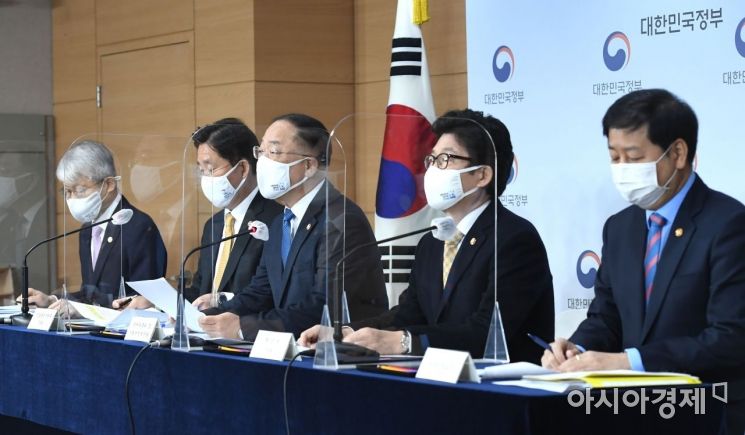
 Hong Nam-ki, Deputy Prime Minister and Minister of Economy and Finance, is holding a joint briefing on the 'Government 2050 Carbon Neutrality Promotion Strategy' at the briefing room of the Government Seoul Office in Jongno-gu, Seoul, on the morning of the 7th. Photo by Kang Jin-hyung aymsdream@
[Asia Economy Reporter Kim Bo-kyung] A plan containing South Korea's greenhouse gas reduction targets for the next decade and its 2050 carbon neutrality promotion strategy has been submitted to the United Nations (UN).
The Ministry of Environment announced on the 31st that it submitted the '2030 National Greenhouse Gas Reduction Target (NDC)' and the '2050 Long-term Low Carbon Development Strategy (LEDS)' to the UN Framework Convention on Climate Change Secretariat through the Ministry of Foreign Affairs. According to the Paris Agreement, greenhouse gas reduction targets and long-term low carbon development strategies had to be submitted within this year.
After the Korean versions of the NDC and LEDS were finalized at the Cabinet meeting on the 15th, the English versions were prepared through review by related ministries for submission to the UN.
The NDC proposes a 24.4% reduction compared to the 2017 emissions (709.1 million tons). It also specifies actively reviewing the possibility of raising the reduction target before 2025.
The LEDS presents South Korea's long-term vision and national strategy to achieve carbon neutrality by 2050.
The five basic directions for carbon neutrality are ▲ expanding the use of cleanly produced electricity and hydrogen ▲ innovative energy efficiency improvements linked with digital technology ▲ promoting the development and commercialization of decarbonized future technologies ▲ promoting sustainable industrial innovation through a circular economy ▲ strengthening the carbon absorption functions of nature and ecology such as forests, tidal flats, and wetlands.
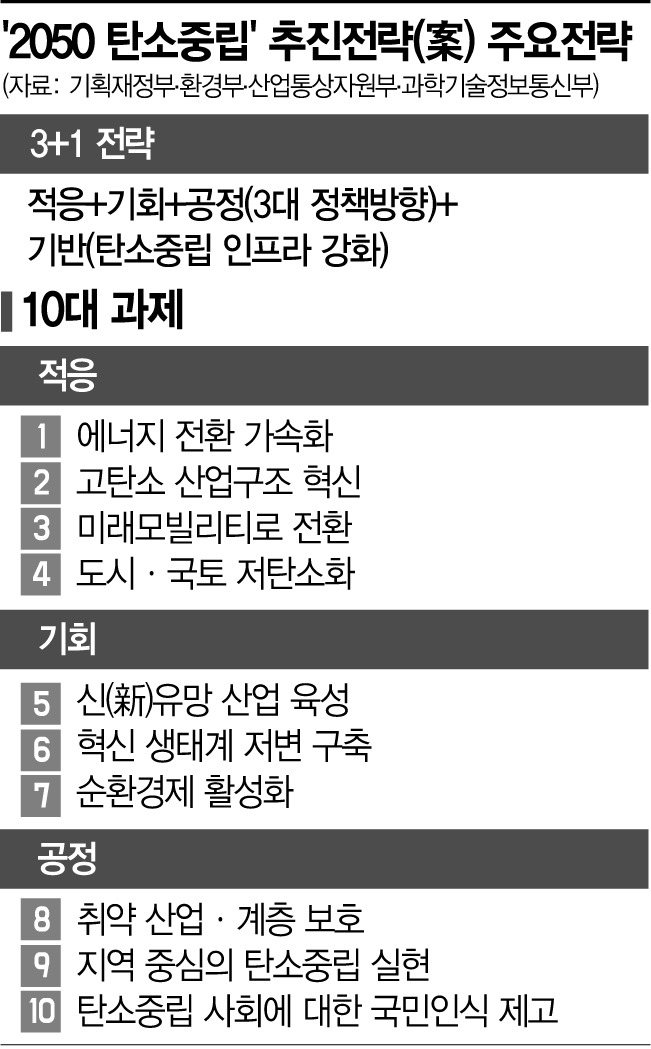
Energy generation centered on fossil fuels will be transitioned through the linkage of renewable energy, green hydrogen, and LNG power generation with CCUS (Carbon Capture, Utilization, and Storage) technology.
The industrial sector plans to build a sustainable industrial ecosystem through future new technologies and resource circulation. It will promote green industrial processes by improving energy efficiency and utilizing renewable energy.
The transportation sector, currently centered on internal combustion engine vehicles, will transition to eco-friendly vehicles such as electric and hydrogen cars, and leverage South Korea's strength as an IT powerhouse to accelerate the popularization of intelligent transportation systems and autonomous vehicles.
Additionally, for existing buildings, the transition to green remodeling will be accelerated. New buildings will aim to increase energy efficiency along with self-production of energy through solar panels and other means.
Furthermore, eco-friendly agriculture and fisheries management and low-carbon distribution will be promoted, and the carbon absorption capacity using natural and ecological resources such as forest management will be enhanced.
An official from the Ministry of Environment stated, "We plan to establish multiple carbon neutrality scenarios next year and gradually prepare key policy tasks by sector," adding, "Regarding the 2030 reduction target, we will strive to raise it within this government based on social consensus."
© The Asia Business Daily(www.asiae.co.kr). All rights reserved.


















