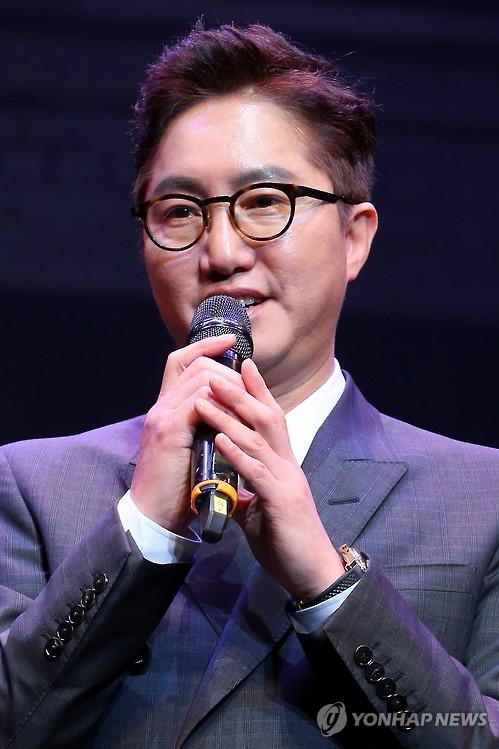
 Shinchunsoo, CEO of Odi Company [Photo by Yonhap News]
[Asia Economy Reporter Byunghee Park] On the 30th, 10 major musical production companies in Korea jointly issued a statement appealing for government policy support. These 10 producers plan to launch the Korea Musical Producers Association to collectively respond to the unprecedented crisis faced by the Korean musical industry due to the spread of COVID-19 and to prepare for the changed performance environment in the post-COVID-19 era.
The joint appeal was made by the 10 production companies of the Korea Musical Producers Association: PMC Production, Shinsicompany, Clip Service, Odi Company, Insight Entertainment, EMK Musical Company, CJ ENM, Acom, Mast Entertainment, and Show Note. These 10 producers intend to unite with small and medium-sized musical producers and regional planners in the future to develop the association like the Broadway League and contribute to the advancement of the Korean musical market.
Shin Chunsu, CEO of Odi Company and chairman of the steering committee, said about the launch of the Korea Musical Producers Association, "Musical producers are coming together to deeply discuss the various crises currently faced. As it is an absolutely necessary time to appeal for government policy support, the association will raise its voice and faithfully serve as a pillar for the future development of the Korean musical industry."
Going forward, the Korea Musical Producers Association plans to develop original musicals that can compete in the global market, discover and nurture new writers and composers, and develop production personnel such as directors, stage, lighting, and costumes to provide opportunities for overseas expansion. They will propose concrete and feasible policies such as institutional improvements, protection of Korean musical export copyrights, and expansion of secondary rights markets. They also plan to find balanced and future-oriented policy and industrial alternatives to establish reasonable production methods for the development of the Korean musical market, including standard contracts for actors and staff, and to continue sustainable co-development with small theater musicals.
The joint appeal released by the Korea Musical Producers Association on this day contains appeals for practical government measures and solutions, including the collapsing Korean musical ecosystem amid the endless pandemic, severe losses due to social distancing measures affecting performances, reconsideration of the two-seat gap seating policy, and negotiations on rental fees for private performance venues.
The full text of the joint appeal by the Korea Musical Producers Association is as follows.
--------------------------------------------------------
Appeal from the Korea Musical Producers Association due to COVID-19
In 2020, due to the unexpected COVID-19, theaters worldwide, including Broadway and the West End, the birthplace of musicals, were shut down. However, despite the prolonged COVID-19 situation, the Korean performance industry did not stop and raised the status of K-quarantine as the only country in the world continuing performances. To keep performances going, all musical workers have united with thorough quarantine and desperate efforts, but due to the endless COVID-19, the Korean musical ecosystem is on the brink of collapse.
The musical industry is currently facing an unprecedented absolute crisis due to COVID-19.
In fact, we are effectively in shutdown.
The production cost of a large-scale musical is approximately 3 billion to 15 billion KRW. The break-even paid occupancy rate to maintain large theater performances is around 60-70%, and surpassing this break-even point amid the COVID-19 weakened consumer sentiment is almost miraculous. According to statistics from February to May, the ticket cancellation rate due to COVID-19 reached 65.9%, delivering a direct blow. Since February, the number of musicals that have been suspended or canceled has decreased by 63.1%, and the estimated loss in performance sales in the first half of the year is about 140 billion KRW. Including the second half, the damage will snowball to an immeasurable figure. Practically, from level 2 social distancing, enormous losses occurred making performance continuation impossible, but producers maintained the stage despite losses to keep promises with audiences, actors, and staff and to sustain the future performance industry. However, with the recent escalation to level 2.5 and the implementation of the two-seat gap seating policy, producers cannot bear the unbearable weight of ongoing losses and face the brink of survival.
On average, about 30 actors and 80-100 staff participate in one large-scale musical with over 1,000 seats, totaling about 200 related workers per production. Approximately 45-50 productions are staged annually, and about 10,000 people work in the industry as their livelihood. When performances are canceled due to COVID-19, these workers have no income. Many actors and staff work as freelancers and often live difficult lives even without COVID-19, but now face severe threats to their livelihoods. The number of unemployed performance workers due to halted performances continues to rise even at this moment.
Due to performance suspensions and social distancing between seats, enormous sunk costs including venue rental fees cause tremendous losses. Policy alternatives for the musical industry must be promptly established.
Excluding labor costs, which make up the largest part of total production costs, the upfront expenses for production are enormous. Especially, venue rental fees are generally required to be paid in full. In private venues, rental fees do not change according to seat availability under COVID-19, and COVID-19 is not recognized as a natural disaster, so force majeure is not acknowledged in rental contracts. Despite repeated reopenings with full refunds and 70%, 50% occupancy due to social distancing upgrades announced by the government, producers have not generated revenue for a significant period, yet private venue rental fees, which constitute a large part of production costs, are strictly enforced according to contracts signed before COVID-19, and this situation continues.
The level 2.5 social distancing two-seat gap seating policy must be reconsidered.
We are deeply grateful to audiences who visit theaters and cooperate thoroughly with quarantine despite difficult circumstances, but producers feel a heavy burden performing under the level 2.5 government policy. Frequent changes in seat operation due to policy shifts with each COVID-19 level increase cause repeated major disruptions in performance progress and ticket management, and the resulting damage directly affects audiences, which is most regrettable and apologetic.
Even in the film industry, a cultural and artistic sector, level 2.5 corresponds to a one-seat gap seating policy in cinemas. Compared to this, in performance venues where eating and drinking are prohibited and no infection transmission cases have occurred, the two-seat gap seating policy is enforced, making the situation effectively harsher and more brutal than a shutdown.
All producers, actors, staff, and audiences are united in sharing sacrifices to overcome difficulties, but the two-seat gap seating policy at level 2.5 is effectively a cruel hope torture that makes performance continuation impossible. This policy leads to unbearable production cost losses, making it difficult to sustain performances.
The Korean musical ecosystem is collapsing. Now, more than ever, urgent government policy support and cooperation are needed. Official seat allocation announcements according to social distancing adjustments are necessary, and we earnestly request reconsideration of the two-seat gap seating policy at level 2.5. Additionally, measures to adjust private venue rental fees according to distancing levels or practical support are urgently needed.
The musical industry is sharing pain together to overcome the current crisis. We believe this is the last desperate effort not only to save the current performance industry amid the pandemic but also to prevent the future industry's collapse. We also seek the public’s generous understanding. The performance industry is doing its best to prevent the national crisis from spreading, and we ask the government to pay a little more attention and consider policies to prevent the collapse of the performance industry.
Practical government support and policy financing for musical industry damage relief must be implemented.
Financial and policy support is urgently needed to keep performances going using government support as momentum. First and foremost, practical systems and financial support for production companies that have led the musical industry and employment must be implemented. Temporary VAT exemptions and other tax benefits should encourage production, and emergency funding using the Ministry of Culture, Sports and Tourism’s 2021 budget resources is necessary. In the future, government-guaranteed low-interest loans, musical funds for investment activation, and other reasonable and practical government policies and support will sustain the musical industry in crisis and lead to the globalization and development of Korean musicals.
We hope COVID-19 ends soon and that we wisely overcome this crisis so everyone can enjoy cultural life freely and gain strength from the warm emotions and comfort conveyed by a musical. Thank you.
December 30, 2020
Korea Musical Producers Association
© The Asia Business Daily(www.asiae.co.kr). All rights reserved.
















