Port and Fishing Harbor Development and Fishing Ground Development Are the Most Frequent
[Sejong=Asia Economy Reporter Ju Sang-don] The Ministry of Oceans and Fisheries announced on the 30th that 217 cases of marine spatial suitability consultations were conducted this year. This is more than ten times the number from last year (21 cases).
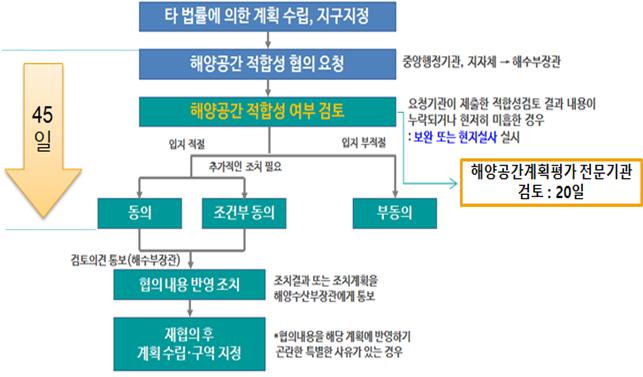
Marine spatial suitability consultation is a system where central administrative agencies or local governments consult in advance with the Ministry of Oceans and Fisheries when establishing plans for the use and development of various marine spaces such as marine tourism complexes, ports, fishing harbors, and marine energy development, or when designating districts or regions. It has been implemented since April 2019 to prevent indiscriminate development of marine spaces and to preserve marine ecosystems.
In the first year of the system's implementation last year, since it was introduced in April, the number of suitability consultations was only 21. However, this year, consultations have been actively conducted since the first half of the year, with 78 cases in the first quarter and 76 cases in the second quarter, totaling 217 cases of marine spatial suitability consultations for the year.
Hwang Jun-seong, Director of the Marine Spatial Policy Division at the Ministry of Oceans and Fisheries, said, "Through marine spatial suitability consultations, unnecessary marine reclamation plans have been reduced or abolished, plans that do not conform to their intended use have been changed, and the scale of excessively estimated fishing harbor facilities has been adjusted. This is evaluated as playing a key role as a vanguard in inducing the rational use and development of marine spaces."
In fact, through suitability consultations, the Ministry of Oceans and Fisheries reduced the scale of large-scale waterfront facility reclamation at Port A, induced changes in plans for installing fishing harbor facilities within the port area of Port B, and guided plan changes to an appropriate scale through reassessment of wharf facilities at Port C, thereby preventing indiscriminate development and enabling efficient project progress.
Looking at the types of plans subject to marine spatial suitability consultations this year, 'Port and Fishing Harbor Development' such as fishing harbor maintenance and fishing village renewal accounted for 107 cases (49.3%), the highest. 'Fishing Ground Development' followed with 97 cases (44.7%). In addition, 'Marine Resource Use and Development' related to industrial sites recorded 9 cases (4.1%), and 'Mineral and Gravel Extraction' related cases were 4 (1.9%).
By requesting institution, local governments such as cities and provinces accounted for the most with 179 cases (82.5%). This was followed by the Ministry of Oceans and Fisheries and regional maritime affairs and fisheries offices with 30 cases (13.8%), and other central administrative agencies with 8 cases (3.7%).
© The Asia Business Daily(www.asiae.co.kr). All rights reserved.
![Clutching a Stolen Dior Bag, Saying "I Hate Being Poor but Real"... The Grotesque Con of a "Human Knockoff" [Slate]](https://cwcontent.asiae.co.kr/asiaresize/183/2026021902243444107_1771435474.jpg)
















