Prosecutor's Office Bill Followed by Lawmaker Hwang Unha Preparing National Investigation Agency Bill
New Dedicated Agency to Handle Six Major Crimes Including Corruption and Economic Offenses
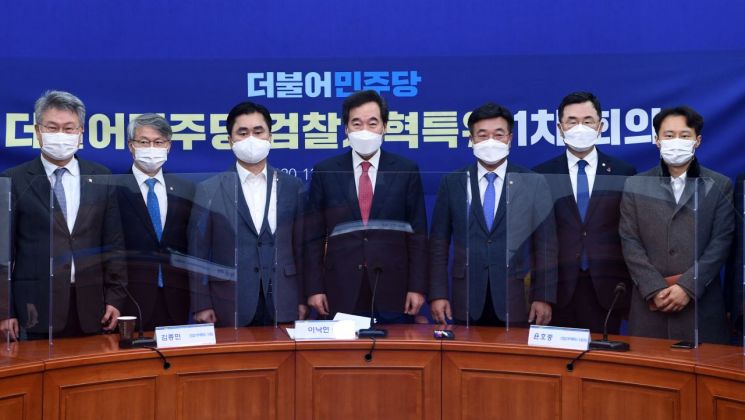
[Asia Economy Reporter Park Cheol-eung] Following the bills to abolish the Prosecutor's Office and establish the Public Prosecution Office, the ruling party is consecutively proposing a bill to establish the 'National Investigation Agency.' The goal is to pass it during the extraordinary session of the National Assembly in February next year. If this happens, the organization called the 'Prosecutor's Office' and the profession of 'prosecutors who conduct investigations' will disappear. However, fierce opposition from the opposition party is expected regarding this series of movements called 'Prosecutorial Reform Season 2,' predicting intense controversy.
On the 30th, Representative Hwang Unha of the Democratic Party's Prosecutorial Reform Special Committee said in a phone interview with Asia Economy, "We are preparing a bill to establish the National Investigation Agency to transfer investigations of the six major crimes (corruption, economic crimes, public officials, elections, defense projects, and major disasters) currently handled by the prosecution. We plan to propose it as early as mid-next month," adding, "While we need to discuss it thoroughly to avoid hasty decisions, it is desirable to pass it by the February extraordinary session if possible."
The Democratic Party, which launched the Prosecutorial Reform Special Committee the day before, has begun preparing specific measures under the policy of completely removing the prosecution's investigative authority. The bills to abolish the Prosecutor's Office Act and the Public Prosecution Office Act, led by Representative Kim Yong-min, serve as the foundation. Representative Kim said in a phone interview, "Various ideas are being actively discussed at the special committee level, and it should be handled as early as the beginning of next year."
Since the by-elections for the Seoul and Busan mayoral offices will be held on April 7 next year, the ruling party may consider February, before the full-scale election campaign begins, as the optimal time to pass the 'Prosecutorial Reform Season 2' bills.
There is also a plan to completely remove the prosecution's investigative authority and distribute investigative powers to existing agencies such as the police, the National Election Commission, and the Fair Trade Commission according to the type of crime. However, currently, more weight is being placed on establishing a new investigative agency.
Representative Hwang said, "There seems to be consensus within the party that all investigative authority cannot be entrusted to the police," adding, "Establishing a new agency is the simplest method compared to existing agencies. Some opinions suggest separating only the economic sector to form a 'Serious Economic Crime Investigation Agency.'"
There is ongoing consideration regarding placing the National Investigation Agency under the Prime Minister's Office, the Ministry of the Interior and Safety, or as an entirely independent agency like the Corruption Investigation Office for High-ranking Officials (CIO), rather than under the Ministry of Justice. The U.S. Federal Bureau of Investigation (FBI) is under the Department of Justice, while the UK's National Crime Agency (NCA) is under the Home Office.
Representative Hwang said, "Unlike other countries, Korea's Ministry of Justice has strong prosecutorial influence, and since there is a possibility that a former prosecutor may become the Minister of Justice in the future, it must be excluded."
Once the Public Prosecution Office Act is enacted, the name 'prosecution' will disappear, and prosecutors' duties will be limited to filing and maintaining public prosecutions. Under the premise of the National Investigation Agency not belonging to the Ministry of Justice, prosecutors may join the investigation agency but will be newly hired as investigators, not as prosecutors.
Representative Hwang said, "We want to create a simple model to avoid complicating the discussion," adding, "We will separate and utilize the prosecution's personnel, budget, and office buildings, and create the National Investigation Agency's organization to correspond to the court system, just like the prosecution currently does."
This means investigative agencies will be dispersed among the CIO, National Investigation Agency, National Police, and Autonomous Police. Representative Kim Yong-min said, "Various ideas are being discussed as ways to prevent side effects caused by the concentration of investigative authority, power, and influence."
© The Asia Business Daily(www.asiae.co.kr). All rights reserved.

















