The Identity Is the Male Squid's Sperm Mass 'Jeonghyeop'
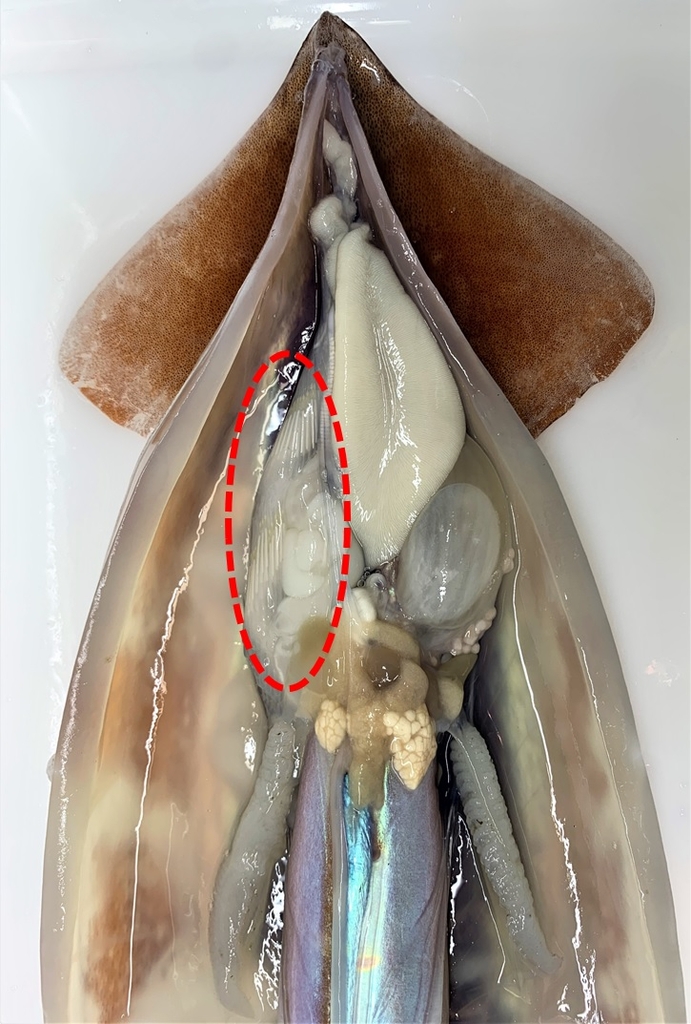
[Asia Economy Reporter Kim Bong-ju] The identity of the squid parasite recently causing controversy online has been confirmed as a sperm mass of the male squid.
On the 29th, the National Institute of Fisheries Science clarified the rumor that "parasites are found in squid," stating, "Most of them are not parasites but sperm masses of male squid."
Recently, a post saying "I found parasites while cleaning the internal organs of a male squid. I can't eat it" was uploaded on an online community, attracting attention. The object mistaken for a 'squid parasite' was a white, elongated-shaped mass.
This seems to have occurred due to an increase in squid catches this year and the rise in people cooking squid at home amid the impact of the novel coronavirus disease.
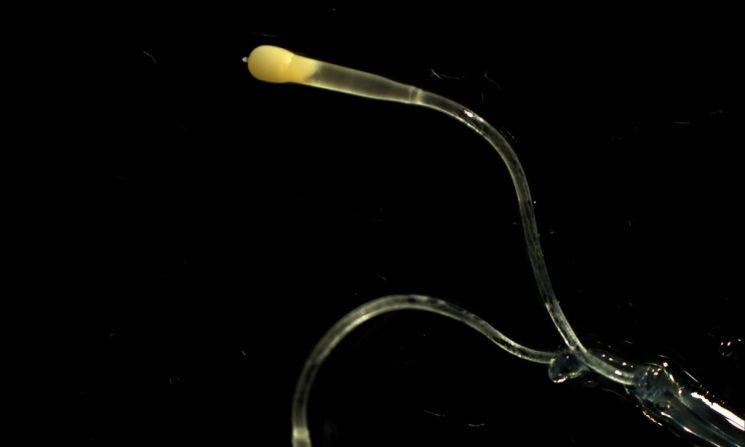 Enlarged view of a male squid's reproductive organ. Photo by National Institute of Fisheries Science.
Regarding this, Dr. Song Hye-jin of the National Institute of Fisheries Science's East Sea Fisheries Research Institute explained, "What pops out while cleaning the squid's internal organs is not a parasite. It is the sperm mass called 'jeonghyeop' of the male squid."
Interestingly, the sperm mass of the male squid has a biological structure that bursts easily with slight touch.
This is because squids reproduce through copulation, unlike fish.
The male squid uses a specialized arm called the hectocotylus, which we recognize as one of the legs, to perform copulation.
The male takes out the mature jeonghyeop from its body and attaches the sperm to the oral membrane around the female's mouth. Fertilization then occurs along with spawning after one to two months.
An official from the Fisheries Science Institute said, "The shape of the jeonghyeop can easily be mistaken for a parasite at first glance, but watching the video provided by the institute will resolve any doubts."
© The Asia Business Daily(www.asiae.co.kr). All rights reserved.
![User Who Sold Erroneously Deposited Bitcoins to Repay Debt and Fund Entertainment... What Did the Supreme Court Decide in 2021? [Legal Issue Check]](https://cwcontent.asiae.co.kr/asiaresize/183/2026020910431234020_1770601391.png)

















