5,625 Corporate-to-Individual Transactions Last Month... 48.8% Increase from Previous Month
Stronger Selling Pressure in Provinces... Seoul Remains Steady
Despite Higher Tax Burden, Judged as 'Long-Term Gain'
 The biggest issue of 2020 was undoubtedly the real estate frenzy. Despite the government's bold promises to control housing prices no matter what, apartment prices soared to unprecedented heights, striking a blow to the hearts of ordinary citizens without homes. The apartment nightscape filling Seoul feels bitterly poignant. I hope the real estate market stabilizes in the new year of 2021. Photo by Yoon Dong-joo doso7@
[Asia Economy Reporter Lee Chun-hee] Although the government has significantly strengthened regulations on corporate ownership of housing, there are concerns that this is instead causing a concentration in Seoul. While high-intensity measures have increased various tax burdens to encourage sales, the selling trend is concentrated in provincial areas.
According to the Ministry of Land, Infrastructure and Transport on the 29th, the number of apartment transactions nationwide last month where corporations sold to individuals was 5,625, a 48.8% increase compared to 3,781 in the previous month. After reaching a yearly high of 6,586 in July and maintaining around 4,000 transactions for three consecutive months, related transactions surged last month.
The selling trend by corporations appears to be due to the government’s plan to sharply increase tax burdens on corporate real estate holdings and transactions starting next year. First, the comprehensive real estate holding tax rate will rise significantly. From next year, for those owning three or more houses, individuals will be subject to different tax rates ranging from 1.2% to 6.0% depending on the housing price, whereas corporations will be uniformly taxed at a 6% comprehensive real estate tax rate. For those with two or fewer houses, individuals face tax rates between 0.6% and 3.0%, but corporations will be uniformly subject to the highest rate of 3.0%. From next year, corporate-owned houses will no longer benefit from the basic deduction of 600 million KRW (900 million KRW for one house), and the 'tax burden cap' designed to prevent sudden tax increases will also be excluded.
Transaction taxes will also increase significantly. Until this year, when corporations transfer housing, capital gains are included in corporate income and taxed at corporate tax rates of 10% to 25%, with an additional 10% tax only on the capital gains. However, from next year, the additional tax rate will jump from 10% to 20%. For example, if the capital gain is 500 million KRW, currently individuals are taxed at 40%, and corporations at 30% (20% corporate tax plus 10 percentage points), but from next year, both individuals and corporations will be taxed at 40%.
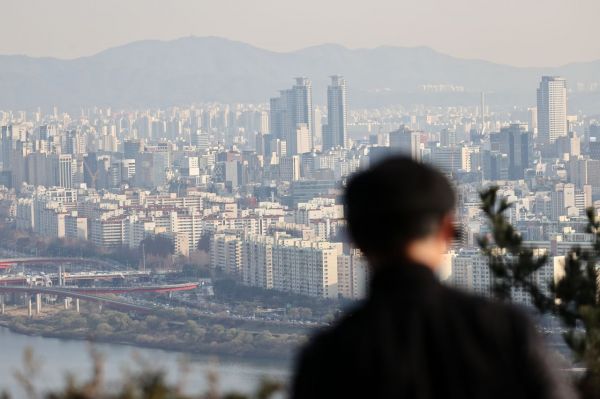 View of apartments in Songpa and Gangnam areas from Maebongsan Mountain in Seoul. [Image source=Yonhap News]
However, questions remain about the effectiveness of these government regulations. The selling trend is concentrated only in provincial areas, while sales in Seoul are actually slowing down. This is analyzed as a result of the government’s enforcement of the 'Three Lease Laws,' which caused a rental crisis in Seoul and the metropolitan area, pushing Seoul housing prices back into an upward trend. Even with increased tax burdens, landlords have found room to pass these costs onto tenants, and there is a long-term expectation of additional capital gains.
In fact, the increase in corporate listings in the metropolitan area, where housing prices are rapidly recovering, has been slight. Last month, the number of apartments sold by corporations to individuals in Seoul was 180, down from 182 in the previous month. After the government’s June 17 and July 10 real estate measures, sales in July were 303 units, then decreased to ▲162 in August ▲136 in September ▲182 in October ▲180 in November, showing a slowdown. Gyeonggi Province also saw only a 2.2% increase to 1,232 units in November compared to the previous month.
On the other hand, in Gwangju, the number of apartments sold by corporations to individuals last month was 849, a staggering 961.3% increase from 80 units the previous month. Sejong also saw a 616.7% increase compared to the previous month, with ▲Gangwon up 151.9% ▲Ulsan up 121.2%, showing a rapid increase in sales of properties located in provincial areas.
An industry insider said, "Recently, especially in Seoul, the ability to pass tax burdens through monthly rent conversion combined with expectations of rising housing prices has led many corporations to hold off on selling their housing from a long-term perspective."
© The Asia Business Daily(www.asiae.co.kr). All rights reserved.


















