Karaoke 3 Million Won · Cafe 2 Million Won... 3rd Disaster Relief Fund to Be Paid in January
Some Advocate 'Universal Payment' Instead of 'Selective Payment'
Experts Say "Disaster Relief Fund Is Not Related to Economic Stimulus"
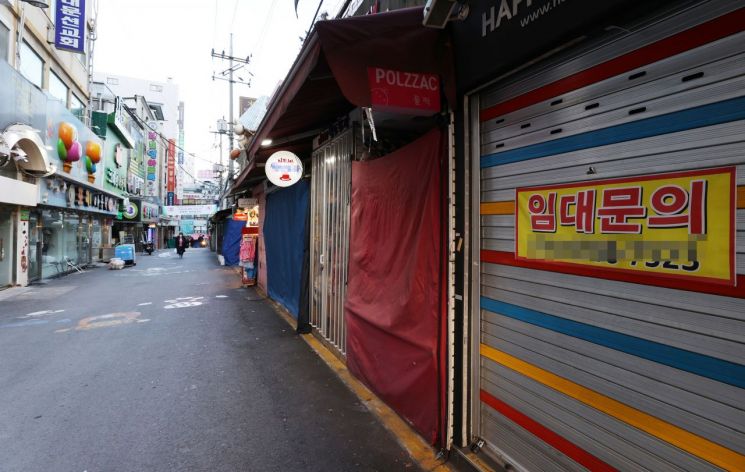 Amid the ongoing impact of the novel coronavirus infection, Namdaemun Market in Seoul appeared quiet on the morning of the 15th. [Image source=Yonhap News]
[Asia Economy Reporter Heo Midam] "Isn't it only the workers at workplaces who are losing out?", "Everyone is having a hard time, so why selective payments?"
The government has decided to provide a third round of disaster relief funds of up to 3 million won in January to small business owners and self-employed individuals struggling due to the impact of the novel coronavirus infection (COVID-19), but controversy over its effectiveness is growing.
The goal is to reduce the economic burden of those whose sales have decreased due to COVID-19, but there are criticisms that fairness is an issue as the scale of store sales and other factors are not taken into account. Experts emphasize selective payments based on sales, saying disaster relief funds have little effect on economic stimulus.
On the 27th, the ruling party, government, and Blue House held a high-level party-government-Blue House meeting and decided to provide a uniform payment of 1 million won to all small business owners and self-employed people affected by the spread of COVID-19 and the government's high-intensity quarantine measures, with an additional 1 million won for businesses with gathering restrictions and 2 million won for businesses with gathering bans.
Accordingly, businesses subject to gathering bans such as entertainment facilities, karaoke rooms, gyms, and academies will receive 3 million won, and businesses subject to gathering restrictions such as cafes, restaurants, PC rooms, beauty salons, study rooms, and marts will receive 2 million won. General businesses whose sales have decreased due to COVID-19 will receive 1 million won in support.
The problem lies in the inevitable fairness controversy because the scale of sales and other factors are not considered. In other words, the damage situation varies greatly depending on the industry and business method, but the same amount is supported to the stores. For example, restaurants thriving with delivery services and restaurants struggling with management difficulties both receive the same amount of support.
As a result, some voices are calling for universal payments rather than selective payments to ease the economic burden on the public. It is pointed out that compensation is needed not only for small business owners and the self-employed but also for workers who lost their jobs and unpaid leave workers affected by COVID-19.
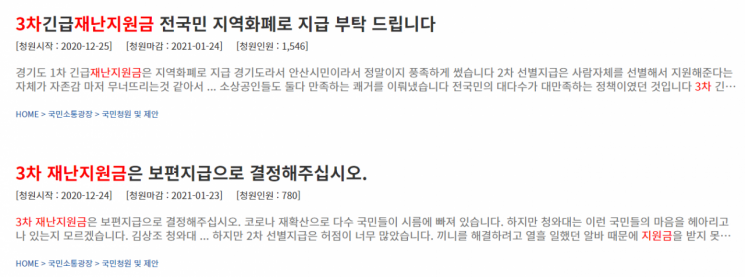 Petitions requesting universal distribution of the third disaster relief fund are being posted one after another on the Blue House petition board. Photo by Blue House National Petition Board capture.
On the Blue House's national petition board, petitions demanding universal payments for the third disaster relief fund are continuously being posted.
One petitioner, who identified themselves as a citizen of Ansan City, Gyeonggi Province, posted a petition titled "Please provide the 3rd emergency disaster relief fund to all citizens as local currency" on the 25th.
He pointed out, "Gyeonggi Province provided the first emergency disaster relief fund as local currency, and I spent it abundantly," adding, "I did not even apply for the second selective payment because the very idea of selecting people to support seemed to destroy their self-esteem."
He continued, "When the first payment was made in local currency with a mandatory consumption period of three months, both local currency consumers and small business owners were satisfied, achieving a great success," emphasizing, "From the 3rd emergency disaster relief fund, please provide it to all citizens as local currency."
 A bustling street in Songpa-gu, Seoul. The photo is unrelated to specific expressions in the article. [Image source=Yonhap News]
Also, the issue arises because whether the store is owner-occupied or not is not distinguished. In other words, not only is the burden of rent not reflected, but small business owners who own their stores can also receive support funds if they meet conditions such as gathering bans.
As a result, some criticize that the criteria for the third disaster relief fund are ambiguous.
A 30-year-old office worker, Mr. A, said, "Small business owners are naturally struggling, but who is not struggling in this situation?" He pointed out, "These days, when you order food through delivery apps, waiting about an hour and 30 minutes is standard. Doesn't that mean business is going well? People like this should be excluded from receiving support funds." He added, "It's very unfair that some people receive support funds while others do not, even though we all pay the same taxes."
Experts suggest that the third disaster relief fund should be provided based on clear criteria. Professor Kim Taeg-gi of Dankook University's Department of Economics said, "It is safe to say that disaster relief funds are unrelated to economic stimulus," adding, "'Disaster relief' means providing money to people in desperate situations. People will spend that money, but saying that disaster relief funds stimulate the economy is almost nonsensical."
He continued, "Currently, the third disaster relief fund is not paid in proportion to the scale of damage to stores. Local governments should have conducted prior monitoring," emphasizing, "There is a need to provide support funds more selectively."
© The Asia Business Daily(www.asiae.co.kr). All rights reserved.
![User Who Sold Erroneously Deposited Bitcoins to Repay Debt and Fund Entertainment... What Did the Supreme Court Decide in 2021? [Legal Issue Check]](https://cwcontent.asiae.co.kr/asiaresize/183/2026020910431234020_1770601391.png)

















