KOSPI Doubles in 9 Months
Frowning After Taking on Inverse Volume
[Asia Economy Reporter Oh Ju-yeon] Individual investors who invested in inverse exchange-traded funds (ETFs) that profit when the index falls are disappointed. This contrasts sharply with the KOSPI index, which fell to the 1400 level in March due to the impact of the novel coronavirus disease (COVID-19) but has nearly doubled in nine months, breaking record highs day after day. Inverse investors, who saw stock prices plummet without a chance to reduce their holdings, will face the new year with the full 4 trillion won they net purchased this year still tied up in the market.
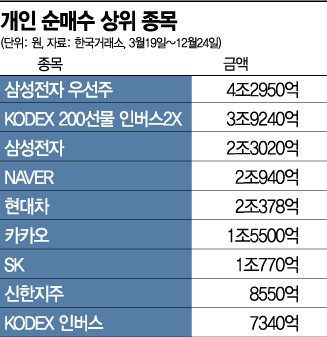
On the 28th, the KOSPI reached an intraday high of 2834.59, setting a new record. Considering that on March 19, the market fell to an intraday low of 1439.43 due to COVID-19, this represents nearly a twofold increase. The rise in the stock market this year was led by individual investors. As of the closing on the 24th, individuals purchased a total of 63 trillion won worth of stocks in the KOSPI and KOSDAQ markets this year. Especially whenever the market wavered due to COVID-19 risks, individuals bought up the shares that foreigners and institutions were offloading, supporting the index from falling and earning the nickname 'Donghak Ants.' During this period, individuals bought large-cap stocks such as Samsung Electronics and Hyundai Motor, as well as representative non-face-to-face (untact) stocks like NAVER and Kakao, generating profits on these stocks. However, in index betting, they invested inversely and suffered huge losses, showing a contrasting pattern.
From March 19 to the 24th of this month, the stock most purchased by individuals was Samsung Electronics preferred shares (4.295 trillion won), followed by the KODEX 200 Futures Inverse 2X ETF (3.924 trillion won). This amount even exceeds the third most net purchased stock, Samsung Electronics (2.302 trillion won). Individuals have been buying Samsung Electronics shares since the price was in the 40,000 won range, selling when prices rose and buying again when they fell. From March to May, when Samsung Electronics was in the '40,000 won range,' individuals bought 2.2 trillion won worth of shares; from June to July, near the '60,000 won range,' they net sold 2.5 trillion won, realizing gains. Then, from August to October, individuals bought 2 trillion won worth of shares in the mid-to-late 50,000 won range and sold 1.1 trillion won worth in the late 60,000 won range in November.
Stocks that individuals net purchased, including Samsung Electronics, were traded profitably as the index rose, but inverse ETFs remain heavily held after large-scale accumulation. Since the index has risen sharply since March, investors have not had the opportunity to reduce their holdings, resulting in an unintended forced holding situation.
In the case of KODEX 200 Futures Inverse 2X, the intraday price peaked at 12,815 won on March 19 but dropped to 2,675 won as of 10 a.m. on the same day, a decline to one-fifth of its value. The KODEX Inverse ETF also halved, falling from 9,325 won to 4,395 won during the same period. The total amount individuals invested in these two products reached 4.66 trillion won.
The greater loss in KODEX 200 Futures Inverse 2X is due to its structure of tracking the daily return of the KOSPI 200 index at -2 times. While a 1% decline in the index yields a 2% profit, because it tracks 'daily' returns, the cumulative return over a period may not correspond to twice the return. Since profits are made only when the index declines and losses can occur during sideways markets, this structure is generally unsuitable for long-term investment.
However, individual investors who experienced the inverse ETF price surge from 5,500 won during the March COVID market to double in a flash have entered the inverse market late, betting on further declines, and have held for nine months. Market experts predict the KOSPI will reach the 3,000 level next year, suggesting that losses for inverse investors may continue.
Lee Eun-taek, a researcher at KB Securities, said, "The KOSPI, which surged sharply in the short term, may enter a short-term lull around the end of the year and early next year due to the exhaustion of factors such as vaccines and additional stimulus measures. However, due to strong liquidity and investor sentiment, it is difficult for stock prices to plunge sharply without 'definite bad news,' and expectations remain for a market rally event in January next year." He added, "The upward trend is expected to continue in 2021."
© The Asia Business Daily(www.asiae.co.kr). All rights reserved.

















