Opposition to US Troop Reduction Limit Clauses Citing Unconstitutionality
Veto Threat on Budget Bill Raises 'Shutdown' Concerns
[Asia Economy New York=Correspondent Baek Jong-min] U.S. President Donald Trump vetoed the National Defense Authorization Act (NDAA) as he left for Christmas vacation in Florida. President Trump strongly opposed the bipartisan restrictions included in the NDAA on reducing U.S. troops stationed in South Korea, Germany, and Afghanistan, calling them "unconstitutional." He also hinted that he might veto the budget bill, raising concerns about a federal government "shutdown."
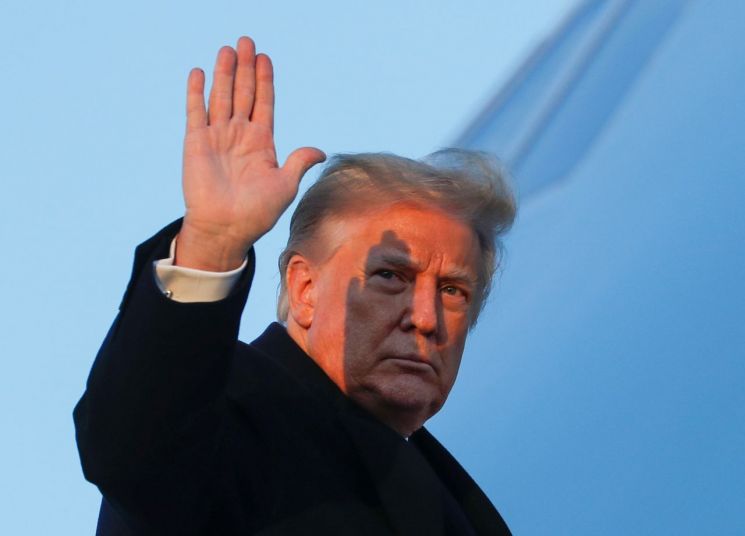
According to U.S. media including The New York Times, on the 23rd (local time), President Trump sent a message to Congress stating, "Unfortunately, this law does not include important national security measures. This law is a 'gift' to China and Russia," explaining his reasons for the veto. President Trump had already indicated his intention to veto the NDAA. He particularly criticized Congress for bipartisan restrictions on his efforts to reduce overseas U.S. troop deployments.
Regarding this, President Trump asserted, "The decision on how many troops to deploy and where to deploy them, including Afghanistan, Germany, and South Korea, is made by the President. Congress should not infringe on this authority." Although President Trump’s dissatisfaction with U.S. forces in South Korea has been known through various channels, it is unusual for him to publicly mention the reduction of U.S. troops in South Korea.
Since President Trump took office, the U.S. Congress has inserted provisions in the NDAA to restrict reductions of U.S. troops in South Korea, fearing attempts to reduce them. The provisions also include restrictions on reductions of U.S. troops already announced in Germany and Afghanistan by the Trump administration.
President Trump also cited the repeal of Section 230 of the Communications Decency Act linked to the NDAA and the budget for renaming U.S. military bases and facilities named after generals of the "Confederate States," who defended slavery, as reasons for opposing the NDAA.
However, the prevailing analysis is that President Trump’s veto will have little effect. To override a presidential veto, a two-thirds majority vote is required in both the Senate and the House of Representatives. Since the NDAA has already passed with this majority and the ruling Republican Party has indicated it will pass the bill again through a re-vote, the override is considered certain.
The New York Times predicted that the bill vetoed by President Trump would be the first to be nullified, stating, "President Trump is tearing the Republican Party apart." The Republican Party is also anxiously awaiting whether President Trump will veto the $900 billion stimulus bill, which he opposed the day before. If President Trump refuses to sign this bill as well, the linked U.S. government budget for next year will not be implemented, leading to a federal government shutdown on the 29th.
© The Asia Business Daily(www.asiae.co.kr). All rights reserved.
![User Who Sold Erroneously Deposited Bitcoins to Repay Debt and Fund Entertainment... What Did the Supreme Court Decide in 2021? [Legal Issue Check]](https://cwcontent.asiae.co.kr/asiaresize/183/2026020910431234020_1770601391.png)