Mentioning Legislative Research Service Report
Financial Services Commission Emphasizes Need for Financial Supervisory Service Independence
Plan to Submit Measures to Strengthen Independence to National Assembly
[Asia Economy Reporter Minji Lee] Yoon Seok-heon, Governor of the Financial Supervisory Service (FSS), once again emphasized the need to reform the supervisory system. He pointed out that the current financial supervisory system is dualized, making independent supervision difficult, which not only exacerbates financial accidents but also inevitably leads to a loss of trust among financial consumers.
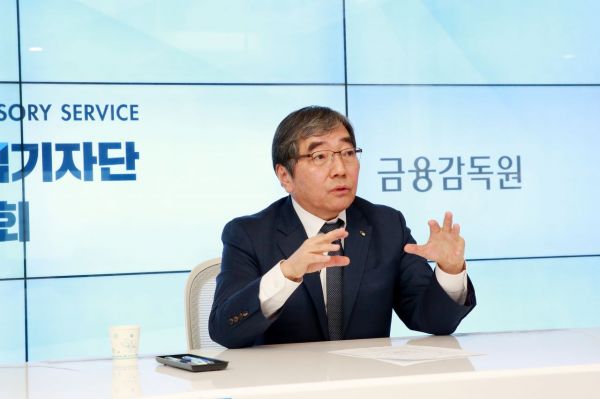
On the 23rd, Governor Yoon stated at the year-end meeting with the press corps, “From the perspective of those in charge of supervision, I believe it is important to gain consumer trust and ensure the healthy development of the financial industry,” adding, “To achieve this, the financial supervisory system must be reformed. Currently, the responsibility between supervisory policy and execution is unclear, making financial accidents such as private equity fund incidents inevitable.”
Looking at the current supervisory system, the Financial Services Commission (FSC) is responsible for establishing financial industry and supervisory policies, while the FSS handles supervisory execution functions such as inspections and sanctions. The current financial supervisory system was established in 2008; prior to that, the Ministry of Strategy and Finance’s Financial Policy Bureau handled financial policy, and the Financial Supervisory Commission was responsible for supervision. Now, the FSS is subordinated to the FSC, and supervisory tasks are carried out according to the FSC’s decisions. Even if manpower and budget are needed, execution cannot proceed immediately without FSC approval, making timely responses to a series of private equity fund incidents like Lime and Optimus difficult.
On this day, Governor Yoon said that to prevent financial accidents in advance and restore consumer trust, the supervisory system must be reformed in two directions. The relationship between financial industry policy and supervisory policy should be reset to maintain at least minimal independence, and furthermore, organic operation between policy execution should be ensured. Governor Yoon explained, “(Through reform) on-site information occurring in the market should be immediately reflected in policy, and the intent of the policy should be well incorporated into the execution process to reach the market.”
He further emphasized that not only budget independence but also supervisory system independence must be achieved. He said, “Budget independence is part of the supervisory system; even if budget independence exists, it does not mean there is independence of the supervisory system,” adding, “Budget independence without supervisory system independence is absolutely insufficient.” The FSS has not yet submitted related proposals to the National Assembly regarding the reform of the financial supervisory system. It is reported that various alternatives, including overseas cases, are being reviewed.
Governor Yoon has consistently raised his voice about the need to reform the supervisory system. During this year’s National Assembly audit, when Song Jae-ho, a member of the Democratic Party of Korea, pointed out that “the FSS is a nominally independent organization under the jurisdiction of the FSC, and this structure has ultimately exacerbated financial accidents,” Yoon responded, “There are parts where authority and conditions do not match responsibility well,” and explained, “Measures to secure the independence of financial supervision, such as budget independence like overseas cases, are necessary.”
Governor Yoon reiterated the necessity of reforming the supervisory system by referring to a report from the National Assembly Legislative Research Office that financial policy and supervisory policy should be separated. Recently, the Legislative Research Office stated, “There is a possibility that financial policy may overwhelm supervisory policy, and supervisory policy may be used as a means to support economic measures,” and “Since the supervisory fees, which are the FSS’s revenue source, can be passed on to financial consumers rather than approved by the FSC, it is reasonable for the FSS budget to be controlled by the National Assembly.”
Finally, Governor Yoon said, “In March this year, the IMF mentioned in its financial sector evaluation of our country that it is necessary to grant the Financial Supervisory Service more operational and execution authority,” and added, “During the remainder of my term, I will strive to secure supervisory means and boost the morale of FSS employees.”
© The Asia Business Daily(www.asiae.co.kr). All rights reserved.

















