AI Ethics Standards Established with the Goal of 'AI for Humanity'
Three Core Principles and Ten Key Requirements for AI Development and Use
Human Dignity, Social Public Good, and Technological Purposefulness
[Asia Economy Reporter Han Jinju] The government has established ethical guidelines for artificial intelligence (AI). To realize human-centered AI, it set "humanity" as the highest value and established standards that can be referenced at every stage of AI development and utilization.
On the 23rd, the Ministry of Science and ICT and the Korea Information Society Development Institute announced at the 4th Industrial Revolution Committee plenary meeting that they have prepared "Artificial Intelligence (AI) Ethical Guidelines" centered on people to present directions for AI development and utilization.
The AI ethical guidelines include three fundamental principles and ten requirements to be observed at every stage of AI development and utilization. As AI technology rapidly spreads, the question of "how to utilize it" has become a global issue, and organizations such as the OECD, the European Union, companies, and research institutions have announced AI ethical principles. Since April, the Ministry of Science and ICT has drafted ethical guidelines aiming for "AI for humanity" through the AI Ethics Research Group and finalized the standards after public hearings and other processes.
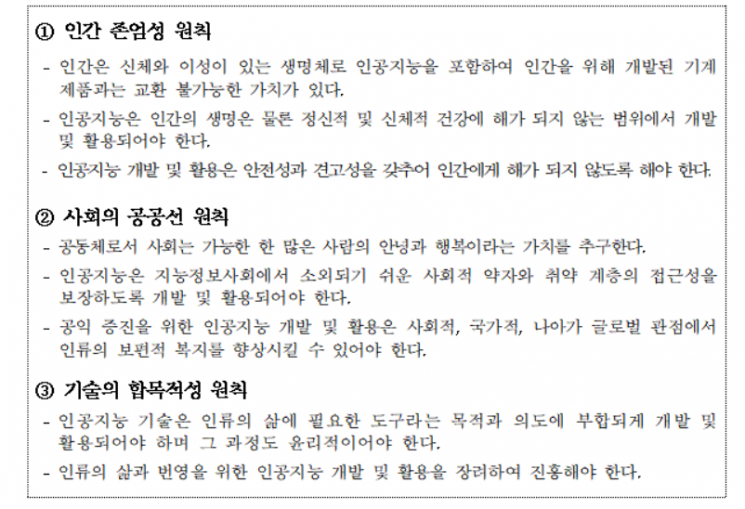
The three fundamental principles of the AI ethical guidelines are ▲Respect for human dignity ▲Principle of social public good ▲Principle of technological purposiveness. AI must be developed within the scope that does not harm human life, mental and physical health, guarantees accessibility for socially vulnerable groups, and can enhance universal human welfare. It must be developed in accordance with the purpose of being a tool necessary for human life, and the process must also be ethical.
The ten core requirements to implement the three principles are ▲Human rights protection ▲Privacy protection ▲Respect for diversity ▲Non-infringement ▲Publicness ▲Solidarity ▲Data management ▲Accountability ▲Safety ▲Transparency. It is required to minimize misuse of personal information without infringing on human rights and freedoms, respect diversity by minimizing bias and discrimination based on gender, age, region, race, etc., and not use AI for purposes that directly harm humans, which is the "non-infringement" requirement. Accountability means clarifying the responsibilities among AI designers, developers, service providers, and users, and safety requires that users can control operations if errors or infringements occur during AI utilization.
The Ministry of Science and ICT plans to promote practical measures such as developing checklists for developers, suppliers, and users to raise awareness of the ethical guidelines and preparing AI ethics education programs. Going forward, they intend to continuously discuss ethical issues with various stakeholders based on the AI ethical guidelines and further develop the standards.
Choi Ki-young, Minister of Science and ICT, said, "Since the draft ethical guidelines were announced on November 27 and after broad public opinion gathering through public hearings, the AI ethical guidelines have been established. We will strive to make these guidelines the starting point for societal discussions and deliberations on AI ethics and a platform for moving toward human-centered AI."
© The Asia Business Daily(www.asiae.co.kr). All rights reserved.

















