High-Intensity Loan Regulations Block Access for Employees and Others
Concerns Over Insolvency Due to Balloon Effect in Secondary Financial Institutions Like Savings Banks
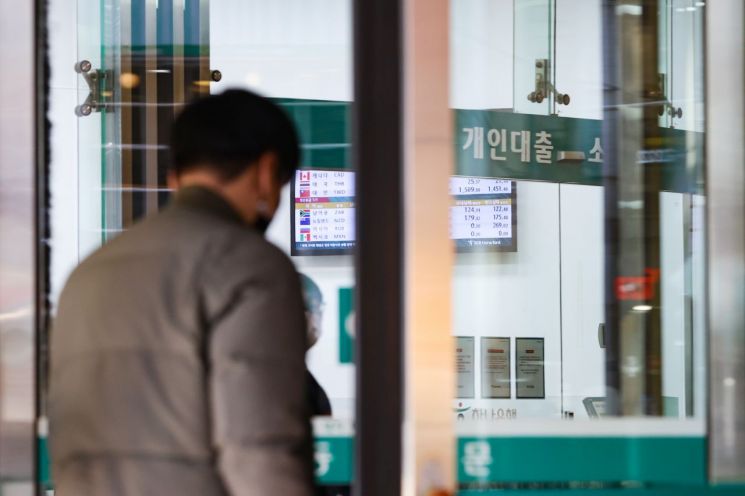
[Asia Economy Reporters Kim Hyo-jin and Gong Byung-sun] Kim Dong-woo (44), who works as the sole breadwinner at a mid-sized company in Seoul, sought credit loan consultations at several commercial banks, including his main bank, earlier this month to finance the remaining payment for an apartment purchase contract he signed last month. However, he was dismayed to find out that the maximum loan amount available was only about 20 to 30 million KRW.
He had planned to cover the remaining payment by combining additional credit loans with previously borrowed funds for living expenses, but recent tightened loan regulations have blocked this route. To complete the contract as scheduled, he must pay the remaining balance within this month. Some banks have even closed credit loan products for salaried workers within just a day or two. Kim lamented, "I can't even stretch my finances for investment, so to secure urgently needed funds, I have no choice but to look into high-interest savings banks."
Due to increasingly stringent loan regulations in the banking sector, many real demand borrowers are struggling to secure quick funds. The government calls this a 'pinpoint regulation' aimed at managing household loans overall and preventing the rapidly increasing liquidity from flowing recklessly into real estate and stock markets. However, the scope and intensity of the regulations are so broad and severe that, according to voices from banking circles, damage to real demand borrowers unrelated to speculation or investment is inevitable.
On the 23rd, a representative from a major commercial bank in City A revealed, "We have seen a sharp increase in inquiries asking 'Which bank should I go to? Please tell me how,' after confirming that credit loan limits for living and operating funds have been drastically reduced or suspended." They added, "Some customers raise their voices, saying, 'Is it reasonable not to provide loans just because, even though we've had a main banking relationship for decades and have no credit issues?'"
It is also known that some banks require partial repayment before extending overdraft accounts. For example, to extend a 30 million KRW overdraft account, about 20% must be repaid upfront. A representative from Bank B said, "The demand from high-income, high-credit professionals is not considered urgent cash needs," and lamented, "There are many inconveniences for ordinary office workers, which puts banks in a difficult position."
The loan thresholds at major commercial banks are rising almost daily. Shinhan Bank has decided to suspend all household credit loans except for low-income financial products through branches from today until the end of the year. KB Kookmin Bank will block all new household credit loans exceeding 20 million KRW until year-end. Woori Bank, NH Nonghyup Bank, and internet-only banks such as KakaoBank and K Bank are also tightening sales of loan products excluding low-income financial products by suspending main credit loan products, reducing limits, or raising interest rates.
Loan Tightening Temporarily Halts Growth Trend
As a result of these loan tightening measures, the growth of credit loans in the banking sector has sharply slowed this month. As of the 22nd, the outstanding balance of credit loans at the five major commercial banks?KB Kookmin, Shinhan, Hana, Woori, and NH Nonghyup?stood at 133.8234 trillion KRW. This is an increase of 130.9 billion KRW compared to the end of last month, which is almost negligible considering that the increase last month exceeded 4.8 trillion KRW compared to October.
There are concerns about a balloon effect where demand shifts from banks to secondary financial institutions. A representative from a savings bank explained, "Since the second half of the year, there has been a trend of expanding loan operations, which seems to be absorbing demand in conjunction with banking sector loan regulations." According to financial authorities, household loans in the secondary financial sector increased by 4.7 trillion KRW last month compared to the previous month, marking the largest increase since December 2016.
© The Asia Business Daily(www.asiae.co.kr). All rights reserved.
![Clutching a Stolen Dior Bag, Saying "I Hate Being Poor but Real"... The Grotesque Con of a "Human Knockoff" [Slate]](https://cwcontent.asiae.co.kr/asiaresize/183/2026021902243444107_1771435474.jpg)
















