Operation with Pump Energy Over 100 Times Lower
Implementation of Brillouin Laser on Semiconductor Chip
Improvement of Measurement Accuracy for Ultra-Precise Sensors Such as Distance and Rotation Detection Sensors for Autonomous Driving
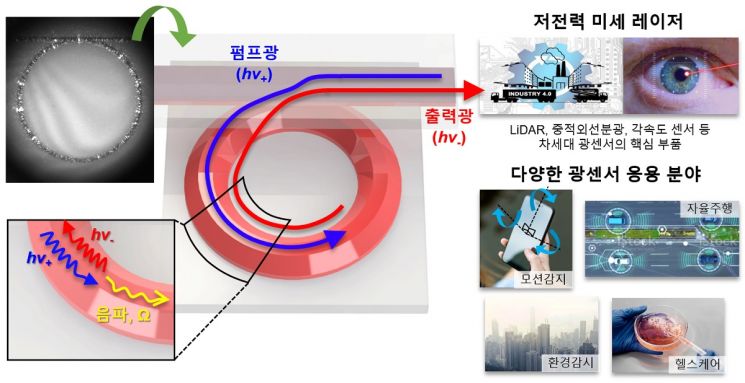
[Asia Economy Reporter Junho Hwang] An ultra-compact Brillouin laser with characteristics such as low power consumption and low noise has been developed. It is expected to contribute to the development of next-generation ultra-precise optical sensors to be used in autonomous vehicles and other applications.
The Korea Advanced Institute of Science and Technology (KAIST) announced on the 22nd that a joint research team consisting of Professors Hanseok Lee and Yonghee Lee from the Department of Physics, Professor Muhan Choi from Kyungpook National University, and Professor Deokyong Choi from the Australian National University recently published these research results in the international journal Nature Communications.
The joint research team developed a Brillouin laser based on chalcogenide glass, which exhibits Brillouin scattering phenomena hundreds of times more effectively than materials primarily used before.
Chalcogenide glass has a fundamental weakness in that it is chemically unstable, making it difficult to shape on a chip through etching. However, the research team solved this problem by developing a new fabrication technique in which optical components spontaneously form during the deposition process. By appropriately forming the underlying structure using silicon oxide, which is easy to process with current semiconductor manufacturing technology, depositing chalcogenide glass on top allows high-performance optical components to spontaneously form. This fabrication technique can be compared to how the shape of snow piled on a roof in winter is determined by the shape of the roof, so by adjusting only the roof's shape without directly touching the snow, the desired snow shape can be obtained.
Using this self-developed fabrication technique, the research team succeeded in implementing a high-performance Brillouin laser based on chalcogenide glass as an ultra-compact optical component on a semiconductor chip. They also demonstrated that laser operation is possible with pump energy more than 100 times lower than previous records.
A representative of the joint research team said, "Miniaturization and low-power operation are essential elements for commercialization," adding, "The development of the Brillouin laser light source by the joint research team is expected to be widely used in next-generation optical sensor development, significantly improving not only the distance measurement required for autonomous driving but also the sensitivity of rotational inertia sensors." He further emphasized, "The new process technique developed during the research is very meaningful because it enabled the introduction of various materials that could not be used before into the field of micro-optical devices, and it is a fundamental technology with great potential for widespread future use."
Professor Hanseok Lee, the corresponding author leading this research, predicted, "Chalcogenide glass can also be applied to the mid-infrared band where various molecular absorption lines exist, expanding its application range to fields such as environmental monitoring based on molecular spectroscopy and healthcare." Another corresponding author, Professor Deokyong Choi, emphasized, "The process technique developed during the research enables heterogeneous bonding of various materials and can be applied to high-efficiency quantum light sources and quantum memory, which are core components of the future quantum internet."
Scientific Terms
Brillouin scattering: A phenomenon where light interacts with a medium to generate and scatter acoustic phonons. The scattered light experiences a frequency downshift corresponding to the energy of the acoustic phonons, and stimulated emission?i.e., replication of light with identical characteristics?is possible, making it useful for laser construction.
© The Asia Business Daily(www.asiae.co.kr). All rights reserved.

















