Proactive Support for Overcoming the COVID-19 Crisis and Successful Implementation of the 'Korean New Deal'
[Asia Economy Reporter Kim Cheol-hyun] Proactive support will be provided through 5.4 trillion KRW worth of small and medium enterprise (SME) policy funds next year to overcome the COVID-19 crisis and successfully promote the 'Korean New Deal.'
The Ministry of SMEs and Startups (Minister Park Young-sun) announced on the 23rd the 2021 SME policy fund operation plan worth 5.41 trillion KRW and stated that applications for policy funds will be accepted online starting from the 24th. SME policy funds are lent to SMEs with excellent technology and business feasibility at long-term (5 to 10 years) and low-interest rates (1.85 to 2.65%) compared to commercial banks, and are operated by dividing the growth stages into startup phase with 2.25 trillion KRW, growth phase with 2.41 trillion KRW, and re-leap phase with 750 billion KRW.
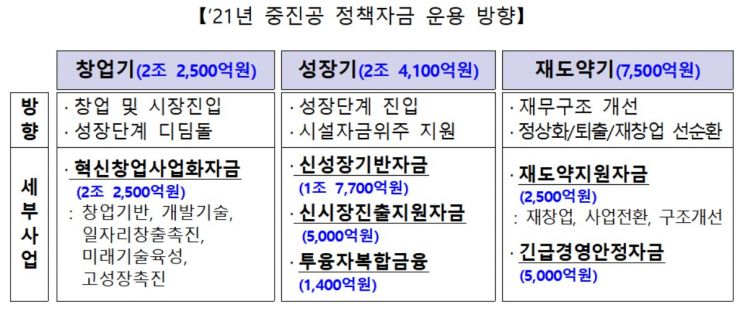
The Ministry explained that the 2021 policy funds aim to strengthen the role of a catalyst for the successful promotion of the 'Korean New Deal' centered on SMEs and startups through ▲strengthened support for core areas such as the Korean New Deal ▲customized support by company type ▲and demand-centered system improvements.
◆ 3 trillion KRW support for core areas including the Korean New Deal = To this end, 3 trillion KRW, which is 57% of the total, will be allocated to core areas such as the Korean New Deal. A total target amount of 2.6 trillion KRW was set for the Korean New Deal, including 2 trillion KRW for the digital and green New Deal sectors and 600 billion KRW for the regional balanced New Deal sector. The total target amount system does not create dedicated funds exclusively for specific sectors but assigns a total target amount without fund segregation, continuously managing it to allow priority support for the relevant sectors.
Specifically, 8 billion KRW will be provided for digital facility investments such as equipment automation and the introduction (operation) of remote work systems to create digital and non-face-to-face work environments, and 6 billion KRW will be allocated to companies introducing automation facilities for production efficiency based on information and communication technology (ICT), such as smart factory dissemination projects and production site digitalization projects, focusing support on the digital New Deal sector. A dedicated fund will be newly established to support green technology commercialization, introduction of environmental and low-carbon production facilities, purchase of raw and subsidiary materials, and introduction of low-carbon and energy-efficient facilities, and 6 billion KRW will be provided to the green New Deal sector, including environmental industries, green technology certified companies, and green New Deal-related technologies.
3 billion KRW will be provided to companies in regional leading industries (48 sectors) and regulatory free zones (24 zones), which have been reorganized around digital, green, and high value-added sectors. In particular, a separate track will be operated to discover and support excellent companies such as regional innovation leading companies driving the regional balanced New Deal. Also, local SME offices will cooperate with local governments and regional innovation institutions to discover representative projects by region and provide 2 billion KRW to companies targeted by these projects. 4 billion KRW will be provided to enhance the competitiveness of women-owned businesses, and 800 billion KRW will be allocated to social economy enterprises with low financial accessibility.
◆ Strengthened customized support by company type to overcome COVID-19 = 1.1 trillion KRW will be provided to startup companies less than 7 years old for product production and production facility introduction costs. In particular, dedicated funds will be operated for youth startups under 39 years old (160 billion KRW), senior technology startups (50 billion KRW), and non-face-to-face sector startups (100 billion KRW). 500 billion KRW will be provided to companies creating and maintaining jobs and nurturing talent, and 290 billion KRW will be allocated for commercialization of government R&D technologies and patented technologies. 360 billion KRW will be provided to future technology holding companies and high-growth companies with 3 to 10 years of business history.
Also, 1.17 trillion KRW will be provided to growth companies with more than 7 years of business history for construction costs of factories, distribution·logistics facilities, and initial operating costs required after facility introduction, and 600 billion KRW will be allocated for companies targeted by smart factory dissemination projects and companies introducing automation facilities. 1.4 trillion KRW will be provided for acquisition of convertible bonds (CB), redeemable convertible preferred stocks (RCPS), and corporate bond issuance (P-CBO method) for companies with high technological performance and future value.
2.5 trillion KRW will be provided to support exports of existing domestic companies and globalization of export companies, and 100 billion KRW of dedicated funds for K-export strong SMEs leading Korean exports such as K-quarantine and digital export companies, and 150 billion KRW of dedicated funds for companies operating in the severely affected materials, parts, and equipment sectors due to COVID-19 will be newly established. 1 trillion KRW will be provided to companies approved for business transformation plans, and a pilot project will be operated to support companies planning business transformation through mergers and acquisitions (M&A) to pursue new industries. 1 trillion KRW will be provided to technology innovation-type re-startup companies, and the scope of structural improvement funds, which were previously limited to working capital, will be improved to also support facility funds.
◆ Demand-centered system improvements such as non-face-to-face services = In 2021, the Ministry plans to significantly reduce spatial constraints and time required for document preparation for SMEs by digitally transforming policy funds, thereby enhancing convenience for companies applying for funds. Through operating online consultation channels, consultation concentration will be dispersed, and 24-hour consultation services will be supported to cover vulnerable consultation times. A mobile application platform equipped with an AI chatbot will be built, where simple inquiries will be handled by the AI chatbot, and specialized consultations requiring fund applications will be handled by dedicated call center staff. Documents directly submitted by customers, such as financial transaction certificates, will be simplified to two types by 2022, excluding financial transaction certificates and shareholder registers. In the second half of the year, an electronic contract system enabling non-face-to-face and electronic loan agreements regardless of time and place will be built and operated.
A stepwise company diagnosis system and liquidity crisis relief measures will also be prepared. The company diagnosis system will be reorganized to focus on prevention and treatment, providing stepwise diagnosis, customized improvement solutions, and linking policy projects according to the company's difficulties. In particular, system improvements will be made for marginal companies and companies exceeding debt ratios that face difficulties in financing due to financial structure deterioration caused by the COVID-19-induced economic downturn. Marginal companies, which are loan-restricted companies, will also be given opportunities to apply for funds and supported through separate evaluations. The debt ratio criteria applied to startups under 5 years will be improved to apply to startups under 7 years, expanding support for startups, and a third-party re-evaluation relief system will be introduced to provide re-examination opportunities for companies failing company evaluations among those exceeding debt ratios.
Applications for 2021 policy funds will start online from the 24th, and pre-consultations will be conducted at 32 regional headquarters of the Small and Medium Business Corporation from the 28th. Pre-consultations will mainly be conducted in a non-face-to-face manner due to COVID-19. Minister Park Young-sun of the Ministry of SMEs and Startups said, "Despite the very difficult situation in all areas such as economy and society due to COVID-19, SMEs and startups have led achievements such as the highest economic growth rate among OECD countries, the boom in the KOSPI and KOSDAQ markets, and export recovery, and the power to overcome COVID-19 and lead the new 4th industrial revolution also lies with SMEs and startups," adding, "policy funds will actively support SME and startup startups, growth, exports, and re-leaps centered on innovative growth areas such as the digital and green New Deal and regional balanced New Deal."
© The Asia Business Daily(www.asiae.co.kr). All rights reserved.
![User Who Sold Erroneously Deposited Bitcoins to Repay Debt and Fund Entertainment... What Did the Supreme Court Decide in 2021? [Legal Issue Check]](https://cwcontent.asiae.co.kr/asiaresize/183/2026020910431234020_1770601391.png)















