[Asia Economy Reporter Kim Jong-hwa] The paper industry experienced mixed outcomes due to the COVID-19 pandemic. Industrial paper manufacturers producing packaging box paper saw gains, while printing and specialty paper companies faced difficulties.
With increased time spent indoors due to remote work during COVID-19, the online shopping and food delivery service markets expanded significantly. According to Statistics Korea's online shopping trends, as of the end of October, online shopping food service transaction volume increased by 71.6% compared to the same period last year, food and groceries by 43.8%, and home appliances, electronics, and telecommunications devices by 39.6%.
As demand for industrial paper such as white cardboard used for food and product packaging boxes surged explosively, related companies showed positive results. Representative domestic white cardboard companies include Hansol Paper, KleanNara, Seha, and Hanchang Paper, while corrugated paper companies include Asia Paper, Taelim Packaging, and Shindaeyang Paper.
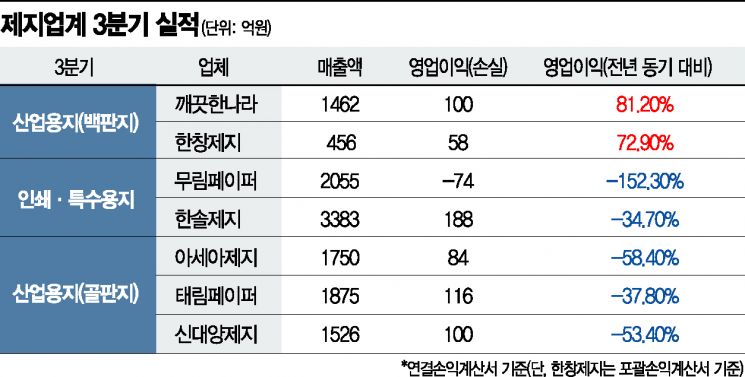
KleanNara reported Q3 sales of 146.2 billion KRW and operating profit of 10 billion KRW, with operating profit increasing by 81.2%. Seha posted cumulative Q3 sales of 142.1 billion KRW and operating profit of 18.4 billion KRW, with sales up 8.8% year-on-year and operating profit nearly doubling. Hanchang Paper also recorded cumulative Q3 sales of 130.6 billion KRW and operating profit of 12.5 billion KRW, a 50.7% increase compared to the previous year.
The 'Big 3' corrugated paper manufacturers?Asia Paper, Taelim Paper, and Shindaeyang Paper?also performed reasonably well. Asia Paper's cumulative Q3 sales reached 521.9 billion KRW, a 0.1% increase from last year. Operating profit was 41.9 billion KRW, down 27.2%. Corrugated paper companies are gradually improving profitability, supported by a surge in parcel volumes, and are considered to have overcome challenges such as two fires.
Industrial paper producers were also fortunate. China’s suspension of waste paper imports, the raw material for corrugated and white cardboard, led to a drop in raw material prices. Pulp prices fell 27.1% from 788,000 KRW per kg last year to 574,000 KRW in Q3. During the same period, waste paper prices decreased 12.7% from 211,000 KRW per kg to 184,000 KRW. While raw material prices declined, delivery prices rose, creating a favorable market environment.
On the other hand, printing and specialty paper companies were hit hard by COVID-19. Reduced foot traffic related to economic activities, decreased demand for specialty papers such as receipts and label stickers due to reduced dining out and travel, and lower demand for printing paper caused by remote work and decreased sales of educational materials and books due to online classes led to a sharp decline in printing paper demand.
Hansol Paper, the top domestic paper company, achieved good results in the white cardboard sector but saw Q3 sales decline year-on-year due to poor performance in printing and specialty paper, which accounts for 70% of its paper business division. Murim Paper, which mainly produces printing paper, also recorded an earnings shock in Q3.
However, the industry is confident about a potential rebound in performance next year. Hansol Paper’s diversified business portfolio, including printing paper, industrial paper, and specialty paper, allows it to respond proactively to changing market conditions. Additionally, last month, Hansol acquired Hansol EM as a subsidiary, laying the groundwork for entry into the eco-friendly management business.
Murim Paper has recently shown outstanding results with eco-friendly products such as 100% biodegradable paper cups and eco-friendly paper cushioning materials. As eco-friendly products become mainstream, it is expected to secure a competitive advantage.
An industry insider said, "With the expectation that COVID-19 will continue long-term next year, economic downturn trends will persist, and factors such as China’s easing of waste paper import restrictions and exchange rate volatility will be variables. Therefore, diversified portfolios and multifaceted efforts such as eco-friendly product development are necessary for each company."
© The Asia Business Daily(www.asiae.co.kr). All rights reserved.
![User Who Sold Erroneously Deposited Bitcoins to Repay Debt and Fund Entertainment... What Did the Supreme Court Decide in 2021? [Legal Issue Check]](https://cwcontent.asiae.co.kr/asiaresize/183/2026020910431234020_1770601391.png)















