Handling Mainly Small and Emergency Loans
Major Banks Cease Services One After Another
Concerns Over Funding Difficulties for Living Expenses
Hana Bank Reduces Discount Rates on Mortgage and Jeonse Loans
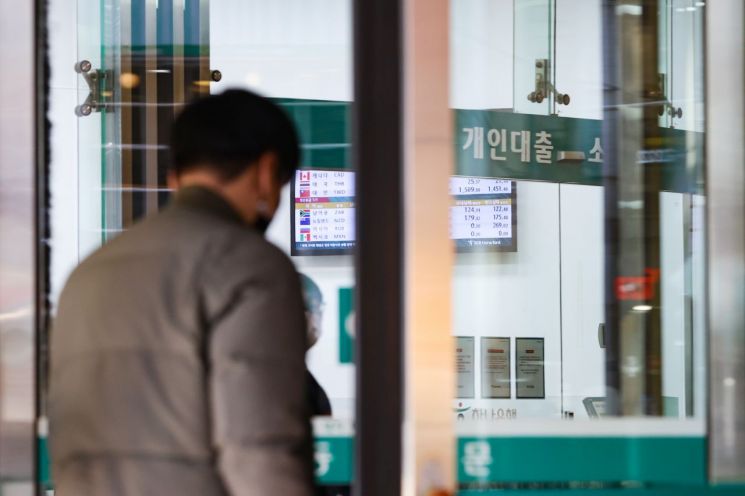
[Asia Economy Reporters Kangwook Cho, Hyojin Kim] As financial authorities tighten household loans in the financial sector toward the end of the year, banks are consecutively suspending loan product offerings or completely blocking unsecured loans. Consequently, concerns are growing among borrowers who urgently need new loans before year-end.
According to the banking sector on the 22nd, Shinhan Bank decided that from the 23rd until the end of the year, it will not accept new applications for most household unsecured loan products at branches, except for low-income financial products. New loans are expected to resume on January 4th next year.
However, consultations completed before the implementation date (the 23rd) or low-income financial products related to COVID-19 will continue to be processed normally after this date.
A Shinhan Bank official said, "This is a measure to prevent the expansion of risks due to the increase in household loans," adding, "Loans for urgent living stabilization funds necessary for livelihood maintenance will be operated normally after reviewing the loan purpose."
Shinhan Bank had earlier suspended its main non-face-to-face product for office workers, the 'Solpyeonhan Office Worker Unsecured Loan,' starting from the 15th. As a result, from tomorrow until the end of the year, both face-to-face and non-face-to-face unsecured loans will effectively be blocked.
KB Kookmin Bank announced that from today until the end of the year, it will not approve household unsecured loans exceeding 20 million KRW. Exceptions include loan requests with desired dates after January 4th next year, loan documents initially submitted before the 21st, and low-income financial support unsecured loans (such as KB Sa-itdol Mid-Interest Loan, KB Saehee Hope Holssi II, KB Happiness Dream Loan II).
A KB Kookmin Bank official explained, "This is a measure to suppress risk expansion toward the end of the year."
Hana Bank decided from today to reduce preferential interest rates by 0.3 percentage points on some mixed mortgage loans and Korea Housing Finance Corporation Jeonse loans. When preferential rates decrease, the final interest rate paid by borrowers increases accordingly.
Additionally, Hana Bank plans to implement regulations such as lowering the basic credit loan limit for professionals by 100 million KRW as early as the end of this month.
A Hana Bank official said, "Due to the increase in household debt, we adjusted the preferential interest rates on some mortgage and Jeonse loan products as a preemptive response to potential risks."
Woori Bank stopped selling the 'Woori WON Office Worker Loan' from the 11th, and NH Nonghyup Bank is tightening loans by reducing the limit on non-face-to-face unsecured loan products by 50 million KRW. Internet-only bank KakaoBank suspended new 'Minus Account Unsecured Loans' for high-credit office workers starting from the 17th.
As of the 22nd, the outstanding balance of personal unsecured loans at the five major commercial banks?KB Kookmin, Shinhan, Hana, Woori, and NH Nonghyup?stood at 133.8234 trillion KRW, an increase of 130.9 billion KRW from the end of last month. Compared to the increase of over 9.4 trillion KRW in November, the growth has virtually come to a halt.
The loan freeze is expected to continue for some time next year. Hong Nam-ki, Deputy Prime Minister and Minister of Economy and Finance, stated at the 12th Real Estate Market Inspection Ministerial Meeting held at the Government Seoul Office, "We will continuously monitor to ensure that measures announced to strengthen management of high-value and high-income unsecured loans are implemented without disruption," adding, "We will manage household liquidity by preparing an 'Advanced Household Debt Management Plan' to induce credit screening based on repayment ability in the first quarter of next year."
He also indicated plans to review measures such as household loan management plans including unsecured loans, application of borrower-level total debt service ratio (DSR) to high-value and high-income unsecured loans, and strengthening post-management of high-value unsecured loans.
© The Asia Business Daily(www.asiae.co.kr). All rights reserved.
![User Who Sold Erroneously Deposited Bitcoins to Repay Debt and Fund Entertainment... What Did the Supreme Court Decide in 2021? [Legal Issue Check]](https://cwcontent.asiae.co.kr/asiaresize/183/2026020910431234020_1770601391.png)















