Professor Sim Youngseok of Silla University, Corresponding Author in Domestic Research Team Achieves World-Class Gas Sensitivity
Using 3D Aligned Porous Nanostructures... Enables Harmful Gas Detection for Mobile and IoT Applications
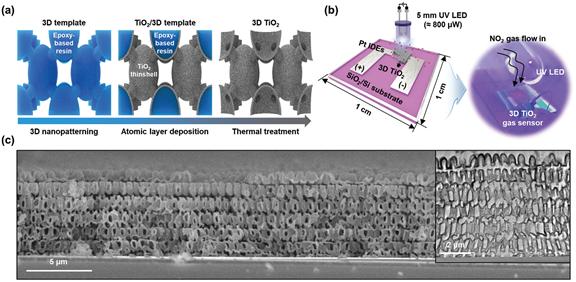 Research illustration of a low-power high-performance gas sensor developed by a domestic research team including Professor Youngseok Shim of the Department of New Materials Engineering at Silla University.
[Asia Economy Yeongnam Reporting Headquarters Reporter Kim Yong-woo] A domestic research team including Professor Shim Young-seok of the Department of Materials Science and Engineering at Silla University (President Kim Chung-seok) has attracted attention by developing a low-power, high-performance gas sensor operated by light.
Professor Shim Young-seok participated as the corresponding author in this research. The study was conducted together with Professor Jeon Seok-woo of KAIST, Professor Jang Ho-won of Seoul National University, Dr. Seo Jun-min, and Dr. Cho Dong-hwi of Northwestern University.
Among various types of sensors, semiconductor gas sensors based on metal oxides have excellent sensitivity. They can also be made small and have the advantage of low production costs.
However, since they operate at high temperatures, a heater made of precious metals must be installed to supply heat. The high power consumption and heat generation of the heater have been major challenges in applying gas sensors to mobile devices and the Internet of Things.
The research team solved this problem using near-field nanopatterning technology. They formed a three-dimensional ordered porous nanostructure and precisely controlled internal defects through atomic layer deposition along with oxide deposition.
Through this, they succeeded in producing a heater-free, low-power gas sensing material operated by ultraviolet and visible light.
The research team conducted experiments exposing the gas sensor to 5 ppm (parts per million: one part per million) concentration of nitrogen dioxide using low-cost LED (Light Emitting Diode) light.
Due to the light scattering and amplification effects occurring inside the three-dimensional ordered porous nanostructure, they achieved a world-class gas sensitivity of 12,200%.
They also succeeded in elucidating the principle of optical amplification phenomena occurring inside the three-dimensional ordered porous nanostructure through optical simulation.
The results of this research were published in the December online edition of the internationally renowned journal Advanced Science. (Paper title: Optically Activated 3D Thin-Shell TiO2 for Super-Sensitive Chemoresistive Responses: Toward Visible Light Activation)

Professor Shim Young-seok said, “When using low-cost LEDs, the power consumption is about 800μW, so the day when gas sensors are installed in mobile phones is not far off,” adding, “The technology developed through this research can be used not only for real-time air quality monitoring and mobile healthcare but is also expected to have broad applications in the Internet of Things field.”
This research was conducted with support from the National Research Foundation of Korea’s Fundamental Technology Development Project (multi-ministerial joint project, nanomaterials technology development project), the Basic Research Project in Science and Technology (strategic project, mid-career research project), and the Ministry of Land, Infrastructure and Transport’s Land and Transport Technology Promotion Research Project.
© The Asia Business Daily(www.asiae.co.kr). All rights reserved.
!["The Woman Who Threw Herself into the Water Clutching a Stolen Dior Bag"...A Grotesque Success Story That Shakes the Korean Psyche [Slate]](https://cwcontent.asiae.co.kr/asiaresize/183/2026021902243444107_1771435474.jpg)

















