Lower Tax Burden Compared to Officetels
Popular Due to No Subscription or Re-winning Restrictions
[Asia Economy Reporter Donghyun Choi] As a reflection of the government's housing market regulations, urban lifestyle housing (hereinafter referred to as urban housing) supplied in the metropolitan area this year has been sold out one after another. This is believed to be because the tax burden is relatively lower compared to officetels, and there are almost no subscription-related regulations.
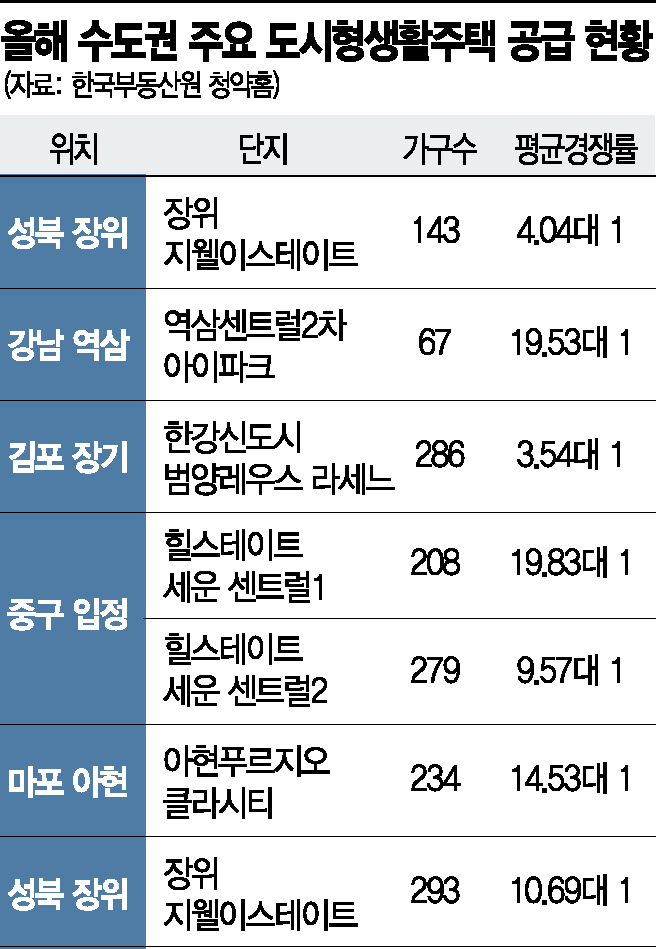
According to the Korea Real Estate Board's Subscription Home on the 22nd, a total of 16,234 people applied for 1,510 units in 7 urban housing complexes supplied through Subscription Home this year, recording an average competition rate of 10.7 to 1.
In Seoul, the Hills State Sewoon Central Phase 1 in Ipjeong-dong, Jung-gu recorded the highest competition rate with an average of 19.8 to 1, and Yeoksam Central 2nd I-Park in Yeoksam-dong, Gangnam-gu also showed a competition rate of 19.5 to 1. In addition, ▲ Hills State Sewoon Central Phase 2 in Ipjeong-dong, Jung-gu ▲ Ahyeon Prugio Clacity in Ahyeon-dong, Mapo-gu ▲ Sewoon Prugio Hericity in Inhyeon-dong, Jung-gu ▲ Jangwi Ziwell State in Jangwi-dong, Seongbuk-gu were all sold out with competition rates ranging from as low as 4 to 1 to as high as 14.5 to 1. Beomyang Reus La Seine supplied in Gimpo Hangang New Town, Gyeonggi also showed a competition rate of 3.5 to 1.
Urban housing refers to communal housing with less than 300 units in urban areas and an exclusive area of 85㎡ or less. The system was introduced in 2009 and is divided into three types: ▲ complex-type row houses ▲ complex-type multi-family houses ▲ studio type.
The high demand for urban housing is analyzed to be due to the relatively low tax burden compared to officetels. In August, the government raised the acquisition tax for residential officetels owned by multiple homeowners to a maximum of 12% through amendments to the Local Tax Act and announced plans to apply capital gains tax surcharges, but these do not apply to urban housing. The acquisition tax for urban housing ranges from 1.1% to 3.5% depending on the purchase price and area. Also, anyone aged 19 or older can apply without a subscription savings account, and there is no restriction on re-winning, which is also cited as a reason.
Urban housing with less than 30 units, which can be sold at the discretion of the construction company without going through Subscription Home, is also popular. In particular, luxury urban housing recently supplied targeting the wealthy has appeared. For example, 'Arts Nonhyeon' supplied recently in Nonhyeon-dong, Gangnam-gu has a sale price exceeding 10 million KRW per 3.3㎡. This urban housing offers breakfast service, valet parking, and room cleaning service.
Some argue that urban housing is becoming a means to evade the private land price ceiling system. In Inhyeon-dong, Jung-gu, 'Sewoon Prugio Hericity' is a case where the developer changed some apartments to urban housing and supplied 293 units in June. Similarly, in Ipjeong-dong, Jung-gu, 'Hills State Sewoon Central' converted a total of 487 existing apartments into urban housing for the same reason and supplied them.
© The Asia Business Daily(www.asiae.co.kr). All rights reserved.

















