Helping Investors Avoid 'Greenwashing'
Green Finance TF Launched... Strengthening Public-Private Cooperation
Guidelines for Green Bond Activation Established This Year
Supporting Excellent SMEs with 1.9 Trillion KRW Fund Raised
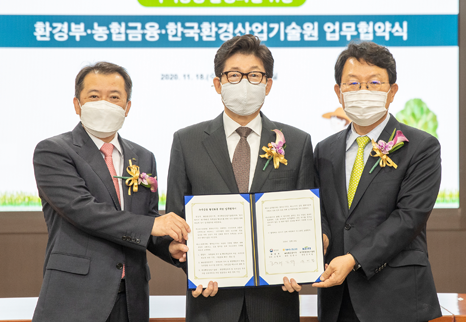 Minister of Environment Cho Myung-rae (center) attended the "Memorandum of Understanding (MOU) Ceremony for Promoting Green Finance" held at the NongHyup headquarters in Jung-gu, Seoul on the 18th of last month, urging the financial sector to take on roles and responsibilities for investment in the green sector.
[Asia Economy Reporter Kim Bo-kyung] The Ministry of Environment, the main government agency for the Green New Deal, is focusing on establishing an institutional foundation to ensure that green finance becomes a socio-economic principle. This year, the Ministry of Environment launched a green finance task force (TF) together with the Financial Services Commission and is strengthening public-private cooperation by signing a memorandum of understanding (MOU) with NongHyup.
First, standards for green finance to prevent greenwashing will be established. "Greenwashing" refers to attracting investment funds by promoting green management without any real connection to eco-friendliness.
◆ Introduction of K-Green Taxonomy by June next year... Support for SMEs = The government's role is crucial to prevent greenwashing. Accordingly, the "Korean Green Taxonomy" will be introduced by June next year to enable judgment on whether financial products qualify as green investments. Clear classification criteria for green economic activities, which form the basis of the green finance system, will be established and gradually advanced. Additionally, guidelines for revitalizing green bonds will be prepared within this year. Incentive systems to promote green investment will be established, and support plans for issuing related financial products will also be prepared.
To enable financial institutions to consider environmental factors when making investment decisions, "environmentally responsible investment" will be promoted, and a standard evaluation system will be developed and disseminated. Institutional improvements are also underway to allow companies to provide environmental information when financial companies conduct environmentally responsible investments. The Ministry of Environment plans to reflect green finance indicators, such as declarations to phase out coal, when selecting water system fund management institutions, marking the first time a central administrative agency has done so.
Financial support measures have also been prepared to reduce the financial burden on excellent small and venture environmental companies. The Future Environmental Industry Loan, which provides long-term, low-interest loans for green facility investments, will raise 1.9 trillion KRW by 2025. Next year, the total loan scale will reach 400 billion KRW, combining 300 billion KRW in government funds and 100 billion KRW in interest subsidies. A public-private joint fund worth 215 billion KRW will be established by 2025 to invest in green industry sectors such as smart water and sewage systems and upcycling industries, supporting corporate growth.
Minister of Environment Cho Myeong-rae stated, "We will accelerate the preparation of green finance policies to lead the global trend toward carbon neutrality by 2050," adding, "While government policies to support the transition to a carbon-neutral ecosystem are important, the responsibility and role of the financial sector are paramount, so we will expand private cooperation to revitalize green finance."
◆ Revitalizing Green Finance... Preparing for Climate Shocks = As of the end of the first half of this year, the scale of domestic green finance products reached approximately 51.6 trillion KRW. The total amount raised by 23 green-related funds currently in operation is 4.08 trillion KRW. Of this, about 2.6 trillion KRW is public investment, and 1.47 trillion KRW is private investment. Shinhan Bank has been promoting eco-friendly green management by issuing green bonds and ESG bonds and becoming the first domestic commercial bank to join the Equator Principles. It also announced plans to invest 20 trillion KRW in the green industry sector by 2030. KB Financial Group formed the "KB Life Infrastructure Fund" and the "KB New Renewable Green New Deal Fund" with scales of 200 billion KRW and 130 billion KRW, respectively.
Climate change affects the economy and finance. Green finance can be seen as a measure introduced to address financial risks caused by unpredictable climate change. According to the Financial Services Commission in August, there are concerns about the deterioration of financial soundness in disease and automobile insurance sectors due to climate change. This is due to abnormal weather such as fine dust and heavy rainfall. Fine dust increases the incidence of respiratory diseases, and heavy rainfall increases cases of automobile flooding damage. As global warming causes greater damage to agricultural products, loan, guarantee, and repayment delays in the agro-food industry are occurring, and as carbon emission permit prices rise, the operating profits and collateral values of high-emission companies are declining.
Green finance is not a new financial regulation but a financial management strategy that enhances resilience, such as asset diversification, to prepare for climate and environmental shocks. This has significant implications for companies facing the post-COVID-19 era.
© The Asia Business Daily(www.asiae.co.kr). All rights reserved.
![User Who Sold Erroneously Deposited Bitcoins to Repay Debt and Fund Entertainment... What Did the Supreme Court Decide in 2021? [Legal Issue Check]](https://cwcontent.asiae.co.kr/asiaresize/183/2026020910431234020_1770601391.png)
















