Establishment of Investigation Human Rights Division Directly Under Chief Superintendent-Level Department Head
De Facto Inspection Duties Including Investigation Objections and Complaints
Transfer of Counterintelligence Investigation Authority to 'Security Investigation Bureau' for Espionage and Terrorism Cases
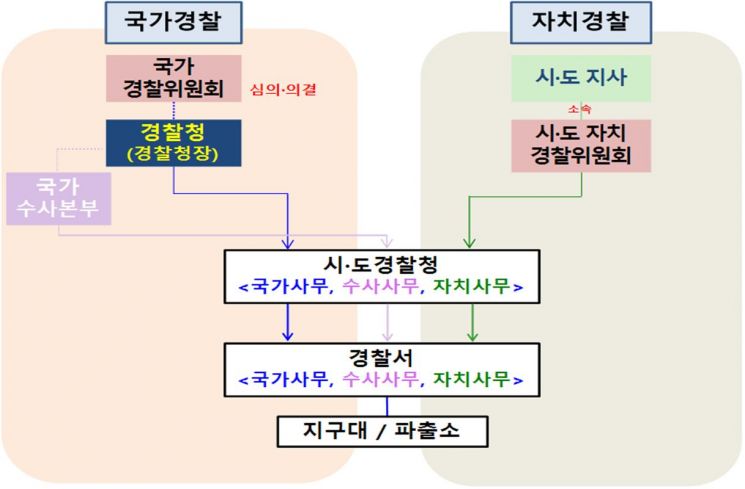 Model diagram of the introduction of National Police, Autonomous Police, and National Investigation Headquarters./Source=Korean National Police Agency
[Asia Economy Reporter Lee Gwan-ju] The outline of the organization of the National Investigation Headquarters (NIH), which will oversee and supervise police investigations, has been revealed. Directly under the headquarters chief, there will be a superintendent-level unit dedicated to investigation human rights, and the NIH will also conduct inspections related to investigation cases. The existing investigative functions within the National Police Agency will be expanded, and tasks will be further subdivided by function.
According to the National Police Agency on the 22nd, the draft of the "Enforcement Rules of the National Police Agency and Its Affiliated Organizations," which was announced for legislative notice the day before, includes the organizational structure of the NIH with these details. Notably, an Investigation Human Rights Officer will be placed directly under the headquarters chief. The superintendent-level Investigation Human Rights Officer will be responsible for establishing systems and policies related to the protection of human rights during investigation procedures and for inspecting and guiding their practical application in the field. This separates and subdivides the duties previously overseen comprehensively by the Audit Office within the National Police Agency, symbolizing a priority on human rights protection during investigations.
Additionally, the NIH will have six bureaus and offices: Investigation Planning Coordination Office, Forensic Science Management Office, Investigation Bureau, Criminal Bureau, Cyber Investigation Bureau, and Security Investigation Bureau. Existing investigative functions within the National Police Agency will be consolidated, with some functions expanded from division to bureau level or transferred from other bureaus to the NIH. A representative example is the Criminal Bureau, which was previously just one division within the Investigation Bureau of the National Police Agency but will now be expanded to bureau level, including the Violent Crime Investigation Division, Narcotics and Organized Crime Investigation Division, and Women and Juvenile Crime Investigation Division. The Women and Juvenile Crime Investigation Division, previously under the Community Safety Bureau of the National Police Agency, has now been assigned to the NIH.
The Security Investigation Bureau, which will bear increased responsibility due to the transfer of counterintelligence investigative authority, will be composed of four divisions: Security Planning and Management Division, Security Investigation Command Division, Security Crime Analysis Division, and Security Investigation Division. The Security Investigation Bureau will oversee investigations related to national security and crimes against national interests, including protection of North Korean defectors, espionage, terrorism, economic security, and advanced security threats. Accordingly, in addition to counterintelligence investigations, crimes previously handled by the Foreign Affairs functions, such as industrial technology leakage, will also be managed by the Security Investigation Bureau. Internal control related to investigation authority adjustments will be handled by the newly established Investigation Planning Coordination Office’s Investigation Review Policy Officer. The superintendent-level Investigation Review Policy Officer will establish systems and policies related to investigation reviews, operate the investigation review system with external committee participation, and oversee complaint handling related to investigations. In particular, this role will also be responsible for investigating and handling complaints and misconduct related to investigations, effectively serving as an inspection function over investigative work.
Direct investigation functions will also be maintained. The Serious Crime Investigation Division of the National Police Agency will be transferred to the Serious Crime Investigation Division within the NIH’s Investigation Bureau and continue operations as before. The Serious Crime Investigation Division, formed by merging the Special Investigation Division and the Intellectual Crime Investigation Unit of the National Police Agency, handles major cases such as large-scale corporate corruption and government agency investigation requests, and is known as the police’s sharpest "sword." The Cyber Investigation Bureau and Security Investigation Bureau will also have direct investigation functions according to their respective task assignments, handling cybercrime and cyberterrorism, and major security incidents, respectively.
© The Asia Business Daily(www.asiae.co.kr). All rights reserved.
![User Who Sold Erroneously Deposited Bitcoins to Repay Debt and Fund Entertainment... What Did the Supreme Court Decide in 2021? [Legal Issue Check]](https://cwcontent.asiae.co.kr/asiaresize/183/2026020910431234020_1770601391.png)