Top 4 of 10 Most Bought Stocks by Domestic Investors in the Past Month: Tesla, Xiaopeng, Nio, Nikola
Tesla Included in S&P 500 Index, Purchased Over 2.6 Trillion KRW
Rising EV Sales in Chinese Market Spur Search for 'Second Tesla'
[Asia Economy Reporter Minji Lee] 'Seohak Ants,' investors in overseas stocks, have been focusing on buying electric vehicle maker Tesla ahead of the positive news of its inclusion in the S&P500, and it has been revealed that they also purchased Chinese electric vehicle companies in search of the 'second Tesla.'
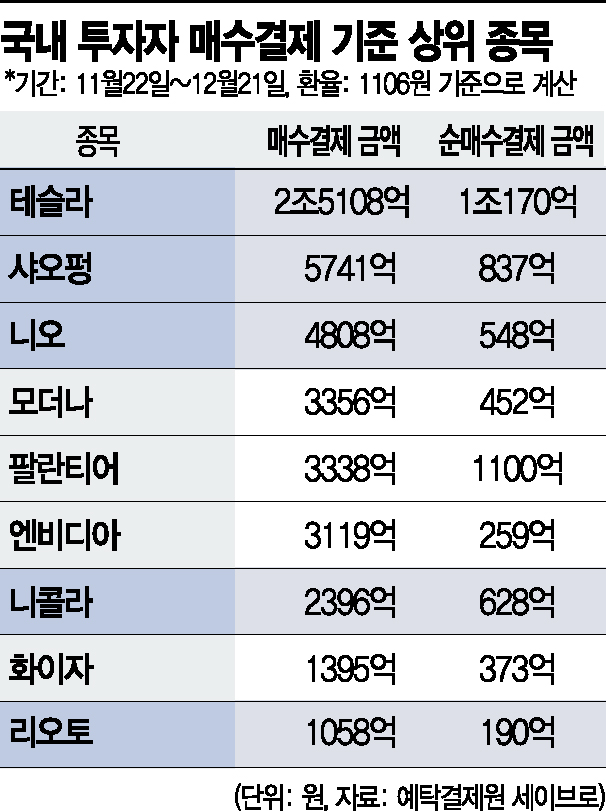
According to the Korea Securities Depository on the 22nd, among the top 10 stocks by purchase settlement amount by domestic investors over the past month until the 18th, four stocks (Tesla, Xiaopeng, Nio, Nikola) were related to electric vehicles. The top stock was Tesla, which domestic investors bought the most this year, with purchases totaling 2.6264 trillion KRW over the month. Following were Chinese electric vehicle companies Xiaopeng (607.7 billion KRW) and Nio (538.7 billion KRW), both listed on the U.S. stock market, ranking second and third respectively. Eco-friendly vehicle companies Nikola and Chinese company Li Auto also saw purchases worth 243.3 billion KRW and 127.8 billion KRW respectively. Looking at the net purchase settlement amount, which sums up the purchase and sale settlement orders, Tesla (1.0482 trillion KRW), Xiaopeng (80.4 billion KRW), Nikola (60.8 billion KRW), and Nio (46.0 billion KRW) all ranked among the top stocks.
The attraction of Seohak Ants to electric vehicle stocks was driven by the news of Tesla's inclusion in the S&P500 index. On the 16th of last month (local time), when S&P Global announced Tesla's index inclusion, Tesla surged about 59.08% until the day before as investors flocked in.
As Tesla grew from a perennial deficit company to one ranked within the top 10 among S&P500 listed companies, it is interpreted that the movement among Seohak Ants to find the 'second Tesla' has become more active. Additionally, with policy support plans from the U.S., China, and European governments for eco-friendly vehicles, investors' sentiment to achieve high returns with relatively small investments has expanded.
The Chinese electric vehicle companies Xiaopeng, Nio, and Li Auto, which have attracted notable buying interest from domestic investors, have target sales volumes that are only about one-sixth of Tesla's. Xiaopeng, Nio, and Li Auto are estimated to sell 25,000, 45,000, and 30,000 units respectively this year, whereas Tesla is expected to sell 600,000 units this year, 1 million units next year, 1.5 million units in 2022, and 2 million units in 2023.
However, as sales volume in the Chinese market continues to increase and the government has announced a goal to raise the proportion of electric vehicle sales to 20% by 2025, the growth rate is expected to accelerate beyond the current pace. Although stock prices fluctuated recently due to news that the Chinese government has launched an investigation into subsidies received by electric vehicle companies, it was reported that the major companies under investigation did not include these firms.
Jonggyu Jeon, a researcher at Samsung Securities, said, "Starting next year, Chinese electric vehicles will enter a full-scale popularization phase, and mid- to long-term policy benefits are expected, which raises growth expectations for Chinese electric vehicle and related battery companies." He added, "The Chinese electric vehicle market is characterized by a strong combination of government, corporate, and consumer needs, and emerging companies such as Nio, Xiaopeng, and Li Auto are actively participating in this competitive market."
Meanwhile, domestic investors have also placed purchase orders for companies other than electric vehicle stocks in overseas markets over the past month, including COVID-19 vaccine developers Moderna (355.5 billion KRW) and Pfizer (139.5 billion KRW). From last month until now, the purchase settlement amount by domestic investors was 24.6636 trillion KRW, and the net purchase amount, after summing sales settlement amounts, was 4.0601 trillion KRW.
© The Asia Business Daily(www.asiae.co.kr). All rights reserved.

















