If Foreign Workforce Increases by 1%P, Wage Growth Rate of Korean Workers Below High School Graduation Decreases by 0.2%P
"Minimize Negative Effects of Foreign Influx, Selectively Accept Suitable Labor Force"
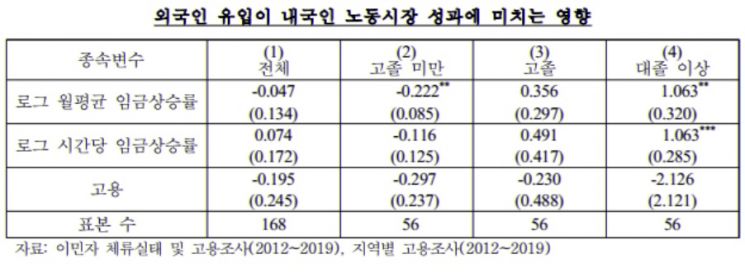
[Asia Economy Reporter Kim Eun-byeol] It has been found that for every 1 percentage point increase in foreign workers in South Korea, the wage growth rate of Korean workers with less than a high school education decreases by 0.2 percentage points. This is because many of the jobs occupied by foreigners entering the country overlap with those held by domestic workers with less than a high school education, such as agriculture, machine operation, and simple manufacturing like assembly work.
This result was revealed in the report titled "Analysis of the Impact of Foreign Workforce Inflow on Domestic Wages and Employment," published by the Bank of Korea on the 22nd. The Bank of Korea stated in the report, "The analysis by education level showed that when the proportion of foreigners with similar job skills among those with less than a high school education increased by 1 percentage point, the wage growth rate of domestic workers decreased by 0.2 percentage points." This analysis was conducted through regression analysis using immigrant residency and employment survey data and regional employment survey data from 2012 to 2019.
This is the first time the Bank of Korea has quantified the correlation between the increase in foreign workers and domestic labor wages. Kim Hye-jin, a senior researcher at the Bank of Korea's Economic Research Institute, explained, "This is because domestic and foreign workers with less than a high school education are in a substitutive relationship, competing with each other."
From 2013 to 2019, the average wage growth rate for domestic workers with less than a high school education was 3.75%. If the number of foreign workers with less than a high school education increases by 1 percentage point (approximately 768 people), the average monthly wage growth rate for domestic workers would drop to 3.73%. As of last year, there were 2.52 million foreigners residing in South Korea, accounting for 4.9% of the total population. From 2000 to 2015, the number of foreign residents in South Korea quadrupled, showing the fastest growth rate among OECD countries.
Looking at the occupations of domestic and foreign workers with less than a high school education, a significant portion overlaps. Among domestic workers with less than a high school education, 28.9% are engaged in machine operation or assembly work, while the foreign worker proportion is 32.9%. In simple labor jobs, where 24.0% of domestic workers with less than a high school education are employed, 35.1% of foreign workers with less than a high school education work.
On the other hand, for those with a college degree or higher, an increase in foreign workers actually corresponds with a 1.1 percentage point increase in domestic wage growth. More than two-thirds of foreign workers with a college degree or higher in South Korea are employed in low-skilled jobs, which do not overlap with domestic workers, and this rather enhances the performance of management and professional positions held by Koreans.
Senior researcher Kim said, "With the working-age population shrinking due to low birth rates and aging, the utilization of foreign labor is expected to expand further. The policy challenge is to minimize negative effects and attract a workforce that fits the South Korean labor market."
© The Asia Business Daily(www.asiae.co.kr). All rights reserved.

















