'Gathering Ban' Death Sentence for Large Restaurants... Small Restaurants Already on the Brink
Temporary Closures Due to Rent and Labor Costs Cause Huge Damage... Widespread Fear of Level 3 Restrictions
Sharp Increase in Closures of Cafes and Bakeries Banned from On-Site Dining "No Means to Endure"
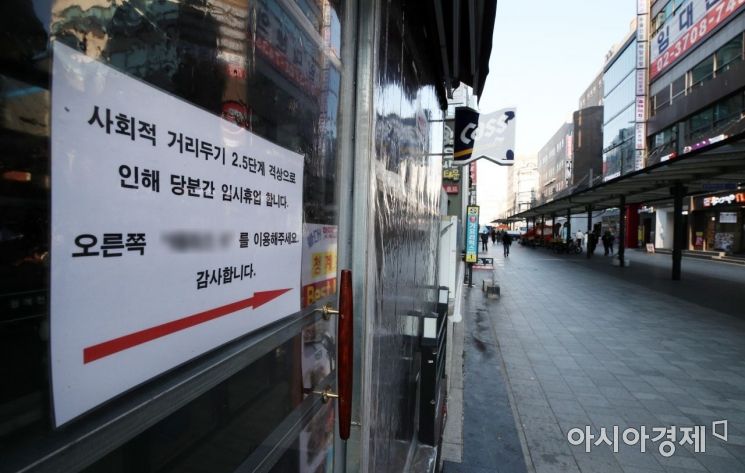 An interim closure notice is posted at a restaurant in downtown Seoul amid the ongoing spread of the novel coronavirus disease (COVID-19) in South Korea. Photo by Kim Hyun-min kimhyun81@
[Asia Economy Reporter Lee Seon-ae] "Since the beginning of this month, we haven't received any group customers of 10 or more, and after the social distancing level was raised to 2.5, customers stopped coming from 8 p.m., so we close early. Year-end reservations have been continuously canceled due to the ban on gatherings of five or more, and even the few customers who used to come in groups of two or three seem to have stopped coming, so I feel completely at a loss about what to do."
Every time the phone rings, it's "Reservation Cancellation"
On the night of the 21st, Mr. Kim, who runs a Korean restaurant in Seodaemun-gu, Seoul, said he now regrets expanding his restaurant two years ago. The amount Mr. Kim has to pay monthly for rent and labor costs exceeds 15 million won, but his sales fall far short of this, increasing his debt. As cancellation notices keep coming instead of reservation calls, his heart sinks every time the phone rings. Mr. Kim said, "Most teams of five or fewer are also canceling their reservations."
Self-employed restaurant owners who endured two months of social distancing during the second wave of the novel coronavirus (COVID-19) in August are repeatedly facing a winter on the edge. Moving locations, we headed to Mapo. Mr. Lee, who runs a Japanese restaurant in Mapo-gu, said, "In the first half of the year, the landlord waived two months' rent, which gave us some breathing room, but since the landlord has no income other than rent, he said further concessions are impossible, which is discouraging." He added, "When the ban on gatherings starts, customers will naturally decrease, and because government measures are inconsistent, there are even ominous rumors among restaurant owners that they might have to prohibit dining inside the restaurants altogether."
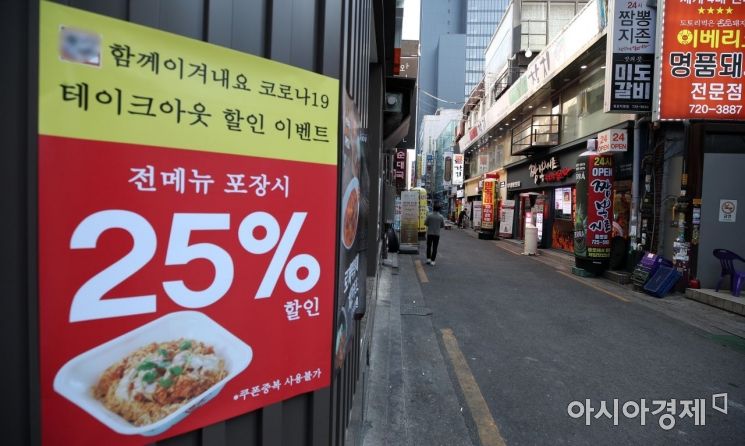 Amid the ongoing spread of the novel coronavirus disease (COVID-19) in South Korea, a food street in downtown Seoul appears quiet despite it being lunchtime. Photo by Kim Hyun-min kimhyun81@
Mr. Jang, who runs a snack bar in Jongno-gu, also said, "For inexpensive snack foods, delivery fees are higher than the food price, making it difficult to establish a delivery system. We are barely holding on with takeout and in-store sales, but small restaurants like ours have been effectively closed for a long time, so if in-store dining is banned, we will have no choice but to close."
Among self-employed restaurant owners, there is widespread fear that the 2.5-level social distancing will continue until the first quarter of next year, along with anxiety that if the level is raised to 3, a ban on dining inside restaurants could follow.
The Korea Foodservice Industry Association pointed out, "We are very concerned after hearing that the quarantine authorities are reviewing whether to raise the level to 3 and are making detailed adjustments to the guidelines equivalent to level 3. If the measures at level 3 require a complete shutdown of operations except for delivery, small business owners will inevitably have to close their businesses."
According to Statistics Korea, Korean cuisine accounts for 44.23% of the entire foodservice industry, and 80% of these are small businesses. A representative from the Foodservice Industry Association said, "Korean cuisine relies heavily on dine-in customers, and the proportions of delivery (5.7%) and takeout (11.4%) are not high, so the damage caused by COVID-19 is greater."
With the start of level 2.5, cafes and bakeries that have removed tables and chairs from their stores are also enduring a harsh winter, especially small businesses with low proportions of takeout and delivery. Mr. Park, who runs a bakery in Yeongdeungpo-gu, said, "Thanks to customers taking cakes to go for the year-end, we barely keep the store open, but if even this stops, we will have to close."
 An eviction notice is posted at a restaurant located in a food street in Seoul amid the ongoing spread of the novel coronavirus disease (COVID-19) in South Korea. Photo by Kim Hyun-min kimhyun81@
© The Asia Business Daily(www.asiae.co.kr). All rights reserved.
![User Who Sold Erroneously Deposited Bitcoins to Repay Debt and Fund Entertainment... What Did the Supreme Court Decide in 2021? [Legal Issue Check]](https://cwcontent.asiae.co.kr/asiaresize/183/2026020910431234020_1770601391.png)


















