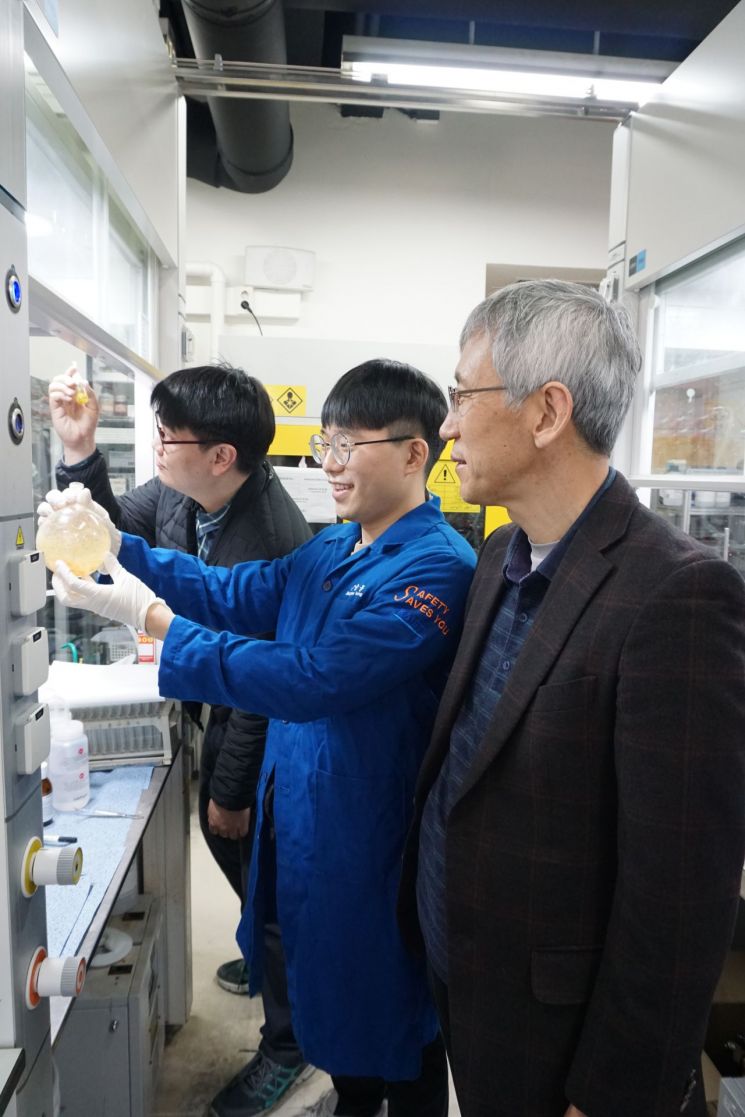
 Jang Seok-bok, Head of Research Group at the Institute for Basic Science (far right), and the research team
[Asia Economy Reporter Junho Hwang] A technology has been developed to manufacture 'gamma and beta lactams,' key raw materials for pharmaceuticals, from hydrocarbons abundant in nature.
The research team led by Seokbok Jang, head of the Molecular Active Catalysis Reaction Research Group at the Institute for Basic Science, announced on the 22nd that they have developed a new catalyst that effectively generates carbocations and converts them into organic compounds with desired structures. Using this catalyst, they also succeeded in producing gamma and beta lactams, key raw materials for pharmaceuticals, from hydrocarbons abundant in nature.
Based on their own research results, the team improved an iridium catalyst into a multifunctional catalyst involved in all reaction stages, including the formation and transformation of carbocations. Inspired by previous studies showing that carbocations are easily formed when electrophilicity (molecules seeking electrons) is introduced, they designed the catalyst to effectively generate carbocations by inserting a strong electrophile called nitrene into carbon-carbon double bonds.
Director Seokbok Jang said, "There is academic progress in efficiently generating carbocations, which are key intermediates in organic chemical reactions, and controlling reaction pathways, along with industrial significance in opening various application possibilities. Using a universal catalyst capable of synthesizing gamma-lactams, beta-lactams, and even chiral compounds, it will be possible to develop pharmaceuticals with diverse structures from substances abundant in nature."
Gamma-lactams are core components of complex organic molecules such as epilepsy treatments and angiogenesis inhibitors. Beta-lactams are raw materials that constitute a large portion of antibiotic drugs like penicillin. Catalysts that activate carbocation generation reactions are necessary for synthesizing useful compounds such as pharmaceutical raw materials. Carbocations are key intermediates in organic chemical reactions that synthesize new substances. Although they react easily with various molecules, their lifespan is shorter than one billionth of a second, making it difficult to control their reactivity. Their existence was first confirmed in 1994, and the researcher who discovered them was awarded the Nobel Prize in Chemistry.
The research results were published in the online edition of the international academic journal Nature Catalysis on the same day.
© The Asia Business Daily(www.asiae.co.kr). All rights reserved.

















