[Asia Economy Reporter Junho Hwang] A big data processing method mimicking the human brain has been developed. The research team explained that this technology can resolve data bottlenecks and achieve processing speeds 59 times faster than existing methods.
The research team led by Professor Yesung Kim from the Department of Information and Communication Convergence at Daegu Gyeongbuk Institute of Science and Technology (DGIST), in collaboration with Professor Moshen Imani's team from the University of California, Irvine, and Professor Tina Lozing's team from the University of California, San Diego, announced these research results at the international academic conference IEEE/ACM MICRO on the 21st.
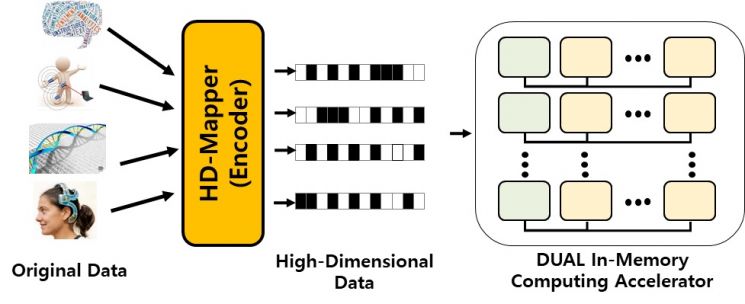
The team overcame computational bottlenecks occurring in big data calculations using two technologies. First, to address the memory bandwidth shortage caused by existing analog-based hardware, they utilized a memory-based computational computer architecture. Additionally, they applied a hyperdimensional computing algorithm, an algorithm mimicking the brain's computational method. By using this, conventional numeric data can be reconstructed into numerous patterned bit sequences, enabling parallel high-speed computation. The research team stated that through this technology, they achieved a 59-fold speed improvement and a 251-fold increase in energy efficiency compared to existing methods.
Professor Yesung Kim said, "Through this research, we can eliminate bottlenecks between memory and computing devices and improve clustering algorithm processing performance by up to several tens of times." He added, "We plan to continue research that can bring innovation to efficient data learning in fields such as big data and artificial intelligence."
© The Asia Business Daily(www.asiae.co.kr). All rights reserved.


















