"Freedom of Expression Shrinking... Could Clash with Biden Administration"
Foreign Minister Kang Kyung-wha: "Freedom of Expression Is Not Absolute"
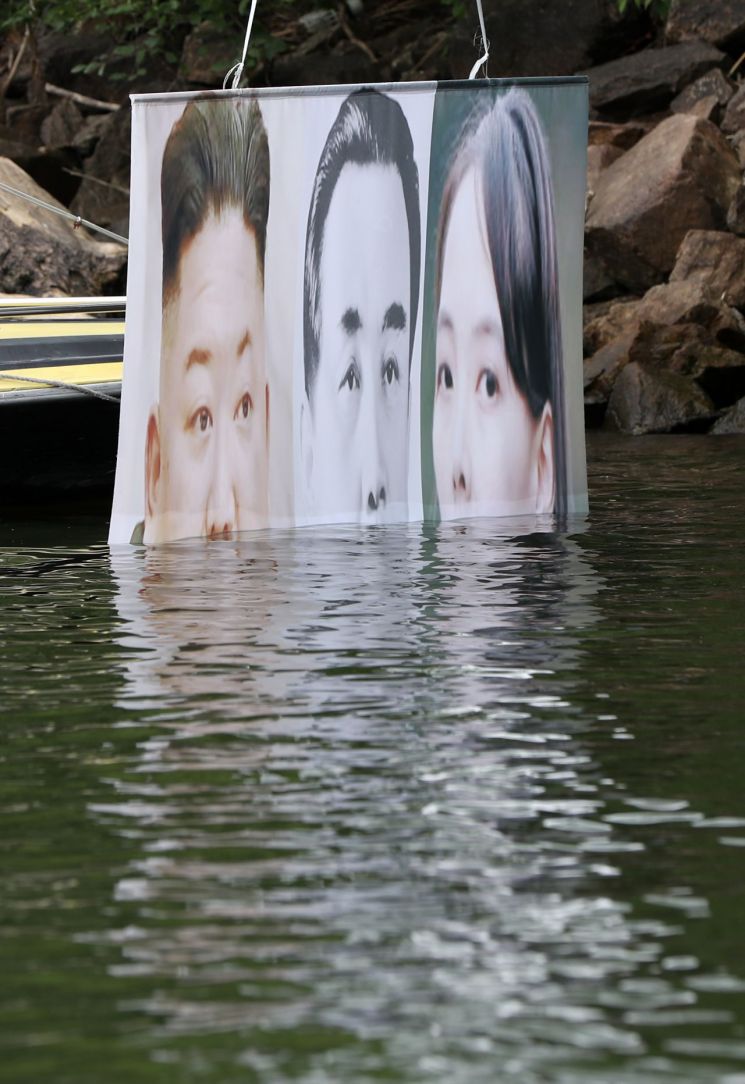 On the night of June 22, a balloon sent by a North Korean defector organization for leaflet distribution fell on June 23 in a nearby hill in Magok-ri, Seomyeon, Hongcheon-gun, Gyeonggi Province.
 The discovered balloon for leaflet distribution was 2 to 3 meters in size and had a photo of North Korean State Affairs Commission Chairman Kim Jong-un and his family attached.
The international community's concerns over South Korea's push to enforce the law banning the distribution of leaflets to North Korea (Partial Amendment to the Act on the Development of Inter-Korean Relations) continue unabated.
Gerald Connolly (Democrat, Virginia), a prominent pro-Korea lawmaker in the U.S. House of Representatives, issued a statement on the 17th (local time), expressing concern that "the South Korean legislature recently passed a bill prohibiting the sending of printed materials, auxiliary storage devices, money, and other items to North Korea through the border areas between South and North Korea and third countries such as China."
Connolly, who also serves as co-chair of the Korea Caucus, a group of pro-Korea lawmakers in the U.S. Congress, emphasized that "in its current form, this bill undermines the ability of South Korean human rights organizations to independently and diversely disseminate information to North Korean residents and has the effect of stifling freedom of expression."
He expressed dissatisfaction with the approach taken by the leaflet ban law and argued that the bill's content must be significantly revised.
He stated, "We do not respond to North Korea's repression of freedom of expression by restricting our own freedom of expression," and added, "I urge President Moon Jae-in to seek substantial amendments before signing this bill."
This marks the third time that U.S. lawmakers have expressed concerns regarding the leaflet ban law, which was passed under the leadership of the Democratic Party of Korea.
Michael McCaul, the Republican ranking member of the House Foreign Affairs Committee, expressed strong concerns on the 14th (local time), and Chris Smith, the Republican co-chair of the bipartisan Tom Lantos Human Rights Commission, voiced similar worries on the 11th (local time).
The Tom Lantos Human Rights Commission plans to hold hearings to review South Korea's leaflet ban law and related issues when the new session begins in January next year.
Criticism has also come from the United Nations.
Michael Kirby, former chair of the UN Commission of Inquiry (COI) on Human Rights in North Korea, pointed out that the leaflet ban law could conflict with the Biden administration in the U.S., which places great emphasis on "freedom of expression."
At an online hearing hosted by the All-Party Parliamentary Group on North Korea (APPG NK) in the UK Parliament on the 16th (local time), Kirby said, "What Americans constantly talk about is the First Amendment," and according to Radio Free Asia (RFA) on the 19th, he noted that "(measures such as the enactment of the leaflet ban law) could cause conflicts with the policies of the new U.S. administration." The First Amendment of the U.S. Constitution guarantees freedom of speech, press, and assembly.
Kirby emphasized, "I believe the new U.S. administration will express even stronger concerns than I do about actions that prevent North Korean defectors from informing their fellow citizens inside North Korea about how exceptional, terrible, and shocking the regime is." On the same day, Thomas Ojea Quintana, the UN Special Rapporteur on human rights in North Korea, issued a separate statement recommending a review of the leaflet ban law, citing its restrictions on freedom of expression.
The South Korean government has actively rebutted these international criticisms. On the 16th (local time), Foreign Minister Kang Kyung-wha appeared on CNN and responded to the host's mention that some in the U.S. Congress are raising issues over the leaflet matter by saying, "Freedom of expression is a very important human right, but it is not absolute," adding, "It can be restricted." The Ministry of Unification also unusually expressed "regret" on the 17th regarding Quintana's remarks.
 Kim Yo-jong, First Deputy Director of the Workers' Party and younger sister of North Korean State Affairs Commission Chairman Kim Jong-un
Meanwhile, the leaflet ban law, which passed the National Assembly plenary session on the 14th, stipulates that anyone who distributes leaflets or commits acts violating inter-Korean agreements around the Military Demarcation Line will be punished with imprisonment of up to three years or a fine of up to 30 million won.
After Kim Yo-jong, First Deputy Director of the Workers' Party of North Korea, raised the issue of leaflets in June and predicted the collapse of inter-Korean relations, the government and ruling party accelerated the preparation of the bill. Consequently, the opposition party has criticized the law as the "Kim Yo-jong Mandate Law."
© The Asia Business Daily(www.asiae.co.kr). All rights reserved.


















