'South Korea's Choice Amid US-China Hegemony Competition' Lecture
"Maintain the ROK-US Alliance While Playing a Mediating and Mitigating Role"
"Also Gather Opinions Among Middle Powers, Including Improving ROK-Japan Relations"
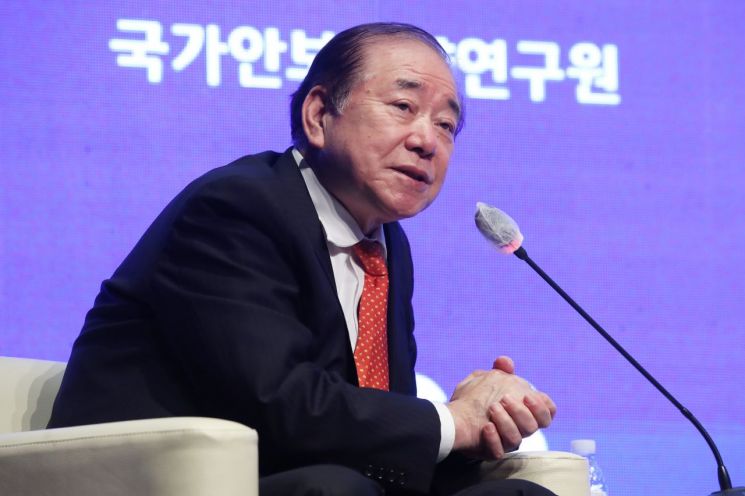 Moon Jung-in, Special Advisor to the President on Unification, Diplomacy, and Security, is speaking as the chair of the 'Experience in Negotiations with North Korea' session at the INSS-Stanford CISAC International Conference held on the morning of the 2nd at The Plaza Hotel in Jung-gu, Seoul.
 Moon Jung-in, Special Advisor to the President for Foreign Affairs and National Security, stated on the 18th that South Korea should maintain its alliance with the United States while playing a role in mediating and easing the US-China conflict amid the new Cold War dynamics between the two powers.
On the same day, during the 26th Sejong National Leadership Forum hosted by the Sejong National Leadership Committee under the Economic and Social Research Council, Moon discussed four possible scenarios South Korea could choose in the midst of US-China tensions under the theme "US-China, Hegemonic Competition and South Korea's Choice."
Moon said, "In the new Cold War situation where the US and China are in conflict, not only South Korea but most middle powers allied with the US will be affected," adding, "South Korea should improve relations with Japan and form a consortium among middle powers such as Canada, the UK, Germany, France, and Australia to try to influence changes in the US."
He emphasized, "For this, South Korea must maintain its alliance with the US," and added, "As a country centered on ideas, South Korea should play a diplomatic role in creating a new order."
Moon highlighted 'South Korea's smart diplomacy' as a practical measure, advising, "Diplomacy must be principled, and national consensus must be built." He also urged active engagement in public diplomacy to promote these ideas domestically and internationally, stating, "Although it is not easy, pursuing this direction and aspiration will bring a bright future for South Korea."
In his lecture, Moon presented scenarios amid US-China tensions including ▲South Korea siding with the US, ▲South Korea siding with China, and ▲South Korea going it alone (nuclear armament), diagnosing their feasibility while critically pointing out their risks.
Moon explained that the US-China conflict can be seen as a conflict between the hegemon (US) and the challenger (China), and in this case, South Korea could unilaterally side with the hegemon to reduce the challenger's level of challenge. This involves close cooperation between South Korea and the US, such as additional deployment of THAAD and deployment of medium-range ballistic missiles targeting China.
However, Moon criticized, "In this case, China would retaliate economically against South Korea and provide military support to North Korea, viewing South Korea as hostile, thereby further strengthening the North Korea-China-Russia triangular alliance."
Regarding the possibility of South Korea siding with China, Moon declared it "premature." He explained, "Realistically, China itself does not want alliances," adding, "The Chinese Communist Party's constitution declares anti-hegemony, and in reality, China has no alliances." Moon added, "Since China does not seek to build alliances, it is not easy for South Korea to side with China."
Moon also criticized the idea of South Korea 'going it alone' as unrealistic. He categorized this into 'South Korea's neutralization' and 'South Korea's independent nuclear armament,' stating, "There are opinions about moving toward neutralization beyond the (US-China) camp logic, but it is questionable how this is possible given the confrontation between North and South Korea." He questioned, "North Korea has nuclear weapons, and we need the (US) nuclear umbrella; how can neutrality be possible?"
Regarding independent nuclear armament, he warned, "The moment South Korea starts nuclear armament efforts, it will face international economic sanctions similar to those imposed on North Korea and Iran." He added, "Not only would the export economy be paralyzed, but the US might also judge there is no reason to maintain the alliance, potentially leading to the termination of the US-South Korea alliance." Furthermore, he expressed concerns about a chain reaction of nuclear proliferation in Northeast Asia, saying, "Japan and Taiwan would also justify nuclear armament."
© The Asia Business Daily(www.asiae.co.kr). All rights reserved.


















