Duty-Free Status for High-Value Automotive Steel Sheets from Hyundai Motor, POSCO, and Others in Fermentation Era
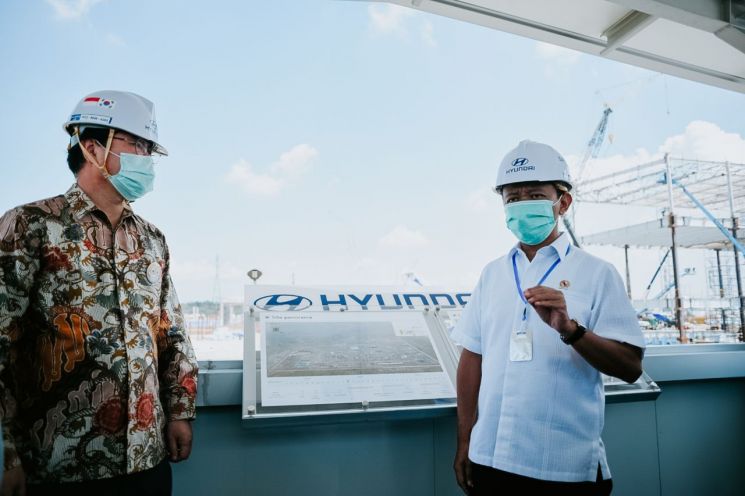 On April 17 (local time), Bachril Lahadalia, Head of the Indonesia Investment Coordinating Board (right), visited the Hyundai Motor factory construction site in the Bekasi Deltamas Industrial Complex and spoke with Lee Young-taek, Head of Hyundai Motor's Asia-Pacific Division. (Photo by Yonhap News)
[Asia Economy Reporter Moon Chaeseok] The government announced that it has concluded negotiations on the Comprehensive Economic Partnership Agreement (CEPA) with Indonesia after eight years and will formally sign the agreement. Once CEPA comes into effect, it will have the same impact as a bilateral Free Trade Agreement (FTA). This is the first bilateral FTA with an ASEAN (Association of Southeast Asian Nations) country since the New Southern Policy was announced in November 2017.
The Ministry of Trade, Industry and Energy announced that Minister Sung Yun-mo and Indonesian Trade Minister Agus Suparmanto jointly signed the CEPA at 10:30 a.m. on the 18th. According to the ministry, CEPA will come into effect within 60 days after ratification by both countries' parliaments. A ministry official explained, "If ratification is obtained during the extraordinary session of the National Assembly as early as February next year, it will come into effect from April."
Indonesia is the largest ASEAN market with a population of 270 million (4th largest in the world). By the end of next year, Hyundai Motor will complete a factory with a production capacity (CAPA) of 150,000 units. This factory plans to produce three types of vehicles: sport utility vehicles (SUVs), multi-purpose vehicles (MPVs), and electric vehicles. Vehicle steel sheets supplied by major companies such as POSCO and Hyundai Steel will be used.
LG Energy Solution plans to build a factory here, where nickel, cobalt, and manganese are abundant, to accelerate its electric vehicle battery business. Indonesia is also strongly committed to increasing foreign direct investment (FDI) through Korean companies.
The product liberalization rate (market opening level) of this CEPA is 94.8%, which is 3.3 percentage points higher than the 91.5% of the Regional Comprehensive Economic Partnership (RCEP). Korea will eliminate tariffs on 95.8% of all items, and Indonesia on 94.8%. Compared to RCEP, Korea will eliminate tariffs on an additional 1.6 percentage points, and Indonesia on an additional 3.3 percentage points.
Notable products include steel products such as vehicle steel sheets. Currently, tariffs of 5-15% are imposed, but with CEPA coming into effect, tariffs will be reduced to 0%. These are high value-added products involving steel companies such as Hyundai Steel as well as Hyundai Motor. Automotive parts such as springs (currently 5% tariff), mechanical parts such as bearings (5%), and textile items such as clothing (5%) will also be duty-free.
Some automotive parts like transmissions (5%) and sunroofs (5%), for which Indonesia had set long-term grace periods of 10-15 years for tariff elimination, as well as precision chemical products (5%), will receive duty-free benefits immediately or within five years.
Agricultural, fishery, and forestry products will mostly maintain the current level of openness through concessions (immediate tariff elimination or phased reduction) within the scope of existing agreements such as RCEP, the Korea-Vietnam FTA, and the Korea-China FTA.
The level of service sector liberalization in online gaming, distribution, and construction will also be expanded beyond RCEP. Online gaming services, a sector of interest to Korea, will be newly opened. The foreign investment share limit in the distribution sector will be improved from 51% (RCEP) to 67%. The construction and engineering services sector will change from 55% to 67%.
Both sides will introduce a "non-regression mechanism" to prevent regulatory levels from increasing in certain service sectors in the future. Indonesia will apply this mechanism to 13 sectors including legal services, international maritime passenger and cargo transport, postal services, and construction and engineering services. Korea will apply it to 35 sectors including engineering, database, advertising, packaging, and tour guide services.
Minister Sung said, "Through CEPA, tariff barriers will be lowered and investment conditions improved for companies in both countries." He added, "Despite the worsening situation of COVID-19, Minister Suparmanto’s visit to Korea to hold the signing ceremony demonstrates the strong will and trust of both countries to overcome the pandemic through free trade."
© The Asia Business Daily(www.asiae.co.kr). All rights reserved.
![User Who Sold Erroneously Deposited Bitcoins to Repay Debt and Fund Entertainment... What Did the Supreme Court Decide in 2021? [Legal Issue Check]](https://cwcontent.asiae.co.kr/asiaresize/183/2026020910431234020_1770601391.png)















