"Comprehensive Review of South Korean Government Measures on North Korean Human Rights"
UN North Korea Human Rights Rapporteur Also Recommends "Reconsideration of the Bill"
Government Expresses "Regret" and Pushes Back... Kang Kyung-wha States "Freedom of Expression Is Not Absolute"
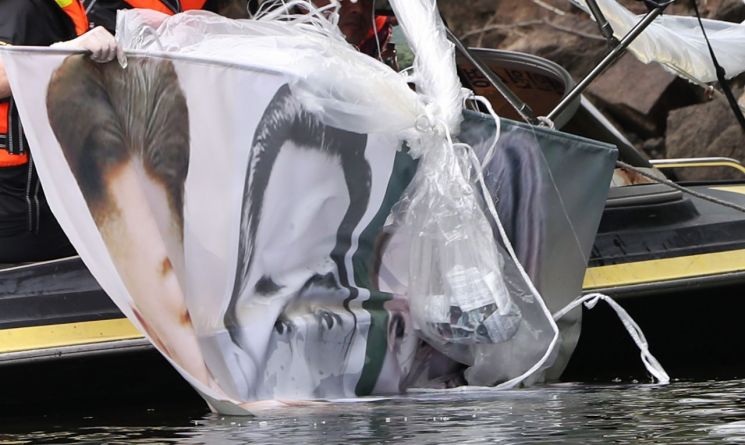 On the night of June 22, a balloon sent by a North Korean defector organization for leaflet distribution fell on a hill near Magok-ri, Seomyeon, Hongcheon-gun on the 23rd, and the police are collecting it.
The discovered balloon for leaflet distribution was 2 to 3 meters in size and had a photo of North Korean State Affairs Commission Chairman Kim Jong-un and his family attached.
The Tom Lantos Human Rights Commission, a bipartisan body under the U.S. Congress, is scheduled to hold a hearing regarding South Korea's law banning the distribution of leaflets to North Korea (an amendment to the Inter-Korean Relations Development Act), according to a report by Voice of America (VOA) on the 18th. This marks the first congressional-level action expressing concern over South Korea's move to enact the leaflet ban law, amid escalating conflicts between South Korea and the international community surrounding the legislation.
A Republican official from the Tom Lantos Human Rights Commission, which addresses global human rights issues, told VOA on the 16th, "As initially announced, once the new session begins in January next year, we plan to hold a hearing to review South Korea's law banning leaflet distribution to North Korea and related matters."
The official added, "While it is not impossible to hold the hearing within this month, considering that the current congressional session has only a few days left, the specific schedule for the hearing will be set starting early January when the next session begins."
VOA reported that the congressional hearing is expected to comprehensively review not only the leaflet ban law but also the South Korean government's measures related to human rights issues.
Earlier, Representative Chris Smith, co-chairman of the Republican side of the Tom Lantos Human Rights Commission, expressed concern over the South Korean Democratic Party's move to pass the leaflet ban law in a statement released on the 11th (local time), stating that if the law is passed, a separate hearing would be convened.
This hearing represents the first congressional-level response to the forceful passage of the leaflet ban law in the South Korean National Assembly. Until now, the U.S. Congress and the international community have voiced criticism of the leaflet ban law.
In his earlier statement, Chairman Smith targeted the Moon Jae-in administration, saying, "There is serious concern over the increasing disregard for fundamental civil liberties in South Korea and the tacit acceptance of communist North Korea."
On the 16th (local time), Thomas Ojea Quintana, the U.N. Special Rapporteur on human rights in North Korea, recommended a review of the leaflet ban law, stating that it restricts freedom of expression. In a commentary sent to Radio Free Asia (RFA), he said, "The leaflet ban law severely limits the activities of many defectors and civil society organizations trying to engage with North Korean residents in various ways," and "I recommend that the relevant democratic institutions reconsider the amendment through proper procedures before the law is enforced."
Reports have also emerged that Steven Biegun, U.S. Deputy Secretary of State, conveyed the U.S. administration's concerns about the leaflet ban law to South Korean officials during his recent visit to South Korea.
Josh Rogin, a columnist for The Washington Post, argued in a column titled "South Korea's New Leaflet Ban Law Sparks Backlash in Washington" on the 17th (local time) that the passage of the leaflet ban law is triggering backlash in Washington. He conveyed the local sentiment, stating, "U.S. lawmakers and NGOs are concerned that South Korea is sacrificing freedom of the press and human rights to appease North Korean leader Kim Jong-un."
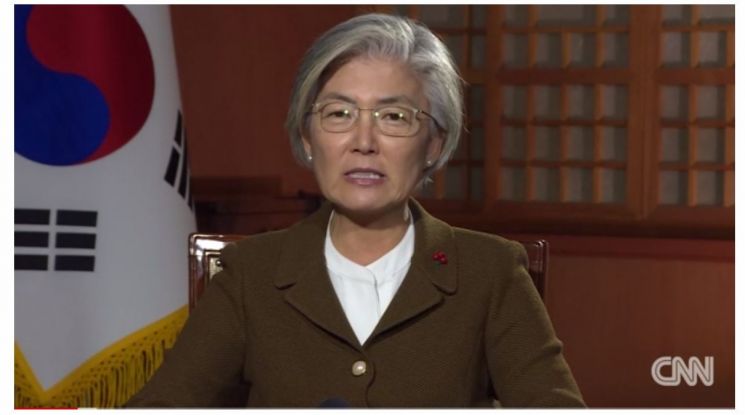 On the 16th (local time), Foreign Minister Kang Kyung-wha expressed the position that freedom of expression is not absolute and can be restricted, considering the situation in South Korea's border areas, in relation to the 'Law Prohibiting the Distribution of Leaflets to North Korea' passed by the National Assembly.
Meanwhile, the South Korean government has strongly opposed the international community's concerns regarding the leaflet ban law.
An official from the Ministry of Unification said on the 17th that they regretted U.N. Special Rapporteur Quintana's comment about the "need for appropriate reconsideration by democratic institutions" regarding the law, which was amended through democratic discussion and deliberation in the National Assembly, the representative body of the people's will, following constitutional and legal procedures. The official also pointed out that "Quintana should take a balanced view that the law imposes minimal restrictions on certain forms of expression to protect the lives and safety of the majority of residents in border areas."
Choi Young-sam, spokesperson for the Ministry of Foreign Affairs, emphasized at a regular briefing on the 17th, "The government guarantees freedom of expression as stipulated in the Constitution and the International Covenant on Civil and Political Rights, which the government has ratified to the fullest extent," adding, "However, considering the balance with respect for and protection of the people's right to life, restrictions on leaflet distribution that pose risks to people's lives and bodies may be imposed within the necessary and minimal scope."
On the 16th (local time), Kang Kyung-wha, Minister of Foreign Affairs, appeared on CNN and responded to a host's mention that some members of the U.S. Congress are raising issues over the leaflet distribution issue, saying, "Freedom of expression is a very important human right, but it is not absolute," and "It can be restricted."
© The Asia Business Daily(www.asiae.co.kr). All rights reserved.