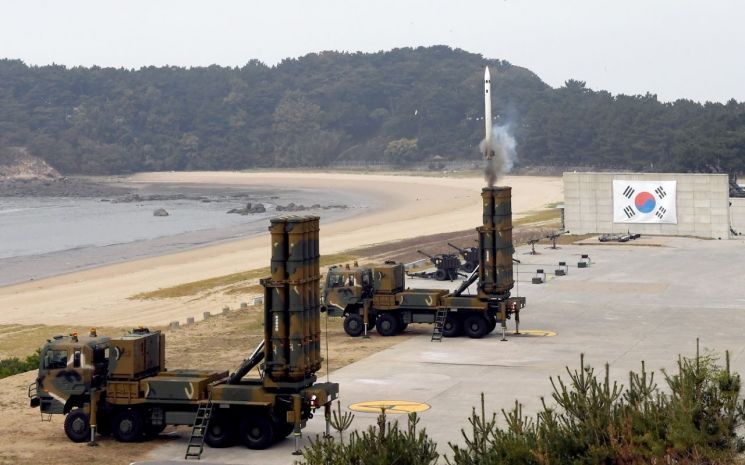
 Air Force Air Defense Guided Missile Shooting Competition Cheongung Patriot (Source: Defense Media Agency)
[Agency for Defense Development]Surface-to-air guided weapons are guided weapon systems that defend against airborne threats such as enemy aircraft, cruise missiles, and ballistic missiles from the ground. Surface-to-air guided weapons are used in air defense operations to protect key national assets such as airfields, power plants, major military facilities, and units. Air defense operations are conducted based on the concept of layered defense by distance and altitude, similar to the concept of using firearms such as machine guns, rifles, and pistols. When intercepting an aircraft identified as hostile, it is most effective to intercept and shoot it down at the longest possible range to destroy the enemy aircraft before it can attack defensive assets. First, long-range surface-to-air guided weapons detect, track, and destroy enemy aircraft infiltrating friendly territory. Enemy aircraft that pass through the defense zone of long-range surface-to-air guided weapons are sequentially defended by medium-range surface-to-air guided weapons, short-range surface-to-air guided weapons, and portable surface-to-air guided weapons positioned close to the defensive assets. The Cheongung, Cheongma, and Shingung systems developed by the Agency for Defense Development are all surface-to-air guided weapons, each performing missions suited to their respective ranges.
▲ Cheongung for medium-range and medium-altitude defense= Cheongung is a medium-range surface-to-air guided weapon responsible for medium-range and medium-altitude defense. Its maximum range is set considering air defense missions, and the maximum altitude is set considering the maximum service ceiling of enemy aircraft. The Cheongung system consists of a multifunction radar for target detection and tracking, a fire control center, launchers, and guided missiles. The launcher serves both as a transport vehicle for the missiles and as the launch platform during movement. When the multifunction radar detects and tracks a target, a missile is launched from the launcher.
The launched missile turns toward the target and is guided by an inertial navigation system toward the predicted impact point. When the target enters the seeker’s acquisition range, the seeker activates to lock onto the target and guides the missile using homing guidance. The Cheongung system has a simple battery configuration, allowing equipment to be deployed in much smaller spaces than before, and applies a vertical launch method, eliminating the need for a flame suppression device on the launcher. The equipment features a low-noise design and various convenience devices to protect the hearing of military personnel working in the fire control center, significantly improving the working environment.
The missile applies a rapid alignment method, so power is not supplied during standby, improving safety. Many functions such as equipment inspection and alignment are automated, enhancing operational convenience and greatly improving user convenience by reducing time for equipment management and deployment during movement.
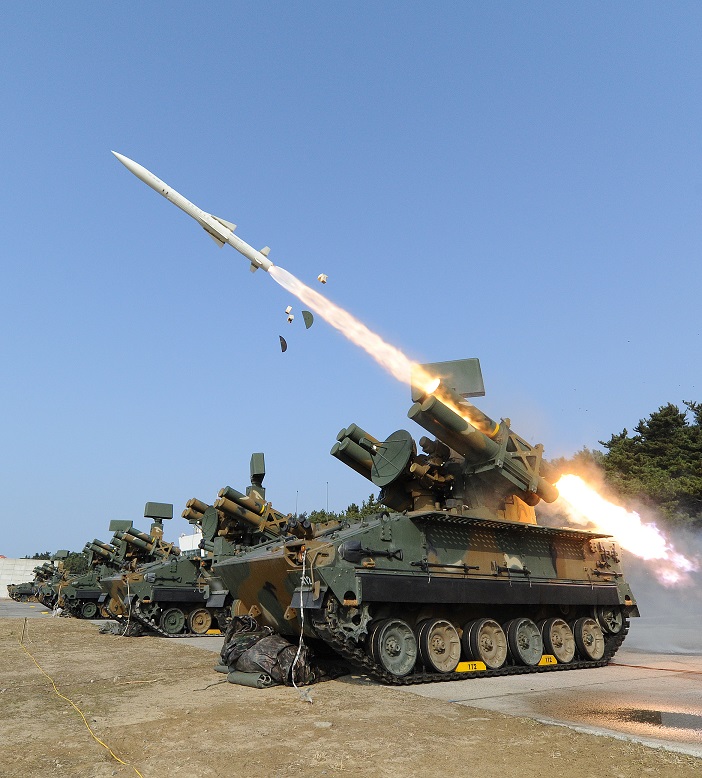
▲ Cheongma for short-range and low-altitude defense= Cheongma is a short-range surface-to-air guided weapon with a maximum range within 10 km and a maximum altitude of about 5 km, designed to defend against enemy aircraft penetrating at low altitudes. It is generally an integrated system mounted on a single vehicle, including a detection radar for target detection and tracking, a tracking radar for engagement target tracking, a fire control system, launcher, and guided missiles.
It uses a line-of-sight command guidance method that guides the launched missile to remain within the tracking radar’s line of sight. It mainly performs missions to defend maneuver units from attacks by enemy close air support aircraft or rotary-wing aircraft and to protect key bases. It also moves with mobility equal to the supported unit to defend maneuver units. For example, when tasked with protecting a tank unit, tracked vehicles are considered as carriers to match the mobility of tanks.
The Cheongma system was the first surface-to-air guided weapon developed by the Agency for Defense Development. Through the development of the Cheongma missile, design technology for highly maneuverable surface-to-air guided missiles was secured, and this experience served as a foundation for developing other surface-to-air guided weapons such as Cheongung and Shingung.
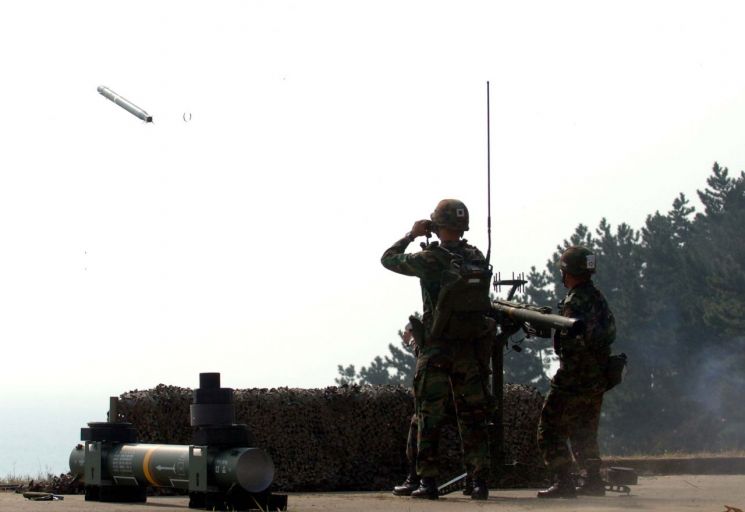
▲ Portable surface-to-air guided weapon, Shingung= Shingung is a portable surface-to-air guided weapon that can be carried directly by soldiers, generally with a range of 5 km and an altitude of about 3 km. Among the surface-to-air guided weapons developed by the Agency for Defense Development, it has the shortest range and the simplest weapon system configuration. It is mainly operated to protect infantry units or important assets.
A distinctive feature of Shingung is that after a soldier visually detects and identifies an enemy aircraft, the launcher must be aimed so that the infrared seeker mounted on the front of the missile can track the target. In other words, the soldier is one of the key components of the weapon system. Portable surface-to-air guided weapons are classified into shoulder-fired missiles, which are launched after being carried on the shoulder with the missile inside the launch tube, and tripod-mounted missiles, which are launched after being mounted on a launcher. Shingung is operated as a tripod-mounted system, allowing a more stable posture for target acquisition compared to shoulder-fired systems.
When the missile is launched, to ensure the operator’s safety, it is first ejected from the launch tube by an ejection motor before the propulsion system ignites. The missile applies a fire-and-forget concept, where the target is visually detected and acquired by the missile’s seeker after launch.
© The Asia Business Daily(www.asiae.co.kr). All rights reserved.
![User Who Sold Erroneously Deposited Bitcoins to Repay Debt and Fund Entertainment... What Did the Supreme Court Decide in 2021? [Legal Issue Check]](https://cwcontent.asiae.co.kr/asiaresize/183/2026020910431234020_1770601391.png)

















